By Denis Hay
Description
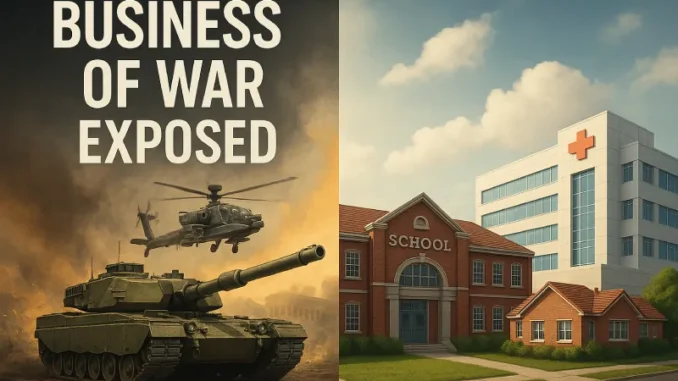
The business of war drains public money from essential services. Learn who profits, who loses, and why reform is urgent.
🎧 Prefer to listen to this article? Press play
Introduction – The Hidden Business Model of War
For more than a century, the business of war has shaped the world’s financial and political systems. Wars are sold to citizens as battles for freedom or security, yet behind the slogans lies a consistent pattern, powerful nations and corporations turn conflict into profit.
In this system, Australia in wars has often acted as a loyal ally, committing troops, money, and resources. Meanwhile, history reveals the business of war has been as much about profit as about ideology. Even US corporations supported Nazis before and during World War II, showing that profit often trumps principle.
Monetary Sovereignty Snapshot
Australia issues its own currency, the Australian dollar. This means the federal government cannot “run out” of money in the same way households or businesses can. Spending is not limited by tax revenue, but by the real resources available, skilled people, materials, technology, and by the need to control inflation.
Why this matters: When we discuss the cost of war, the real question is what public goods and services are not delivered because those resources are tied up in military commitments.
Statistic Snapshot
Australia’s military costs:
- Afghanistan: A$8.5b (2001–21)
- Iraq: A$4.1b (2003–21)
- AUKUS subs: A$268–368b over 30 years
The Problem – Why Australians Feel Stuck
The Financial Engine Behind War
Wars are not only fought on battlefields, they are driven by government spending and corporate contracts. In the pre-1983 era, when Australia’s currency was pegged to sterling or the U.S. dollar, government war spending often required raising funds through mechanisms like war bonds to protect reserves and maintain the peg.
Consequences for Citizens
From Vietnam to Iraq, Australians have seen real resources, skilled labour, industrial capacity, and political focus diverted away from housing, health, and education.
The public “cost” is not about running out of money, but about what Australia chooses not to do because those resources are tied up in military commitments.
The Impact – What Australians Are Experiencing
Everyday Effects
Defence budgets compete directly with public priorities. Rising military spending absorbs workers, materials, and technology that could otherwise be used to build homes, hospitals, and schools. Multi-decade projects like AUKUS lock Australia into a pathway of sustained military resource allocation.
Who Benefits from This System
Defence contractors, arms manufacturers, and banks profit regardless of war outcomes. In WWII, Boeing, Ford, and GM thrived on military contracts, while Ford, General Motors, IBM, and Standard Oil maintained ties with Nazi Germany before the U.S. entry into the war.
In both past and present, the business of war rewards corporate shareholders while limiting investment in public well-being.
World War II – Profits on Both Sides
During WWII, American industry surged. Boeing, Ford, and GM shifted to war contracts. Yet, history also shows that US corporations supported Nazis before and during the early years of the war.
Australia fought alongside the Allies in Europe, North Africa, and the Pacific. Military bases here became critical to the war effort.
Currency Sovereignty Timeline – Why War Bonds Mattered Then
Australia has not always had complete control over its currency.
- 1910: Australian pound introduced, pegged to British sterling.
- 1931: Left the gold standard but kept sterling parity.
- 1966: Decimalisation created the Australian dollar, pegged to sterling and later the U.S. dollar.
- 1983: The Australian dollar was floated, giving full modern currency sovereignty.
Why this matters
Before 1983, Australia could not create unlimited currency without risking its exchange rate peg or gold reserves. War bonds were a way to raise funds in the currency system of the time.
Today, as a fully sovereign currency issuer, the government does not need to sell bonds to “fund” spending. However, it still chooses to issue them for other reasons, such as managing interest rates and providing safe investment assets.
Financing the Fight
In the 1940s, governments promoted war bonds as patriotic investments. In Australia, citizens bought bonds believing their savings directly funded the military, which, under the pegged currency system, they effectively did.
Today, such funding is unnecessary for a currency-issuing government, yet the political framing of sacrifice through bonds and debt persists.
The Solution – What Must Be Done
Australia’s Monetary Sovereignty and Reform
Since 1983, Australia has been a fully sovereign currency issuer. This means we can fund public purposes without relying on “revenue first” models. Modern Monetary Theory (MMT) explains that the real limits are resource availability and inflation risk, not the balance of a tax account.
Instead of committing hundreds of billions to long-term military contracts, we could break free from the business of war, which means redirecting resources toward housing, health, and education..
Please read our complete guide on Australia’s monetary sovereignty.
Policy Solutions and Demands
- Full transparency on war-related contracts.
- Parliamentary approval for all foreign military commitments.
- Redirection of at least 50% of new defence resource allocations to public services.
- Public ownership of defence manufacturing to remove private profit motives.
- Strengthened FOI laws to expose lobbying by arms dealers.
Frequently Asked Questions
Q: What does the term business of war mean?
It refers to the system where governments, corporations, and financiers treat war as a source of profit through contracts, control of resources, and political influence.
Q: How has Australia in wars shaped its economy?
Participation in allied wars has committed Australia’s real resources to military aims rather than domestic priorities.
Q: Did US corporations support Nazis during WWII?
Yes. Companies like Ford, General Motors, IBM, and Standard Oil maintained business ties with Nazi Germany before and during the early war years.
Q: Why do you avoid saying wars are paid for with tax dollars?
Since 1983, Australia has issued its own floating currency and cannot run out of money. The real cost of war is the opportunity cost, the housing, healthcare, and education not provided because those resources are directed toward military commitments.
Q: Why is the business of war so persistent?
The business of war persists because it is embedded in political decision-making and corporate profit systems.
Final Thoughts – Breaking the Cycle
The business of war thrives when secrecy, inflated budgets, and endless commitments are normalised. Australia must use its monetary sovereignty to prioritise peace and public purpose instead of profit-driven conflict. Imagine an Australia where public money and resources build homes, fund hospitals, and strengthen education instead of bankrolling wars. We can do better. We must do better.
What’s Your Experience?
How do you think the business of war has shaped Australia’s priorities? Share your perspective below.
Call to Action
We’d Love to Hear from You!
Inspired by this article?
See what others are saying on our Reader Testimonials page.
Please share your thoughts via our Reader Feedback form. Your voice helps shape future content.
Scroll down and leave a comment below to join the discussion.
If this article resonated with you, explore more on political reform and Australia’s monetary sovereignty at Social Justice Australia.
Spread the word:
Please share this article with friends, family, or your social networks to keep the conversation going and help build a fairer, more just Australia.
Email this to 3 friends who care about social justice and a fair go for all citizens.
Keep Independent Journalism Alive. Support Voices That Challenge the Status Quo
We’re 100% reader-supported, no ads, no corporate strings, just honest, truth-driven journalism.
If our work informs or inspires you, please chip in.
Donate Now, one-time or monthly. Even $5 helps us keep publishing.
Together, we’re making change possible.
Already donated? Share the love by leaving us a quick review on Google to help others find us.
This article was originally published on Social Justice Australia
Also by Denis Hay:
Dear reader, we need your support
Independent sites such as The AIMN provide a platform for public interest journalists. From its humble beginning in January 2013, The AIMN has grown into one of the most trusted and popular independent media organisations.
One of the reasons we have succeeded has been due to the support we receive from our readers through their financial contributions.
With increasing costs to maintain The AIMN, we need this continued support.
Your donation – large or small – to help with the running costs of this site will be greatly appreciated.
You can donate through PayPal or credit card via the button below, or donate via bank transfer: BSB: 062500; A/c no: 10495969


Personally I believe the war industry or weapons industry is the new fossil fuel industry, they spread propaganda in their own interests, for money mostly. They will bleed countries dry with increasingly more expensive ways of ‘destroying our enemies’ while selling to these same supposed ’enemies’ the same story. Then like the gun mentality the USA has, if you have a weapon you may as well use it, get you moneys worth.
My question is why do we allow ourselves to be sucked in?
Thanks Daryl, you’ve nailed an excellent comparison. The war industry really does mirror the fossil fuel lobby. Both thrive on fear campaigns and relentless propaganda, both lock governments into decades of spending that serves corporate profits, not public purpose.
Why do we allow ourselves to be sucked in? Partly because the business of war is sold as patriotism and security. Politicians frame it as “keeping us safe,” but as you point out, once weapons exist, there’s pressure to use them. The deeper reason is structural; defence contractors and financiers have built a system where endless war is economically rewarding for them. At the same time, the public pays for lost hospitals, housing, and education.
As Australians, we can challenge that narrative. By recognising our currency sovereignty, we see that we are not forced to choose between war and social investment. We can demand transparency, redirect resources, and refuse to be trapped in a cycle that only benefits the few.
Buy bomb.
Use bomb.
Now you have to buy a new bomb.
Use bomb.
Now you have to buy a new bomb.
Ad nauseam.
Profit from selling destruction and one use weapons good for business.
Can anyone identify a successful country using MMT.
It is a theory, that has a hugely significant downside.
I’ll pose the reasonable question- what could possibly go wrong?
Most of the folk get it. Methinks part of the strategy is to compromise locals into going along with this real graft. Just talking with a neighbour, why the heck did we not make better us of Timor Gap gas instead of just handing that over.
Instead we were spying on dirt-poor Timor L’Este for TNC corporations backed by their governments.