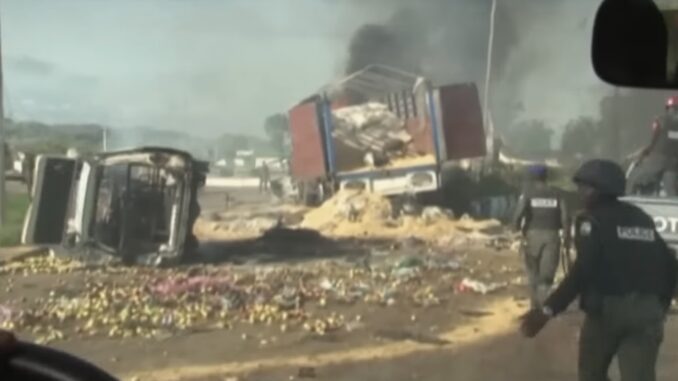
Introduction: The Dangerous Simplicity of a Single Story
In December 2025, following a U.S. airstrike in Nigeria, Australian Senator Michaelia Cash issued a statement declaring that “Australia should always stand with partners confronting Islamist terror.” This framing presents the Nigerian crisis as a binary struggle against a singular, religiously-defined evil. However, this narrative is not just an oversimplification – it is a dangerous political instrument. It masks the complex tapestry of Nigeria’s violence, erases the suffering of millions of non-combatants, and deflects scrutiny from the failures of governance and the global interests at play. This article dissects the Senator’s statement against the evidence, revealing how convenient “half-truths” obscure a reality where resource scarcity, climate change, state failure, and criminality are the primary engines of conflict, often exploiting religious and ethnic fault lines colonial powers helped to create.
The Nigerian Mosaic: A Landscape of Converging Conflicts
To attribute Nigeria’s violence solely to “Islamist terror” is to ignore the distinct, overlapping conflicts tearing at the nation’s social fabric.
1. The Jihadist Insurgency: A House Divided
In the northeast, the conflict involves two main factions stemming from the original Boko Haram: Jama’atu Ahlis Sunna Lidda’awati wal-Jihad (JAS) and the Islamic State West Africa Province (ISWAP). Contrary to the monolithic image of “Islamist terror,” these groups are often at war with each other over ideology and territory, at times inflicting more damage on one another than state forces have managed. While ISWAP has recently demonstrated alarming resilience and tactical sophistication, including night attacks with advanced equipment, their primary victims are often Muslim civilians in their areas of operation. The insurgency has killed tens of thousands and internally displaced over 2.3 million people.
2. The Farmer-Herder Conflict: A Clash of Survival
Central to the country, a separate and devastating conflict pits predominantly Muslim Fulani herders against Christian farmers from various ethnic groups. Labelling this as religious war is a profound misdiagnosis. The core driver is existential competition over dwindling land and water. Climate change and desertification in the north have compressed grazing lands, pushing herders south into farming communities, whose own land has expanded due to population growth. By 2021, this conflict had claimed over 15,000 lives—a toll that now rivals or exceeds that of the jihadist insurgency. This violence is inherently local, retaliatory, and rooted in economics, not theology.
3. Criminal Banditry and State Violence
In the northwest, profit-driven armed bandit groups terrorise populations through mass kidnappings, cattle rustling, and raids. These groups, many of whose members are ethnic Fulani, exploit the same ungoverned spaces and communal tensions as the farmer-herder conflict, further blurring the lines between crime and communal strife. Compounding the crisis, the Nigerian military itself has repeatedly committed atrocities. Erroneous airstrikes have killed hundreds of civilians at communal gatherings, with authorities offering little beyond apologies and minimal accountability. Security forces have also been accused of widespread human rights violations during counter-terrorism operations.
A Pattern of Omission: The Political Utility of the “Half-Truth”
Senator Cash’s reductive statement is not an isolated error but aligns with a documented pattern of evasive political conduct. In 2017, as Employment Minister, she initially told a Senate committee her office had “nothing to do” with leaking news of police raids on a union, only to admit hours later that her senior media adviser was the source. When later questioned under oath, she refused to answer even basic factual queries, invoking “public interest immunity” in what critics labelled a “cover-up” and a “mockery of ministerial accountability.”
This history is instructive. It demonstrates a willingness to retreat behind procedural shields when confronted with inconvenient facts. Applying this same approach to foreign policy – adopting an imported, simplistic narrative while ignoring contradictory evidence – serves specific functions:
- Moral Justification for Intervention: Framing the conflict as a “war on terror” provides a clear, politically palatable rationale for military and strategic involvement, including by external powers like the U.S., in a region rich in resources like oil.
- Erasure of Complexity and Accountability: It absolves viewers of the difficult work of understanding root causes – colonial legacies, catastrophic governance, corruption, and climate change – that no single military strike can address.
- Partisan Alignment: The narrative closely mirrors that of certain U.S. political and evangelical circles, which have heavily promoted a “Christian genocide” frame rejected by the Nigerian government itself. Senator Cash’s echo of this framing suggests a prioritisation of ideological alignment over independent, evidence-based analysis.
Conclusion: Our duty to see Clearly
The duty of a vigilant observer is to look past the convenient story to the messy, uncomfortable truth. Nigeria is not in the grip of a single “Islamist terror,” but of multiple, interlocking crises where jihadists, criminals, desperate communities, and an often-abusive state vie for survival and supremacy.
Muslims are the primary victims of the jihadist groups the West condemns. Christians and Muslims alike are victims of a climate-driven resource war. All are victims of a state that has failed to protect them, provide justice, or offer a viable future. To reduce this profound human tragedy to a slogan about confronting evil is to betray the very people we claim to stand with. It is a “half-truth” that paves a slippery slope toward endless, ineffective conflict and the continued neglect of the real drivers of violence. True solidarity demands that we bear witness to the full, complex picture and hold our leaders to account when they choose the comfort of a lie over the challenge of the truth.
References
- Small Wars Journal. (2025). Next Fight Nigeria: An Introduction to the Central Nigerian Operational Environment.
- International Crisis Group. (2024). JAS vs. ISWAP: The War of the Boko Haram Splinters.
- ABC News. (2017). Michaelia Cash: Here’s a timeline of how the Employment Minister got into this position.
- Human Rights Watch. (2023). Nigeria: Erroneous Military Airstrike.
- Heliyon Journal. (2024). Communal conflicts in Nigeria: Assessment of the impacts on….
- Wikipedia. (2024). Boko Haram.
- The Guardian. (2017). Michaelia Cash claims ‘public interest immunity’ over union raid tipoff.
- Global Centre for the Responsibility to Protect. (2025). Nigeria.
- ISPI. (2025). “Burn the Camps”: Jihadist Resurgence in the Lake Chad Basin.
- BISI. (2024). The Growth of Farmer-Herder Violence in Nigeria.
Keep Independent Journalism Alive – Support The AIMN
Dear Reader,
Since 2013, The Australian Independent Media Network has been a fearless voice for truth, giving public interest journalists a platform to hold power to account. From expert analysis on national and global events to uncovering issues that matter to you, we’re here because of your support.
Running an independent site isn’t cheap, and rising costs mean we need you now more than ever. Your donation – big or small – keeps our servers humming, our writers digging, and our stories free for all.
Join our community of truth-seekers. Donate via PayPal or credit card via the button below, or bank transfer [BSB: 062500; A/c no: 10495969] and help us keep shining a light.
With gratitude, The AIMN Team




This is an article that demonstrates the necessity of genuinely good journalism.
I lived in Nigeria for two years, travelling extensively in areas far too dangerous to enter today. I met many Fulani in the northern regions of the country. I was very nearly the victim of police and judicial violence when I stopped to help the victims of an horrific crash. I was travelling in the same direction as the crash occurred (a truck jackknifed and a car smashed into into the section where the prime mover joined the trailer). The driver was decapitated, but his horribly injured female passenger was in desperate need of help. The driver of the truck, myself and my husband managed to release her from the wreck and we took her to the nearest hospital as there was no way to contact emergency services.
On arrival the main concern was our “responsibility for causing the crash” even though we explained that we were behind both the truck and the car, so far behind we didn’t even see the crash, only the aftermath. Nevertheless we were informed we were under investigation for causing the death of the decapitated driver. It was a terrifying few hours until we were finally released – after the company for which my husband worked had, we later found out, paid an enormous bribe demanded by the police at multiple levels of seniority. This happened in 1971, so has nothing on earth to do with jihadists, but is does demonstrate the historical dysfunction of Nigerian society that Cash has so conveniently ignored!
It is a complex society blending Muslim, Christian, Fulani, Voodoo and many divergents groups within those sections. Divisions were also based on geopolitical factors including the groups involved in then recent Biafran war.
Cash is a totally ignorant and ill-informed sensationalist. She at best believes she knows what is going on, at worst she is ready to frame a totally false narrative. Hoping to fool disenfranchised, or frightened people who want to believe she somehow has the answers.
Thank you to the AIM network for at least revealing the on-going deliberately divisive dialogue of the opposition.
The helmeted shrieker from W.A. is a classic example of why politics in this country has gone to shit,especially the soon to be declared dead LNP..Lying Nasty Party.
What a frightful bunch of mouth breathers.
Michaelia Cash was the perfect “monkey see, monkey do” lackey for Morrison’s inner sanctum sanctorum. How she maintains her Senate seat defies logic but perhaps that is an indication of the thinking of the citizens she represents.
The economy of Nigeria is mainly subsistence farming and the usual suspects, mining oil extraction and other resources which are all extraction industries.
There is also a lot of Chinese money in the country….
https://en.wikipedia.org/wiki/Economy_of_Nigeria#Agriculture