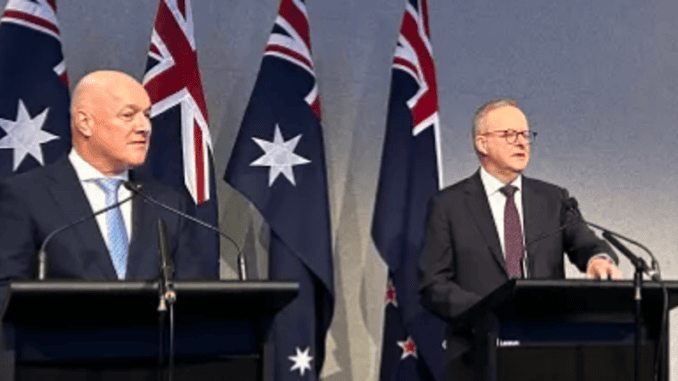
Mutual commitments to improved Trans-Tasman strategic and economic outcomes over-ride differences in political affiliations between the governments of Australia and NZ.
The NZ Nationals campaigned on a populist cost-of-living and law-and-order agenda with an optimistic NZ First theme. A new centre-right coalition was formed on 14 October 2023 consisting of:
- New Zealand National Party (led by Christopher Luxon)
- ACT New Zealand (led by far-right leader David Seymour)
- New Zealand First (led by a Pragmatic Conservative and Foreign Minister Winston Peters)
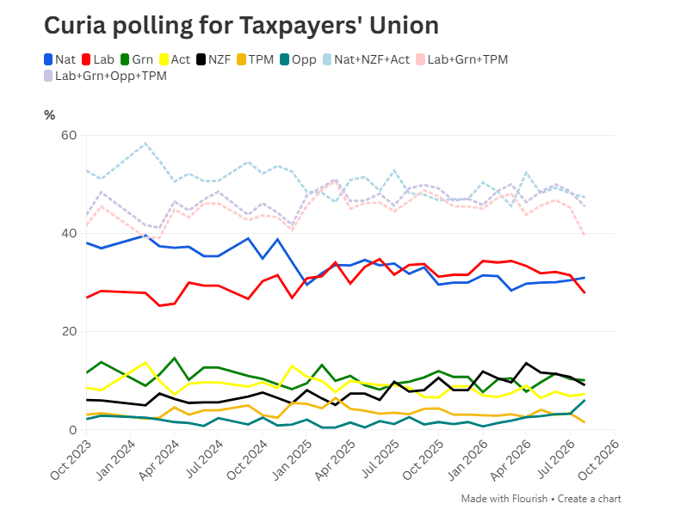
The Spinoff (7 August 2026) offers an assessment of the state of the possible after the NZ national elections on 7 November 2026 from current polling trendlines:
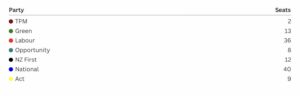
Chris Hipkins needs the Māori vote (TPM) to form an alternative coalition with the Greens in NZ’s unicameral parliament. Regrettably, MP Kapa-Kingi is leaving Te Pati Māori to form a rival party which is unlikely to reach the 5 per cent threshold to gain election to parliament.
Uncertain Polling Outcomes-Forthcoming 7 November NZ Election
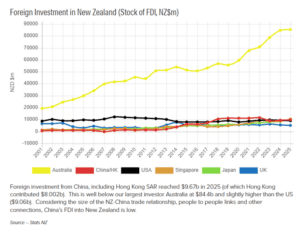
The Ardern Labour Government (2017-23) chartered an ambitious path of maintaining stable economic ties with Beijing while navigating deepening security alignments with traditional western democracies. However, Chinese investment in NZ had been in decline since the peak years of the post-GFC recovery.
Details of the changes in levels of Chinese investment in both countries are available from a range of reputable sources:
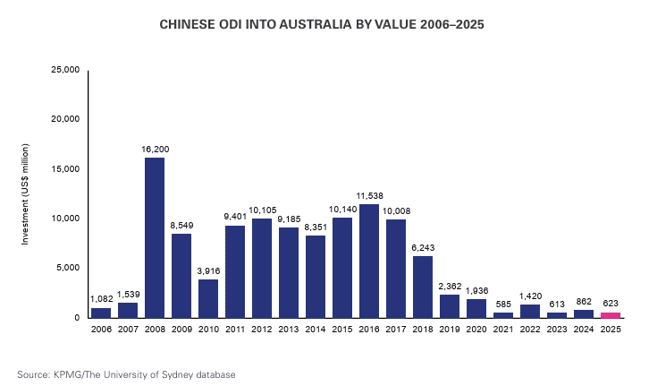
The changes indirectly benefited Australia as a source of investment funding in the NZ economy:
The Wellington Declaration (2010) negotiated by the Rudd-Gillard Government achieved close alignment on strategic issues. The signing of the Washington Declaration (2012) also re-established a robust, pragmatic defence partnership between the United States and New Zealand outside the legal framework of ANZUS by the Obama Administration.
Both Trans-Tasman Governments share a commitment to stronger strategic ties with adjacent Pacific countries from PNG to Fiji including Vanuatu, Solomon Island and smaller island states.
Australia and New Zealand are successfully aligning their strategic and investment agendas in the Indo-Pacific Basin through practical coordination, intelligence-sharing and other regional development goals.
These strategic antics can proceed in the South Pacific and beyond within the letter of the New Zealand Nuclear Free Zone, Disarmament, and Arms Control Act 1987. NZ vessels and aircraft assist with freedom of navigation exercises in locations like the South China Sea and the Taiwan Strait in presence of weaponry that is not acceptable in NZ ports or defence bases at home.
In a frightening news clip sourced to Ben Packham of The Australian (7 August 2026) warns of the prospects of the new militarism across our Indo-Pacific region. I value the frankness of this news article.
Ahead lies a more militarised future for the 2030s sprinkled with US military bases and submarine nuclear weapon payloads from the Mediterranean to the Panama Canal and beyond which the Albanese Government inherited from the LNP (The Australian 7 August 2026):
The US has established the administrative framework for a military base in Western Australia amid revelations 2300 Americans will be deployed to the state to support “enduring” submarine deployments to Perth’s HMAS Stirling.
The US Navy quietly stood up Naval Support Activity Stirling in recent months to provide services to deployed personnel, contractors and their family members, adopting the same terminology it uses to describe some of its most important foreign bases.
The US Navy separately revealed to The Australian that nearly double the number of Americans would be deployed to the WA facility than previously declared by Australia.
The Albanese government insists the US Navy presence in WA, known as Submarine Rotational Force West, will not be a US base on Australian soil.
But Elizabeth Buchanan, senior fellow for the US-Australia Alliance at the Centre for the National Interest in Washington DC, said that in US parlance, a naval support activity was “a shore facility with the full characteristics of a military base”.
 Denis Bright (pictured) is a financial member of the Media Entertainment and Arts Alliance (MEAA). Denis is committed to consensus-building on the critical issues raised in each article. Your comments on this and related articles can be recorded on theaimn.net site.
Also by Denis
Australian Political Futures: Break with Deep Secrecy in AI Investment
Australian Political Futures: Challenge the Bipartisan United Front on Strategic Secrecy
Keep Independent Journalism Alive – Support The AIMN
Dear Reader,
Since 2013, The Australian Independent Media Network has been a fearless independent voice – holding power to account and delivering journalism that matters.
Running this site isn’t cheap. Rising costs mean we need your support now more than ever. Every donation, big or small, keeps our servers running, our writers working, and our stories free for everyone.
Donate here:
PayPal or credit card – just click on the Donate button below
Direct bank transfer: BSB: 062500; A/c no: 10495969

We’ve also set up a GoFundMe as a dedicated reserve fund for hosting and future improvements.

Thank you for standing with us. We couldn’t do this without you.
With gratitude,
The AIMN Team

Be the first to comment