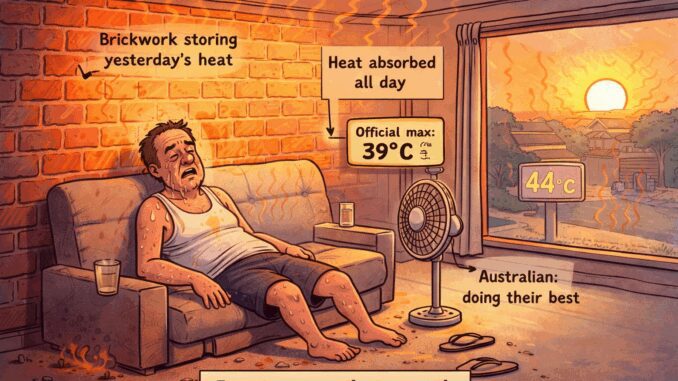
Australians are told every summer how hot it’s going to be.
But increasingly, the information we’re given bears little resemblance to the heat people are actually exposed to – and that disconnect is becoming dangerous.
This isn’t about climate denial or attacking science. It’s about using the right science for the right purpose, and recognising that the way we talk about heat has failed to keep pace with the conditions people now live in.
The temperature you’re told isn’t the heat you feel
When weather services report a maximum temperature – say 39 °C – many people reasonably assume that reflects what they’ll experience in their suburb, on their street, or in their home.
It doesn’t.
Official readings, such as those used by the Bureau of Meteorology, are taken under carefully controlled conditions:
- In shade
- Well ventilated
- Away from roads, buildings, cars, and concrete
- Designed for long-term consistency, not human exposure
These measurements are excellent for climate records and historical comparison. They are not designed to describe the heat load people actually endure in built-up environments.
In suburbs dominated by asphalt, brick, concrete, and dark roofs, real-world conditions can be 8–15 °C hotter than the official figure once radiant heat and stored heat are accounted for.
Yet this gap is rarely explained clearly to the public.
Why this matters more than most people realise
Heat doesn’t kill dramatically. It kills quietly.
People collapse days into heatwaves, not minutes into them. They underestimate risk because the numbers they’re given don’t match what their bodies – and their homes – are experiencing.
When a forecast says “Maximum 39° C”.
Many people hear:
- “Hot, but manageable”
- “I’ve handled this before”
- “It’ll cool down later”
But what they may actually be dealing with is:
- Street-level exposure equivalent to 45–50 °C
- Buildings that have absorbed heat all day
- Nights that don’t cool enough for the body to recover
- Cumulative heat stress across consecutive days
That mismatch delays protective action – and increases health risk, especially for older people, children, and those with chronic illness.
The missing piece: buildings don’t just get hot – they store heat
One of the most dangerous misconceptions about heat is the idea that air temperature alone determines comfort and safety.
It doesn’t.
What matters just as much is thermal mass – the ability of buildings and materials to absorb, store, and later release heat.
Brick, concrete, tiles, stone, and even plasterboard act like thermal batteries:
- They absorb heat throughout the day
- They continue releasing it long after the sun goes down
- They can keep indoor spaces hot even when outside air temperatures fall
This is why people often say, “It’s still hot inside even though it’s cooled down outside.”
They’re not imagining it. The house itself has become a heat source.
Why this changes how heatwaves should be managed
During short hot days, thermal mass can help.
During extended heatwaves, it becomes a liability.
If a building:
- Isn’t actively cooled early
- Isn’t shaded
- Has limited night purging
- Faces repeated hot days without a full cool-down
Then each day adds heat to the structure, not just the air.
By day three or four, people aren’t cooling a room – they’re trying to cool walls, floors, furniture, and ceilings that are already heat-soaked.
This is why:
- Overnight temperatures matter so much
- Consecutive days are far more dangerous than single extremes
- Homes that “cope fine” on day one can become unsafe by day four
Official forecasts rarely communicate this compounding effect.
Why “it’ll cool overnight” is no longer a safe assumption
In many heatwaves, overnight minimums stay above 22–25 °C.
That means:
- Buildings don’t fully release stored heat
- The body doesn’t fully recover
- The next day starts hotter than the last
This is one of the strongest predictors of heat-related illness and death – yet overnight risk is still downplayed compared to daytime maxima.
A house that never truly cools is not a safe refuge, even if it has air-conditioning.
“Your car thermometer is wrong” … not really
People are often told that car temperature readings are inaccurate and should be ignored.
That’s misleading.
Car sensors measure local, radiative heat exposure. They are unsuitable for climate records, but they often reflect the heat stress people actually experience at street level.
Dismissing these readings without explanation teaches people to distrust their own perception – exactly when they should be paying attention.
The data already exists – the communication doesn’t
Australia already has:
- Urban heat-island research
- Apparent temperature and heat-stress modelling
- Excess mortality data from heatwaves
- Satellite land-surface temperature data
- Health department heat-risk thresholds
What’s missing is a public-facing translation layer.
The system answers, “What is the regional reference temperature?”
People need answers to:
- How hot will my surroundings get?
- Will my house store this heat?
- Will it cool enough overnight to recover?
- How many days will this persist?
- What actions matter before the heat peaks?
Those questions are largely left to individuals to figure out – often too late.
What safer heat information would look like
We don’t need new technology. We need honest framing.
Imagine forecasts that said:
“Although the official maximum is 39 °C, built-up suburbs may experience conditions equivalent to 47–50 °C. Buildings will absorb heat throughout the day and may remain hot overnight. Actively cool living spaces early, reduce heat storage, and plan for limited overnight relief.”
That information already exists. It simply isn’t prioritised.
This isn’t alarmism – it’s accuracy
The goal isn’t to frighten people.
It’s to give them relevant, actionable information.
Australians are resourceful. When people understand how heat actually behaves – in streets, in buildings, over multiple days – they adapt.
What they can’t do is respond to danger that’s been averaged away.
As extreme heat becomes more frequent and persistent, continuing to rely on technically correct but exposure-blind temperature reporting isn’t just outdated.
It’s unsafe.
Keep Independent Journalism Alive – Support The AIMN
Dear Reader,
Since 2013, The Australian Independent Media Network has been a fearless voice for truth, giving public interest journalists a platform to hold power to account. From expert analysis on national and global events to uncovering issues that matter to you, we’re here because of your support.
Running an independent site isn’t cheap, and rising costs mean we need you now more than ever. Your donation – big or small – keeps our servers humming, our writers digging, and our stories free for all.
Join our community of truth-seekers. Donate via PayPal or credit card via the button below, or bank transfer [BSB: 062500; A/c no: 10495969] and help us keep shining a light.
With gratitude, The AIMN Team


The government spent 90 $million of a new web site. The web site is vile.
“if it ain’t broke
Don’t fix it”
fancy calling 43 degrees, “sunny”.
A good article. I would presume most people already factor this into their routine in Australia , however, I acknowledge that common sense is not a flower that blooms in every garden.
Urban design is improving in some cities, but the effects will only be noticeable long term, eg, when saplings grow into trees, and depending on the varietals planted. Trees planted for their canopy (rather than their aesthetic appeal) would work best, but seems that this isn’t always considered when new developments are planned and executed…
Just an observation…
Here we have to also include the following….Government – Town Planning, Property Developers, Finance, and Real Estate, all profit motivated.
Property developers – none of any new developments of the past 10 years or so has any ‘space’ for green strips and trees that provide shade; I see development after development crammed cheek by jowl on top of each other which takes the entire block for the building covered in concrete?
Almost all buildings are pre-fabricated from framing thru to fit outs, that’s the only difference these days, the finishes and appliances are bulk bought by developers and builders.
Deforestation by State and local governments of local forests that have two purposes, recreation and water storage; now he have governments not only giving away our resources for the benefit of large foreign owners, they are also now providing leases for huge data centres for AI?
Too bad if you want a drink of clean water!
Small scientific fact, our bodies are 80% water, go figure!
This is a subject that I and a few others were discussing at least 3 decades ago, including the issue of inappropriate housing stock.
And we have the Federal Government with Murray Watt telling us to go suck eggs when it comes to climate change and approving inappropriate gas projects?
And we wonder why the country is burning? Go figure, there’s not a sensible brain to be found amongst anyone in Government anywhere.
I’ve been observing this discrepancy for some time now. Three days ago all our news and weather reports said the maximum temperature in Springwood, Blue Mts would be 35c – Manageable right? In fact at the time my mobile phone weather App was saying now 34c (mid afternoon). On coming our of the aquatic centre, got into the car which was partially shaded, opened the sunroof and windows and the ‘ambient temperature’ recorded 44.5c, that’s the external temperature, not the temperature inside the car, which is even hotter.
Must be something wrong with my car guage, is it under the bonnet, engine hot nah, hadn’t used the car for over two hours, sun on the bonnet, engine hasd’t cooled down? We drove off, several kilometres later, coolant circulating shouldn’t affect the ambient air temperature, perhaps I was parked in a hot spot. Nah.. I’m further up the mountains and the ambient temperature is still 44.5c. Not until I’ve climbed more than 300 metres altitude to Hazelbrook does it show a 2 degree drop to 42.5c. Still nowhere near 34c which at the time was reported to be 3-4c lower in Hazelbrook than Springwood, at around 31c.
So not only, might we see and feel a huge discrepancy between sun and shade temperatures, but ambient or radiant air temperature even in the shade were in fact around 10c higher than reported and possibly as much as 15c higher. If I’d had a thermometer in the car it would have been even higher until the sunroof was opened and closed when the air con kicked in. It doesn’t need direct sun for the inside of a car to heat up when parked either. How much of our residential landscape is road, tarmac, open unshaded car parks and large brick, concrete, tiled roof, corrugated iron and colorbond with no street or garden shade and trees? Springwood has more trees than many Sydney suburbs and sits at around one thousand feet altitude. But it still showed 10-12c above expected weather reports and apps. Give a thought for people down on flat plains with no trees, and a sea of radiant hot tin and tiled roofs in Western Sydney, new suburbs where the developers have chopped almost every tree in sight for space, access and profit, where the local geoclimate often creates the hottest place on the planet in Summer. Those developers shout be ‘shot’, along with their sitting councils and local politicians – A well place tree is worth more than 100 politicians and business men!
Then there’s the average house in anyone’s suburb, which continues to heat up indoors through the night without the aircon on, as the hot roof and walls act like all surround central heating appliances before sun up – and not even recovered before the morning blaze, with all your windows and doors open to dissipate the heat. Open all the doors and windows in winter and the central heating or reverse cycle warmth disappears rapidly, but not in summer, the heat keeps on coming.
Thankfully our house is pretty good at staying cool in summer and holding onto indoor heat in winter – We found growing trees and bushes front and back providing shade created a cooler garden micro climate in summer, reducing average indoor temperatures by as much 5c+ long before we got round to installing an air con appliance recently. Pulling curtains, closing windows front and back depending where the morning and afternoon sun was and opening up at night (but not until the outdoor temperature had cooled, and once again the garden does a good job here too (like a mini transpirational ocean breeze – much less stored radiant heat). This is more effective and enduring than just switching on the indoor air con in extreme heat, which becomes a battle of elements as soon as you switch it off, cooling the air indoors while being simultaneously heated by the all-surround hot roof and walls, rather like putting cotton wool in your ears on the dance floor of a stadium discotheque.
Weather apps and reports are all very well, provide some guide, but clearly they can be out by very wide margins (10-15c) on local surrounds depending on the environment, which offer little or no protection, mediation or caretaker management. Monitoring your immediate outdoor and indoor spaces and adjusting your strategy during day and night is a far more reliable strategy – And if you don’t plant, grow, look after the trees and shaded areas in your garden, look to the long term mediation of your immediate environment, no weather report is going to help you, and there will be no ‘cheap fix’ air con that will solve your problem unless you have 100% direct solar power and battery.
Personally, I find a well managed shaded garden microclimate with tree surround and healthy lower ground level canopy to prevent soil and plant erosion, evaporation; insulating and protecting the ground in which the tree roots don’t get starved by water loss, is a very self generating, sustainable and effective outdoor aircon management system (above protects below, and below protects and sustains above). Our garden is usually 4-5c cooler (or more in central shaded areas than the local surrounding residential road and open sunburnt landscapes.
…and we haven’t even discussed water loss, preservation and retrieval.
I always thought is was bizarre how in NSW Health we gave so much attention and focus to mental health and physical assessments and data collection, but so little of our services focused on treatment, therapy and prevention – and I note it has got far worse as our working environment has become more business and monetary orientated, toxic, dysfunctional and exposed. Climate change and health are directly related and fires will rage with our bodies and minds, not just in and on our homes. As long as we have weather reports and forecasts, without mid to long term planning, action, care and prevention it won’t make a toodles of difference.
The heat is hot here in the bush… just ask these animals at Imperial Lakes Nature Park. Please help… ‘nough said… “link” https://chuffed.org/project/emergency-water-for-wildlife
…and I just want to say that I’m not saying anything about the lowering of the
It’d be hot down in those mines up your way, LOVO. A stop at the Miner’s Lamp on the way home would have been demanded. Is that pub still there?
Back in the 80s Keith Ridley would take me there whenever I was in town.
Keith the thie*…..rhymes with reef, the ‘cheap’ hardware store owner, mm…I remember him well. Wouldn’t brag about knowing him, mate…jest sayin’😆. ..as for pub’s i reckon where down from 60 gazillion pubs to about 8…’sigh’ (sounds like you haven’t been here for a long, long time,cobba)…..though we’re still here and still mining. Migs.
It’s been a while, LOVO. I used to go there every two months with work. I loved the place.
I remember in 1986 sitting in a paddock in the middle of the night with Pro Hart’s daughter (Marie?) waiting for Halley’s Comet to arrive. It didn’t.
I’ve got rellies up there too.
Small bloody world. I was a mate of Kim’s and knew the whole family. Pro’s wife was our Landcare groups first Patron.
As to the link above, please help if you can or share the link…the situation is becoming dire.