
Australia’s aged care system is confronting a strange paradox.
Across the country, older Australians are being formally assessed as needing support – yet many must wait months before that support actually begins.
The official justification is efficiency. But the economics suggest something very different.
Delaying support does not eliminate costs. It simply moves them further down the road – where they become harder, more expensive and far more painful to deal with.
When help arrives too late
Imagine an older person living at home with a spouse who is already struggling with their own health problems. An assessment confirms they need help: a little cleaning, some personal care, perhaps assistance with meals or medication.
Nothing dramatic. Just enough support to keep things stable.
But the services cannot start yet.
So the spouse keeps trying to manage alone.
Fatigue builds. A fall happens. An ambulance arrives. A hospital bed is occupied. Recovery takes weeks, independence is lost, and residential care suddenly becomes unavoidable.
A small amount of help, delivered at the right time, could have prevented all of it.
And the financial difference is staggering.
What changed in aged care assessments
The introduction of the Single Assessment System and Integrated Assessment Tool (IAT) was intended to standardise aged care assessments across Australia.
The IAT uses structured scoring to determine eligibility and priority for aged care services.
But an important change occurred alongside this shift.
From November 2025, experienced assessors no longer have the ability to override the algorithm’s funding decisions.
As reported by The Weekly Source:
“From 1 November, the option for highly skilled and experienced human aged care assessors to override assessment decisions generated by the Integrated Assessment Tool (IAT) algorithm was removed.”
At the same time, waiting lists for higher-level home care packages have persisted.
This creates a growing contradiction in the system: People can be assessed as needing support – yet still wait months before that support begins.
The gap between assessment and care
For older people and their families, the delay can be devastating.
For the health system, it can also be extremely expensive.
Across Australia, tens of thousands of people remain on waiting lists for higher-level home care packages.
During that waiting period:
- carers become exhausted
- frailty worsens
- falls become more likely
- hospital admissions increase
- independence is lost sooner
The system eventually pays the bill – just in a much more expensive way.
The Two Paths of Aged Care
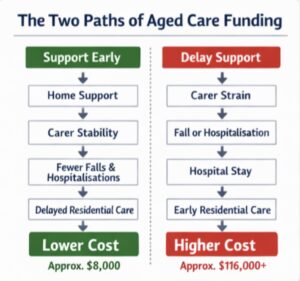
One path begins with timely support.
Small services stabilise the situation, carers remain capable, and the person continues living safely at home.
The other path begins with delay.
Carer strain grows, a fall or illness occurs, a hospital admission follows, and the person may lose independence permanently.
Both paths lead to care.
But one costs vastly more than the other.
The economics of prevention
Consider a simple example.
Providing modest home support might cost approximately:
Cleaning, personal care, and allied health support for a year: about $8,000
But if support arrives too late, the costs escalate quickly.
A typical crisis pathway may look like this:
- Event
- Approximate cost Hospital admission
- $10,000
- Rehabilitation
- $6,000
- Residential aged care (one year earlier)
- $100,000
- Total: $116,000
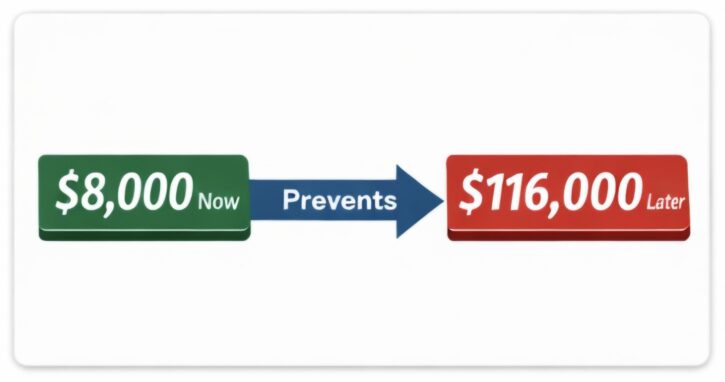
In economic terms, prevention is not just humane.
It is dramatically cheaper
Scaling the problem nationally
Now multiply that simple example across the country.
If just 10,000 older Australians deteriorate while waiting for support:
- hospital admissions alone could cost hundreds of millions
- earlier entry into residential care could cost billions
Residential aged care subsidies alone can exceed $100,000 per resident per year.
Even small increases in early residential placement therefore have enormous financial consequences.
The Australian Institute of Health and Welfare has repeatedly highlighted the importance of supporting people to remain at home longer.
“Older Australians generally prefer to remain living in their own homes for as long as possible.” (Australian Institute of Health and Welfare).
Supporting that goal is not only socially beneficial – it is economically rational.
Waiting lists as deferred liabilities
Waiting lists may appear to reduce spending in the short term because funding is delayed. But economically they function as something else entirely.
They are deferred liabilities. The costs do not disappear.
They simply reappear later in different parts of the system:
- hospital admissions
- ambulance call-outs
- residential aged care
- exhausted carers requiring support themselves
In public finance terms, this is known as cost shifting.
One part of the system appears to save money, while another quietly absorbs the expense.
The human factors algorithms struggle to see
Algorithms are good at standardising decisions.
But care needs are not always easy to standardise.
Experienced assessors often recognise early warning signs that structured scoring models struggle to capture:
- carers nearing exhaustion
- subtle frailty changes
- fragile household situations
- declining resilience after illness
These signals can indicate when a small intervention now may prevent a major crisis later.
The cost curve of delay
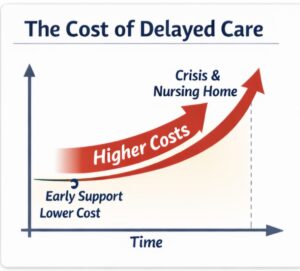
When support arrives early, costs remain relatively stable.
When support is delayed, costs rise sharply as crises begin to occur.
Hospital beds fill.
Residential care demand rises.
Carers become patients themselves.
The real choice facing aged care policy
In aged care policy, the choice is rarely between spending and saving. The real choice is between two types of spending:
- spending early to prevent crises
- spending far more later when crises occur
The economic logic is straightforward. Delaying support does not remove the cost. It multiplies it.
Conclusion
Australia’s ageing population will require thoughtful, sustainable care systems in the years ahead.
That means investing wisely in the supports that keep people healthy, independent and living at home for as long as possible.
Because when care arrives too late, the system takes a long and tortuous road to reach the same destination.
Only with higher costs and worse outcomes along the way.
The principle is simple: Pay now, or pay later – but later always costs more.
Bibliography and Sources
Australian Institute of Health and Welfare – Aged Care Data
Department of Health and Aged Care – Aged Care
Royal Commission into Aged Care Quality and Safety
The Weekly Source: “Snail mail only option for consumers querying aged care assessments”
OECD: Preventive Health Economics
Keep Independent Journalism Alive – Support The AIMN
Dear Reader,
Since 2013, The Australian Independent Media Network has been a fearless voice for truth, giving public interest journalists a platform to hold power to account. From expert analysis on national and global events to uncovering issues that matter to you, we’re here because of your support.
Running an independent site isn’t cheap, and rising costs mean we need you now more than ever. Your donation – big or small – keeps our servers humming, our writers digging, and our stories free for all.
Join our community of truth-seekers. Please consider donating now via:
PayPal or credit card – just click on the Donate button below
Direct bank transfer: BSB: 062500; A/c no: 10495969

We’ve also set up a GoFundMe as a dedicated reserve fund to help secure the future of our site.
Your support will go directly toward covering essential costs like web hosting renewals and helping us bring new features to life. Every contribution, no matter the size, helps us keep improving and growing.

Thank you for standing with us – we truly couldn’t do this without you.
With gratitude, The AIMN Team

An excellent coverage of the Aged Care dilemma in Australia.
My personal experience as Guardian for a solo old friend is that the providers are a mixed bunch. Due to our regional location we were limited in our choice of provider.
As a consequence we were subjected to bullying, uncooperative administration, carers who slept on the job (and were kept on by the provider after complaint) and it was generally a most unpleasant ENORMOUSLY EXPENSIVE experience. The latest insult has been the carer who ripped off the ”patient” over $10,000 which the provider was very slow to act upon. The matter remains in police hands. Not a company to deal with in our experience.
One size fits all has never and will never work.
It does not matter what Government is in power, they did the same thing to all WW2 veterans when they returned home, many with PTSD that went untreated for decades, and my late father had to battle for a full TPI pension for over 20 years, irrespective of the fact that his doctor supported and provided documentation for the claim; Government respects no one.
You’re just a number to be used for the overall benefit.
Aged Care, at 88+ I will be gone long before any care or help arrives. The hours spent filling in forms etc. must have been to create the illusion that one can be reassured all is well. The time limit allowed to get the widows cleaned (outside only and not the highest ones) must have been based on a very small house on a single easy access level plot, for us it barely touched the job. Can I call a friend?
Good article and important versus our public and political narratives being directed towards ‘the other’ and all things ‘immigration’.
However, our permanent migrant is modest and capped vs high border movement churn under the NOM eg students, backpackers, temp workers etc. who depart, hence are net financial contributors, like tourists, paying $billions to budgets.
Why is that important? In the permanent population we have relatively fewer working age taxpayers vs more retirees; this is evidenced by increasing old age dependency ratios.
The Senior in 2023 did one of the best demographic articles that contradicts the RW MSM following Tanton Network tactics, ie. inflate immigration and/or population growth, while ignoring how ageing drives long term, pop growth.
‘ABS data shows Australia is ageing, prompting a workforce, retirement and health wakeup call.
We keep hearing that Australia is ageing, but what does that look like?
The Senior’s analysis of ABS population data from 1982-2022 shows a growing proportion of people aged 55+ representing the whole population, a shrinking amount of younger people, and a greater proportion of the overall population being eligible for retirement.’
Meanwhile the RW MSM and ecosystem has us venting about marginal border crossing numbers……