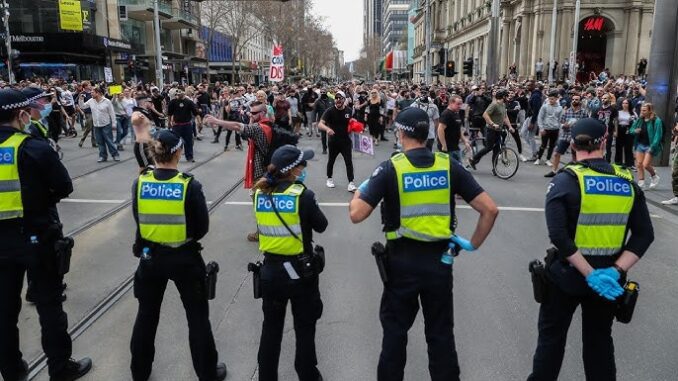
This article presents a critical analysis of the Victoria Police Force, tracing its philosophical and operational journey from its 19th-century foundations in British ‘policing by consent’ to its modern manifestation as a paramilitarised, politically leveraged institution. It argues that a series of structural, cultural, and political shifts have fundamentally altered the force’s relationship with the community it serves, transforming it from a community-integrated service into a tool of social control, enforcement, and revenue generation, often at the expense of addressing root-cause social issues. This analysis draws on legislative history, official reports, academic commentary, and media coverage to map this transition and propose a pathway back toward a guardian-oriented model.
1. Founding Philosophy: The “Constable” and Policing by Consent
The Victoria Police was established in 1853, inheriting the British Peelian principle of “policing by consent.” The foundational idea was that the “constable” was a citizen in uniform, deriving authority from the community’s collective will for order, not from the state’s coercive power. Legitimacy rested on public approval of police actions, the use of minimal force, and a focus on crime prevention. The early force was decentralised, with officers expected to know their local beats intimately, fostering trust through daily, non-punitive interactions.
2. The Catalysts of Change: A Multi-Decade Shift
Several interconnected factors drove the force away from this model:
- Paramilitarisation & Foreign Doctrine: From the 1970s-80s, influenced by global trends and domestic anxieties (e.g., the 1986 Walsh Street shootings), the force began adopting paramilitary trappings: darker, more aggressive uniforms, military-style ranking and command structures, and the procurement of tactical equipment (e.g., the Special Operations Group). Crucially, training and strategy increasingly drew from U.S. models (notably “broken windows” and zero-tolerance policing) and Israeli counter-terrorism and public order tactics, which emphasise threat neutralisation over community rapport.
- The Political Instrument Thesis: Police have been repeatedly deployed to enforce political agendas, eroding perceived neutrality. Key examples include:
- The violent clashes during the 2011 Occupy Melbourne protests.
- The stringent enforcement of COVID-19 lockdown and vaccination mandates (2020-2022), where police became the visible face of highly contested public health orders, creating deep rifts with segments of the community.
- The use of fines as a revenue-raising and behaviour-modification tool, particularly evident in traffic enforcement and COVID fines, framing the officer as a tax collector rather than a safety guardian.
- Systemic Failure & Bureaucracy: The Police Complaints Authority (PCA, 1972) was widely viewed as ineffective, leading to its replacement by the Office of Police Integrity (OPI, 2004) and then the Independent Broad-based Anti-corruption Commission (IBAC, 2011). Despite these reforms, issues of accountability persist. Furthermore, promised IT reforms have failed to liberate officers from administrative burdens, reducing time for community engagement. Chronic under-resourcing for complex social issues—domestic violence, mental health crises, homelessness, youth disengagement—forces police into a reactive, often inappropriate, first-responder role for which they are poorly trained.
3. Consequences: Erosion of Trust and Officer Wellbeing
The cumulative impact of these changes is a profound role contradiction and systemic crisis.
- Community Perception: For many, particularly in marginalised communities, police are now perceived as a “tool of occupation and control.” When most public interactions are punitive (fines, move-on orders, arrests) rather than preventative or supportive, trust evaporates. Band-aid legislation, such as the recent machete bans, is seen as addressing symptoms (weapons) while ignoring root causes (poverty, lack of opportunity, gang recruitment drivers).
- Officer Health & Efficacy: The shift from a guardian to a warrior mentality, combined with chronic stress from under-resourcing and exposure to trauma, has devastated officer mental health. Studies, including those by Beyond Blue, indicate disproportionately high rates of PTSD, depression, and suicide among Australian police. Inadequate training in de-escalation and social crisis intervention leaves officers ill-equipped, fostering reliance on force and technology (e.g., pervasive CCTV), which further entrenches community suspicion.
4. A Pathway Forward: Reclaiming the Guardian Mandate
Transforming Victoria Police requires a fundamental reorientation, not mere reform. Recommendations include:
- Philosophical & Training Overhaul: Abandon U.S./Israeli-derived warrior models. Reinstate procedural justice and guardian mindset training as core principles. Mandate extensive training in trauma-informed response, mental health first aid, and social crisis negotiation.
- Demilitarisation: Scale back paramilitary uniforms and equipment for general duties. Redesign patrol strategies to prioritise foot patrols and neighbourhood policing panels where officers are accountable to local stakeholders.
- Divest & Empower: Create and fund dedicated, civilian-led crisis response teams for mental health, homelessness, and drug addiction, removing these issues from the police remit. Redirect fine revenue into these social support services.
- Legislative & Political Neutrality: Legislatures must cease using police to enforce contentious political agendas. The force’s role must be strictly defined by criminal law enforcement and community safety, not social engineering or revenue collection.
- Radical Transparency & Accountability: Strengthen IBAC’s powers and resources. Implement real-time body-worn camera analytics and community oversight boards with real power over local policing priorities.
Conclusion
The Victoria Police Force stands at a crossroads. It can continue as a increasingly paramilitarised, politically directed instrument of enforcement, or it can undertake the difficult work of returning to its foundational principle: policing by, for, and with the community. The latter path requires courageous political will to reinvest in social infrastructure, redefine the police mission, and rebuild fractured trust. The health of the community and the officers who serve it depends on this choice.
References
Historical Foundations: “Victoria Police: A History” (1953). Victoria Police Museum resources.
Paramilitarisation & Doctrine: Hogg, R. (1991). “Policing and Penalty: From Patrols to Politics.” In The Promise of Penalty. Hogg, R., & Brown, D. (1998). Rethinking Law and Order.
Political Deployment: The Age / ABC News archives on Occupy Melbourne policing (2011).
The Guardian Australia series on COVID-19 fines and policing (2020-2022).
Systemic Issues & Accountability: IBAC Reports: “Special report concerning police misconduct issues related to drug use and association with persons of interest” (2020).
Parliamentary inquiries into the Police Complaints system (1980s-2000s).
Officer Mental Health: Beyond Blue (2018). Answering the Call: National Mental Health and Wellbeing Study of Police and Emergency Services.
Community Perception & “Band-Aid” Laws: The Conversation analyses on Victoria’s machete ban legislation (2024) and articles on over-policing in marginalised communities.
Keep Independent Journalism Alive – Support The AIMN
Dear Reader,
Since 2013, The Australian Independent Media Network has been a fearless voice for truth, giving public interest journalists a platform to hold power to account. From expert analysis on national and global events to uncovering issues that matter to you, we’re here because of your support.
Running an independent site isn’t cheap, and rising costs mean we need you now more than ever. Your donation – big or small – keeps our servers humming, our writers digging, and our stories free for all.
Join our community of truth-seekers. Donate via PayPal or credit card via the button below, or bank transfer [BSB: 062500; A/c no: 10495969] and help us keep shining a light.
With gratitude, The AIMN Team


Sorry, but the days of “community” backed policing are long gone. Policing today is all about control, the inforcing of government policy and as the recent Victorian “Treaty” has shown, government is not about reflecting the views of the people, it’s all about some political ideology
George Orwell saw this coming, it’s called control, sadly, it seems George got it right.
I have come to the same conclusion, especially since police funtions are now so politicised. A prime example is the violence and hostilty with which peaceful protests are treated by police. Their violence towards protestors seems almost personal, which I can only assume comes from the belief system inculcated during their training? Whatever happened to, “Tenez le droit”? When did it become, “Do the bidding of the government of the day”?
More disturbed by ABF Terror Unit embracing US far right or white Christian nationalist literature, from the top; may also reflect state forces’ culture too?
‘The Great Replacement’ of Renaud Camus was informed by Jean Raspail’s ‘Camp of the Saints’ about swarthy foreigners invading southern Europe. The same has inspired Reagan, Buckley, Bannon, Musk, Miller, Meloni, Orbán et al.
Was also used by ‘conservatives’ around Bill Buckley of National Review fame to avoid anti-semitism and KKK by having far right focus on ‘liberals’ and the centre. Redolent of the late Weimar NSDAP attacking ‘cultural Marxism’ of the Frankfurt School, with many of the faculty being Jewish heritage.
Not only did the ABF threaten an ICE like sweep of the Melbourne CBD 2015 with advice to make sure you have you ‘papers please’; no one in our white media realised this would mean racial profiling since we do not have ID reqs.
ABF before the end of the Morrison LNP regime and Dutton as Home Affairs, successfully applied (why?) for Classification Australia to have ‘Camp of the Saints’ reclassified down from ‘Mature’ to ‘Restricted’; again not a whisper…..
Mature’ to ‘UNRESTRICTED’
Apart from the fact that the issues you highlight are correct, the other factor here is the psychological profile of anyone wishing to be part of that!
In essence these people are for want of a better description ‘type A personalities’ and ‘over the course of their police careers officers develop a number of traits, such as cynicism, aloofness, suspiciousness, and alienation, which help them cope with the stresses of their jobs.’
The police are no different to the those they deem as a ‘risk’, the only difference is that they wear a uniform and have local, state or federal sanctions.
It’s not what you do, it’s how you behave.
Explanation is not validation.
https://www.sciencedirect.com/science/article/abs/pii/004723529290078N
The police personality: Type A behavior and trait anxiety
So maybe like the pollies claiming that their expenses are within the ‘rules’ maybe the rules for psychological profile need to be changed?