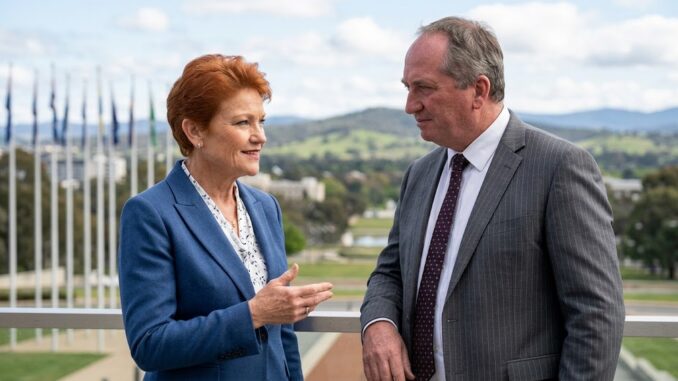
The reasons for the rise of far-right politics are often cited as financial stress, housing shortages, and frustration with government.
Yet this doesn’t explain why disillusioned voters are drifting toward the far right instead of the left.
To understand that, we need to look at how far-right ideas actually connect to mainstream Australian values – not treat the far right as some separate, foreign or imported movement.
The common assumption is that far-right politics is fundamentally opposed to democratic values. Or as a kind of “sickness” in an otherwise healthy system.
But political scientist Cas Mudde argues the opposite: “The radical right isn’t a rejection of mainstream values, it’s an extreme version of them.” Meaning this drift to the right has grown out of ideas already normal and accepted, just pushed further.
To see this, it helps to look at the three core ingredients of far-right politics: nationalism, authoritarianism, and populism. And ask how much of each already exist in Australian life.
Nationalism: Defining who counts as “us”
Nationalist language is nothing new in Australian politics.
Phrases like the “national interest,” “Australian values,” and warnings about the “nation in danger” are everywhere, and people who disagree with those phrases are often branded “un-Australian.”
This has deep roots. The dispossession of and violence against First Nations peoples was foundational to the Australian state, and legal scholar Irene Watson argues that this violence remains built into Australian law today. One of the very first laws passed by the new federal parliament in 1901 was the White Australia Policy, which tied national identity directly to race.
We like to think we’ve moved past this. But in the lead-up to the 2016 election, then-Immigration Minister Peter Dutton claimed refugees “won’t be numerate or literate” and would be “taking Australian jobs.”
These two claims, that refugees are simultaneously incapable and a threat, are not as contradictory as they sound. Together, they paint outsiders as both lesser and dangerous, while reassuring “hard-working families” that their fear of falling behind is justified, and that someone or some party or grouping needs to protect them from these threats.
Authoritarianism: Institutions turned against citizens
Cases of authoritarianism, meaning when a government uses state power to override democratic norms, has been seen in Australia.
For example, the 2007 military intervention into remote Northern Territory Indigenous communities (codenamed Operation Outreach, led by the Australian Defence Force, at Prime Minister John Howard’s direction) led to compulsory income management; enforced bans on alcohol, pornography, and gambling in dozens of communities; and suspended the permit system for access to Aboriginal lands and acquired government-controlled leases over townships.
Another clear case was the Robodebt fiasco introduced by Coalition governments between 2015-19.
It led to investigations into nearly half a million welfare recipients claiming they owed money they didn’t actually owe.
The fallout was severe, including at least five suicides linked to the debt-collection process. When Labor formed government in 2022 it called a Royal Commission into Robodebt which the new Liberal leader, Peter Dutton, dismissed as a “witch hunt”.
Dutton said instead of the Royal Commission, the public focus should instead be on families “struggling to pay their power bills”.
By framing the issue as one between welfare recipients and struggling families, that reinforces a far-right idea: that one group’s wellbeing must come at another group’s expense. And that taps into another old colonial pattern where “our” security has always been linked to dispossessing someone else.
Populism: Speaking for “the people”
The claim of populists is that they are the authentic voice of ordinary people and against the views of out-of-touch elites.
That is not necessarily unique to the far right as every party in Australia uses this pitch to some degree. It works because it resonates with people who feel left behind by leaders they see as elitist and out-of-touch.
What’s different about today’s far-right populism is how directly it merges with nationalism. There is an emerging message from the far right that the elites are rigging the system to favor “others”. By that they mean the elites favour Indigenous Australians, immigrants, and people of colour over “hard-working Australian families.”
The implication is unmistakable: real Australians are white, and everyone else is undeservedly benefiting from the system.
A pattern, not an accident
Far-right movements don’t emerge from nowhere, they derive from existing ideas and then updated and re-fashioned into something new and appropriate to current circumstances.
That’s exactly what’s happening now. The One Nation far-right is drawing on very Australian nationalist and authoritarian threads already woven into society and repackaging them to address and explain today’s anxieties.
If we treat the far right as a fringe problem involving only a small number of extremists, we miss how deeply these ideas are already embedded in the mainstream – and how much work it will take to address that.
Dr Ibolya Losoncz is a Research Fellow at the School of Global Governance and Regulation at Australian National University (ANU)
This article was first published in The Klaxon and 360info.org
Keep Independent Journalism Alive – Support The AIMN
Dear Reader,
Since 2013, The Australian Independent Media Network has been a fearless independent voice – holding power to account and delivering journalism that matters.
Running this site isn’t cheap. Rising costs mean we need your support now more than ever. Every donation, big or small, keeps our servers running, our writers working, and our stories free for everyone.
Donate here:
PayPal or credit card – just click on the Donate button below
Direct bank transfer: BSB: 062500; A/c no: 10495969

We’ve also set up a GoFundMe as a dedicated reserve fund for hosting and future improvements.

Thank you for standing with us. We couldn’t do this without you.
With gratitude,
The AIMN Team
A great article.
Especially this — “The radical right isn’t a rejection of mainstream values, it’s an extreme version of them.”
And of course, with that in mind it’s not difficult to nudge voters to the Right when the media is almost totally controlled by Big Business, and Big Business has the financial clout to influence even the State media.
But people are social by nature — this is innate.
This can never be extinguished.
And because their social instincts have been betrayed by the liberal economic policies rolled out by the major parties, they will lean to anyone promising relief, even when that someone is owned by Big Business.
If One Nation does become a force, it cannot last.
Voters will soon realise the deception.
People like One Nation implant in the minds of the mortgage belt electorate that they are grooming, that interest rates and thus their ability to access housing either by way of mortgage loans or rental properties, are all the fault of the Labor government. Or as Barnaby Joyce likes to say, the Labor socialist government.
They are, of course, misleading their target electorate into believing that the Labor government are responsible for setting interest rates when, in fact it is the Reserve Bank of Australia. Between May 2022 and November 2023, the RBA implemented exactly 13 interest rate increases over an 18-month period, lifting the official cash rate from a record low of 0.10% to 4.35%.
The objective of the RBA is to quell inflation by discouraging spending (by us) which, in a financial environment where most borrowing for homes is by variable interest rates means that every time the RBA increases rates, it is the mortgage belt that get hit directly in the guts and they blame it on the government.
‘One Nation’ would have us believe that under their economic management things would be entirely different: interest rates will go down and everybody will have access to cheap home loans – it’s all snake-oil and is based on Trumpian thinking where you will be aware, he is trying to force the Fed.(the Federal Reserve which serves as the central banking system of the United States in the same way as our RBA.) to reduce interest rates and bring about a consumer paradise similar to that being floated by One Nation.
To achieve the aspirations of the far-right we would need to shut down the RBA, disband the Fed. and believe that inflation and unlimited government borrowing is good for us.
Ultimately, under this analysis economists will tell us that respective economies will collapse under the weight of debt but on the bright side by the time that happens Trump , Hanson and Joyce will have retired on their millions looted from the system.
Uhm ….. there were a reported about 2,200 suicides linked to the Robodebt Scam initiated by Scummo when Treasurer and continued at over $900 MILLION cost to the taxpayers, rather than seek a legal judgment.
@ Steve: Our goal must be to discourage voter support for the PHONeys despite the full support of the Murdochcracy Media Manipulation Monopoly.
We must broadcast the cost of PHONey ”policy bubbles” showing that health services will be further reduced, uncapped bosses’ salary packages will consume any ”savings” and workers will be reduced to feudal peasant status.
@ Terry Mills: The easy solution for easing the mortgage slavery inflicted by the Australian banks for the benefit of foreign domiciled shareho0lders, especially foreign bank shareholders, is to abandon floating point interest rates for housing and require all principal residences to be funded on ”fixed for the term interest” rates so that borrowers know what their outgoings will be in advance.
Based on their current performances neither Pawlean nor Beetrooter have represented any voters.
It could only be New England where decades of political grooming have encouraged voters to believe that employing a person for about $5,000 per week to sit in the shade sucking an endless beer, pestering the women-folk and sleeping with planter boxes is a good investment in staff. How many such businesses would survive this business plan over a period of 13 years??
The elephant in the room is the Mudrake-led MSM, pushing their RRWNJ agenda. Surprised they were not mentioned in the article.
Terry Mills,
the inflation that contributed to the cost-of-living crisis in the early ’20s, when the RBA raised interest rates dramatically, was recognized, by non-Murdoch media aligned sources, as being driven by worldwide supply chain problems created by the Covid pandemic and the Ukraine war, and shortly afterwards by local corporate profiteering.
How was the RBA raising interest rates supposed to fix supply chain problems and corporate profiteering?
Before I get branded as One Nation-like, I don’t believe One Nation is an answer to anything, but I object strongly to any inference that criticism of Labor is One Nation-like, if that’s what the purpose was.
ABC Rear Vision has an excellent podcast looking at human rights and how it has often been a matter of hypocrisy — not able to see our own abuses.
In fact, it gives the difference between left-wing and right-wing (who claim to be conservative but not really conservative) thinking in a nutshell. Both wings believe in human rights. Right-wing thinkers point out the violations of human rights in others, in China, Russia, Myanmar, Saudi Arabia, Iran, etc. Left-wing thinkers say that all that is true, but what about seeing our own abuses towards our own people, particularly our indigenous, any non-white people, or refugees.
In right-wing thinking the problems in society are always due to others. We fail to look at ourselves and even actively deflect any responsibility. We never say “Sorry”.
As an example of “left-wing” thinking, Jesus said to not remove the speck in our brother’s eye while ignoring the log in our own.
Right-wing people are likely to protest about losing their own freedoms, particularly freedom of speech, even when that speech is irresponsible and hateful. This thinking is even likely to complain that their freedom is being impinged by the abolition of slavery against their right to own slaves, or the denial of workers rights and the right to form and belong to unions. That is the right of freedom is the right to deny others of freedom. The right to spread hateful and irresponsible speech denies others the right of free speech. We fail to acknowledge the consequences of our actions and deny that problems like climate change exist.
We indeed have used our belief in human rights in this hypocritical way and a form of “virtue signalling” to believe we are good while others are bad.
https://www.abc.net.au/listen/programs/rearvision/rear-vision-human-rights-post-colonialism-united-nations/107016724
Thommo
We are on the same page. I agree with you that for the RBA to increase interest rates to overcome supply chain problems is a nonsense. Thw RBA tell us that we are spending too much and interest rates have to increase to curb our spending which again is a nonsense.
Paying our mortgages after the banks have passed on the RBA rate increases is clearly a non-discretionary expense and not one that we can avoid – how would the bank react if we were to tell them we won’t pay the increased repayments on our mortgages as we are trying to assist the RBA by curtailing our spending!!!
As regards housing borrowing and mortgages I together with NE Cocky and possibly yourself, agree that housing loans must be at fixed interest rates for the duration of the loan or thirty years whichever first occurs.
Thanks for the reply Terry.
Yes, we seem to be on the same page on the RBA decisions. I’d also add, although some increase in rates from the 0.1% eventually would’ve been reasonable, the increase at that time, and especially the size of that increase, contributed to increasing rents, and so actually made inflation worse than it otherwise would have been.
The RBA is a non-elected body. It is meant to be independent, but appointments to its board have been in the hands of the duopoly governments, who, imo, have served corporations not the people. There was a review of the RBA under Labor. The resulting change in composition of board members, I believe, was to replace 3, what I call banker-corporate-types, with one academic and two banker-corporate-types.
To my biased eyes, the RBA board was stacked with banker-corporate-types before the review and remained stacked with banker-corporate-types after Labor’s review – no amount of self-questioning my own biases has changed that opinion.
Where we seem to differ is in the responsibility the government of the day has in ensuring that the RBA acts in accordance with its mandate.
You perfectly accurately point out the objective that the RBA has had, or at least claimed to have had – reducing inflation. I say ‘claimed to have had’ as some of the decisions and subsequent explanations given seem more in line with an objective of reducing wages growth than prices stability. What I think also needs to be considered is the RBA’s actual mandate.
The original mandate apparently was:
(a)The stability of the currency of Australia;
(b)The maintenance of full employment in Australia; and
(c)The economic prosperity and welfare of the people of Australia.[27]
Which, I believe, was amended to “clarify the existing dual mandate of price stability and full employment.”
The RBA has abrogated its responsibility, imo, to full employment, by using a definition of full employment which is nothing more than a circular argument to remove full employment from the mandate and instead simply focus on price stability. That is, it defines full employment, as the number of people employed that will meet/create inflation within a certain range.
That is the RBA not meeting its mandate, imo.
Where is the accountability for the RBA’s decisions? The review, and Jim Chalmers, wanted any accountability for decisions removed altogether. This didn’t get up (thank goodness imo.)
The review and Chalmers wanted the ability of the government to override RBA decisions removed on the basis of ‘independence of the RBA’. As the Greens pointed out: “Independence does not, and should not, equal freedom from accountability.”
The RBA is an unelected body of unaccountable technocrats, almost entirely banker-corporate-types, that make decisions of enormous consequence to the welfare of Australians. The responsibility of making sure those decisions are in the best interests of Australians rests, imo, with the government of the day.
My assessment of the RBA’s decisions has been heavily influenced by the writings of the likes of Greg Jericho and Michael Pascoe (hardly rabid right-wingers, and certainly not Murdoch stooges who attack the RBA when the Coalition are in power but condemn any government criticism as an attack on independence when Labor is in power.)
My personal assessment is that the RBA has made a series of bad decisions that have adversely affected many Australians unnecessarily, is not trying meet its mandate on full employment, seems to be ideologically-driven rather than fact-driven, has focussed primarily on fictitous wages breakouts, rather than grounded in the reality claims to be influenced by corporate feelings about where inflation might be going, and may well have demonstrated incompetence.
I believe Labor has failed in the responsibility, that I believe it has to the Australian public, to act to protect the Australian public from an RBA repeatedly making bad decisions, and in taking the opportunity to genuinely reform the RBA. Therein lies where I suspect we differ on this.
The problems that Terry and Thommo are discussing will not be going away any time soon.
The problems are the same ones that were thrashed out in antiquity — this is nothing new.
The solutions are known and the solutions are simple, but they will not be enacted because the economic history in which the solutions are to be found, is no longer taught.
Is no longer a component of the economic curriculum.
And so the Jim Chalmers of the world, the Reserve Bank governors of the world, think they can fiddle here, fiddle there and make a difference.
For all their qualifications, they are economic illiterates.
Thommo, these people would have no more idea of how the masses live than
fly to the moon.
Uhm ….. Having skipped high school economics ….. Is is true that mortgage rates, mortgage repayments and rents are excluded from the calculations to control inflation??
Seems that the RBA is playing a three thimble trick on Australian voters that allows bank shareholders to enjoy fabulous annual dividends, especially the foreign owned banks invested in the CBA.
Remember how when the CBA was privatised that the IPO of $2.50 was considered ”a good price”. Certainly now the latest price to day is $159.32 with the annual dividend in excess of $2.50.
How can you do a ”whole of national economic evaluation when you exclude one of the biggest expense factors that the RBA makes worse for the mortgage slaves having floating point mortgage interest rates, rather than ”fixed for the term” interest rates on primary residential mortgages?
Steve
You seem to be saying that True long-term fixed-rate mortgages (LTFRMs) that last the entire life of a 30-year loan are not feasible or politically possible in Australia. I think it’s more a question of political will.
The United States as you know is the undisputed leader with over 90% of U.S. mortgages on 30-year fixed contracts. The government-backed entities Fannie Mae (Federal National Mortgage Association (FNMA)) and Freddie Mac ( the Federal Home Loan Mortgage Corporation (FHLMC)) absorb the risk, allowing banks to offer fixed rates without penalty.
Denmark also has 30-year fixed-rate mortgages as the standard baseline. It operates via a highly unique, privatised “covered bond” market.
France and The Netherlands both have Long-term fixed rate schemes in the in 20 and 30 years bracket.
We could do the same in Australia if we didn’t pander to the banks who have a highly energetic and apparently effective lobby in the Canberra corridors of power.
Terry, apologies for not giving more detail.
I agree that long-term fixed rate mortgages are needed.
So we have to ask why it is that they have not been adopted here.
The problem not faced by the Reserve Bank and all orthodox economists, is that the overall problem, the intractable problem, lies in the financialisation of the global economy.
This always results in a growing burden of debt, a continuous erosion of living standards, and the emergence of an oligarch class that takes over the management of economic policy.
As we see today.
Prof. Michael Hudson has been studying economic history for fifty years or so, and he found a common feature among the ancient civilisations.
They all grappled with this problem, and the solution was that monarchs, with the support of the proletariat, tethered the oligarchs, prevented their dominance, by establishing a cancellation of debts on a regular basis. That the origin of “jubilee”.
And why can that not happen today?
As Hudson said in an interview — we know the whole world has to move away from this pernicious dollar system, and I couldn’t agree more. So why isn’t it moving away faster? If it’s so good for the world, why isn’t the world doing it? And that’s because the overwhelming majority of the countries of the world are dominated by elites who are invested in the dollar system. They are the ones who take their money and put it in the Cayman Islands, or, why bother with the Cayman Islands when you’ve got New York and London, but anyway, that’s what they’re invested in. And that’s why the critically important piece of this, which is capital controls, is practically a bad word to say in polite circles. If you went to a cocktail party with all sorts of fancy, rich people, and you said “capital controls”, the entire party would move to the other end of the room from where you’re standing, because they don’t want to be associated with this.
Even Abraham Lincoln, self-educated, from the backwoods of Kentucky, knew more about economics than Jim Chalmers and the oxygen thieves sitting on the Reserve Bank Board.
In 1861 he wrote a note to Congress to remind them that “if one has to choose, one has to understand that the priority in economics always has to go to labor, that capital itself is the product of labor.”