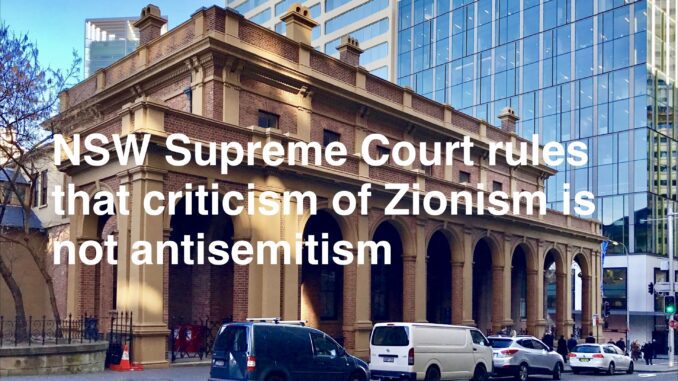
The term “antisemitism” is now so commonly used as an accusation as to be placed beyond questioning. This is particularly so in countries claiming some protections for free speech or lawful assembly. Use that term to your heart’s content and stifle discussion. Carry a placard accusing Israeli policy of genocidal propensities – antisemitic. Raising the issue of dispossession and ethnic cleansing of Palestinians by Israeli authorities – antisemitic. Mention specific slogans, some used with full throated approval by Israeli Zionists themselves – antisemitic. But an interesting New South Wales Supreme Court decision, delivered by Justice Desmond Fagan, restores much needed and merciful balance. Put it simply, not all acts directed at Israel or unflattering views held about that country, however crudely framed, carry the antisemitic streak.
The acts in question in the case before Fagan were certainly crude. The 22-year-old Mohommed Farhat had been a vandal for hire, defacing parked motor vehicles (nine in total) and the walls of various buildings (four in total) in the eastern Sydney suburb of Woollahra using spray-paint. His November 2004 acts featured slogans including “PKK”, “PKK coming” and “Fuk Israel”. A vehicle was also set alight. It transpired that A$4,000 had been given to Farhat to execute his acts of arson and graffiti, including a complement of drugs. The wording used in the vandalism had also been suggested by the recruiter.
On pleading guilty, Farhat was given a term of imprisonment of a year and eight months by the NSW Local Court Magistrate Scott Nash on November 18, 2025. Important in this case was the use of powers available to the state government under the Terrorism (High Risk Offenders) Act 2017 (NSW) to deem an offender an “unacceptable risk” in committing a serious offence in the event of being released on parole. Farhat would have been eligible for release after 10 months but for the concerns of the Corrective Services, which deemed him a “national security risk” inmate in January this year. The State then requested an extended supervision order of a year’s duration with 55 attached conditions. The proceedings, taking place over four days of hearings, centred on whether Farhat’s crimes could be regarded as posing such a risk.
While Fagan delivered his decision on July 30, the reasons were published on August 17. In his reasons, a controlling factor for Fagan was the Federal Court case of Wertheim v Haddad (2025), where Justice Angus Stewart postulated what “the reasonable, ordinary listener” would understand as being said in the context of critiquing Israel and Zionism. Depending on the context, such a reasonable person could “understand that not all Jews are Zionists and that disparagement of Zionism constitutes disparagement of a philosophy or ideology and not a race or an ethnic group.” It also followed that political criticism directed at Israel “however inflammatory or adversarial, is not by its nature criticism of Jews in general or based on Jewish racial or ethnic identity.”
Fagan reasoned that such phrases as “Fuk Israel” could only be considered antisemitic as “dictated […] according to established common usage in Australia.” He found that Farhat had not intended to “express hatred of Jews”. Slogans such as “Fuk Israel”, construed objectively, were “crude expressions of political hostility to the state of Israel”, a “curse against a foreign state.” They were “not antisemitic according to the ordinary understanding of that concept in the Australian community.” It also did not matter that the graffitied slogans had been made in a locality with a high proportion of Jewish residents: this did “imbue the curse with an antisemitic character.”
The judgment also gave the definition of antisemitism so treasured by the Australian government, most state governments and their agencies, and the Special Envoy for Antisemitism Jillian Segal, a frightful dressing down. The International Holocaust Remembrance Alliance (IHRA) definition deems antisemitism to be “a certain perception of Jews, which may be expressed as hatred toward Jews. Rhetorically and physical manifestations of antisemitism are directed toward Jewish or non-Jewish individuals and/or their property, toward Jewish community institutions and religious facilities.”
This semantic spray did not impress Fagan. With bracing clarity, he stated that the text was “so verbose and imprecise that it could not realistically be attributed to the ordinary, reasonably informed member of the Australian public.” It was unclear what a “certain perception” was. Might it manifest “in the expression of some other, less egregious, sentiment towards Jews and, if so, what?” The inclusion of “non-Jewish individuals” was also baffling and “counterintuitive” as were the lack of limits to the notion of which “rhetorical [or] physical manifestations” might amount to antisemitism.
The justice was far from alone in making remarks about the shoddy formulation. He noted the views of Sir Stephen Sedley, a former judge of the Court of Appeal of England and Wales who accepted the proposition that the IHRA failed “the test of any definition: it is indefinite.” Fagan also drew on the critical submission by the Jewish Council of Australia (JCA) to the Royal Commission on Antisemitism and Social Cohesion, established in response to the Bondi terrorist attacks of December 14, 2025. “Discussion of the IHRA wording and adoption of it by some institutions does not change the established meaning of a word that has been in use in the English language for 150 years.” Many of the submissions made to the Senate Legal and Constitutional Affairs committee informing its October 2024 report on the Commission of Inquiry into Antisemitism at Australian Universities Bill 2024 (No. 2) also noted the conflation of “political criticism of Israel with antisemitism.”
The IHRA definition was, the judgment asserted, not intended to give effect to common understandings of antisemitism but aimed to furthering another goal: “Its tendency, and the apparent purpose of promoting it, is to graft onto the community’s abhorrence of antisemitism, understood as hostility to Jews for their Jewishness, a parasitic rejection of protest against Israel.” Such a rejection refused to acknowledge the public repudiation by a majority of Australians of Israeli policies (a Pew Research Center poll from June 4, 2026 found that 79% had an unfavourable view of that country) reflecting a “humanitarian reaction to Israel’s genocide of the Gazans since 7 October 2023, the livestreaming of which to mobile handsets would be difficult to ignore.” It followed that any assertion that 79% of Australians might be “antisemitic because they disapprove of Israel’s treatment of the Palestinians” was bound to be “preposterous.”
Justice Fagan was convinced that the state had not made the case “that the defendant poses an unacceptable risk of committing a serious terrorism offence if not subject to extended supervision.” What mattered was whether he might succumb to using “illicit drugs and lower order crime”; there was no evidence that Farhat had been “politically radicalised.”
Beyond court proceedings, there have also been broader concerns Farhat’s case has seen fiddling on the part of NSW Police. “The material failure of police to provide critical evidence to the court has resulted in Mr Farhat’s prolonged and quite possibly wrongful incarceration, as well as serious errors of fact and law,” wrote Greens MP, Sue Higginson, to the NSW oversight body, the Law Enforcement Conduct Commission (LECC).
Fagan’s reasons provoked howls of protest from the offices of the Executive Council of Australian Jewry. This was a dangerous example of judicial “activism” that avoided “the community impact”. (Presumably a judge favouring an aggressively wide interpretation of antisemitism, one armouring and fortifying Israeli policy from scrutiny, would not be entertaining activism.) “It’s quite extraordinary [given] where we are as a society, as a country, globally with antisemitism, that we’re still being dragged back to these foundational discussions about is and what isn’t antisemitism,” groaned Alex Ryvchin on Sky News. Jamie Hyams, director of public affairs at the Australia Israel & Jewish Affairs Council (AIJAC) chastised Fagan for appearing “to range a long way past the question the court had to decide, into contested questions of history, politics and international law on which his honour appears to have had no independent expert evidence.” Such expert evidence, it would seem, can only be sought by those sacred sources approved by a select cartel, one sympathetic to Israeli policies, whatever their import.
The authorities in NSW have shown what can only be contempt for Justice Fagan’s ruling that Farhat had been subject to a “serious miscarriage of justice.” The commissioner for corrective services, Gary McMahon, had already intervened last December to have the parole order revoked without a hearing from the defence team, a nasty denial of natural justice that should provoke further comment. The parole authority’s August 24 decision also refused to acknowledge the ruling and the reasons by Farhat that he had been a vandal for hire: he would be kept in prison as “the offending was reflective of a deep-seated adherence on the part of the offender to an extremist ideology of an antisemitic character.” The purported ignorance to the meaning of the phrases used was also rejected. It follows that this miscarriage of justice, and the project of inoculating Israeli policy from stern and valid criticism, continues.
Keep Independent Journalism Alive – Support The AIMN
Dear Reader,
Since 2013, The Australian Independent Media Network has been a fearless independent voice – holding power to account and delivering journalism that matters.
Running this site isn’t cheap. Rising costs mean we need your support now more than ever. Every donation, big or small, keeps our servers running, our writers working, and our stories free for everyone.
Donate here:
PayPal or credit card – just click on the Donate button below
Direct bank transfer: BSB: 062500; A/c no: 10495969

We’ve also set up a GoFundMe as a dedicated reserve fund for hosting and future improvements.

Thank you for standing with us. We couldn’t do this without you.
With gratitude,
The AIMN Team

There is growing disquiet about Zionist interference in Australian politics.
I predict that this will be a major issue leading up to the next federal election. In the mean time politicians, media and pro-Zionist lobbyists will employ all available means to suppress critical public discussion about Zionism and anti-semitism in Australia.
I fail to see how criticism of Israel can be considered anti-semitic when a good number of Jews in Israel consider its actions in Gaza to be unjustified. Are there other nations we mustn’t criticise for their actions or policies?