Continued from Part 1
Recap
Throughout my life, I have encountered a wide range of speeches, both effective and ineffective. This particular speech, however, did not stand out. It was nothing to Bragg about.
I own two collections of notable speeches. While I do not intend to compare Senator Andrew Bragg’s recent address at the National Press Club to those delivered by individuals such as Obama or Margaret Thatcher, I found his speech remarkably disappointing. It was reminiscent of Pauline Hanson’s least effective speeches. Nonetheless, I acknowledge his willingness to bring forward new ideas to his party, which is currently struggling for ideas and direction.
Bragg told his party they are in a precarious position and stressed the need to embrace new ideas and acknowledge their misreading of the current political climate. Demonstrating such candour required considerable courage.
To summarise, the Shadow Housing Minister proposed significant housing reforms, such as reducing the National Construction Code and lowering net overseas migration to fewer than 180,000 annually. The speech received criticism from the federal government and internal dissent from Coalition colleagues, notably about the migration targets and building standards. The full speech is available on YouTube. My commentary appears in bold throughout his speech.
The Demand Side
Labor’s HAFF is a sinkhole of more than $10 billion. Operating for almost three years, it has delivered only 1,400 homes, and the Auditor-General found that half had actually been bought, not newly built!
We need the Integrity Commission to do its job because the Senate’s power to investigate wrongdoing is compromised by union influence over the majority of the Senate.
There is a protection racket which needs to be smashed by a change of government to end the Coalition between Labor/unions and Big Super.
The concept of a “protection racket” between the Australian Labor Party (ALP), trade unions, and the multi-trillion-dollar industry superannuation sector (“Big Super”) is a central narrative used by the federal Liberal-National Coalition. Critics argue that the current legislative system creates a mutually beneficial cycle of financial and political power.
Improving the system also requires the right public financing, which is why Angus Taylor announced our pledge to a $5 billion last-mile infrastructure facility.
Retirement Outcomes: The federal government and union bodies such as the ACTU strongly reject these characterisations, framing universal superannuation and industry funds as a core pillar of Australian retirement dignity that benefits ordinary workers rather than serving as an ideological tool. [1, 2]
The Senate report also identified waste and fraud in the banking system, and recommended expanding the Consumer Data Right.
Taxes
Housing taxes are too high. Up to 50% of the cost of a new home goes to government charges, taxes and fees.
Labor has added $77 billion in new taxes, which we will reverse.
Just by reversing the Budget housing measures, we will enable 75,000 more homes.
The SMSF borrowing ban alone could reduce housing supply by as many as 16,000 property transactions each year, not 4,000.
Labor is deliberately reducing supply just because it doesn’t like individual investors. Labor believes investment in housing from Big Super is desirable, but individual investment in housing is undesirable.
Today I announce we will seek to amend Labor’s terrible SMSF ban to permit borrowing to invest in new housing. By law, owners cannot live in these houses, so this ban only stops new housing.
These communist style taxes are nonsensical. No wonder Australia is more than 200,000 homes behind Labor’s housing target.
Firstly, describing the Labor Party as communists is disingenuous in light of the fact that he would know that it is untrue.
Secondly, Property values rose sharply. Under the Howard government (1996–2007), capital city home prices surged by roughly 174% (averaging about 15.8% annually), aided by the introduction of the 50% capital gains tax discount for investors and retained negative gearing. [1]
Later Coalition Years: Under Abbott, Turnbull, and Morrison, dwelling values continued general upward trends, though housing affordability steadily worsened for first-home buyers.
Labor seeks to change the character of Australian housing to promote corporate and institutional ownership. So far they’ve shovelled billions from the HAFF, passed “build to rent” tax cuts and made the corporate cop ASIC bend the investment disclosure rules.
The federal Labor government’s housing agenda is currently behind schedule, largely due to critical structural issues within the construction sector, including severe shortages of skilled tradies and declining market confidence. It won’t be any different for the LNP.
We just want more investment from everyone because more investment means more houses, more affordability, and cheaper rents.
We are looking to cut taxes to facilitate more dwellings generally, including granny flats, airspace builds or simply more houses on Australian land – built where people actually want to live.
These are all supply-side matters. But we cannot escape the demand side.
The risk of pump-priming prices is clear. Since Labor made the 5% scheme a free-for-all in October 2025, almost 40 per cent of the take-up has been by people with high incomes, including a couple earning over $670,000.
This has made things worse for first home buyers who genuinely need assistance. It’s been peddled as a riskless solution, even though Labor knew about the risk of price spikes and negative equity.
The new Senate report sets out the recklessness of Labor’s 5% deposits – from failing to properly model price impacts, through to the arbitrage created by favourable capital treatment.
At a minimum, 5% deposits must be means-tested because the unrestricted version is a bad policy and the nation can’t afford it.
For the past two elections, we have had a super-for-housing policy, which recognises the centrality of housing to retirement.
The simple fact is that no matter what each party says about building houses. They cannot do it without the necessary tradespeople. Therefore, Delayed Timelines: Independent forecasts suggest that at the current pace of construction, the nationwide 1.2 million target will not be fully met until mid-2030, with states like New South Wales lagging even further behind. [1]
As I said in my First Speech, compulsory super remains a strange but huge illiberal experiment.
The 2023 Intergenerational Report (IGR) shows Age Pension spending makes only a small difference to our long-term fiscal position.
Age Pension spending has been reasonably stable at just over 2 per cent of GDP over the past 26 years. It will remain at 2 per cent by 2063 according to the IGR.
Age Pension Expenditure as a share of GDP
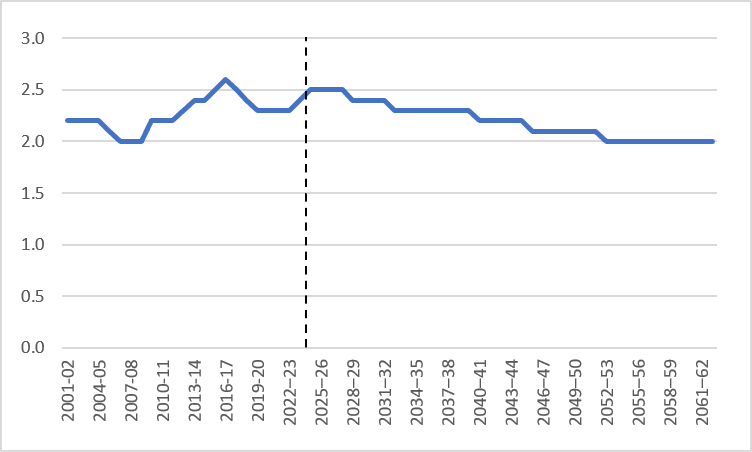
Meanwhile, superannuation tax concessions as a share of GDP are projected to overtake Age Pension spending in the 2040s.
Mandates are always costly. And in this case, it takes 12% from people’s wages to vest them with managers they will never meet. It is a loss of liberty.
Increasingly, Australians are reaching preservation age, which is 60, and using super to pay off their mortgages.
What was the point if there is no public finance benefit and minimal personal benefit?
If you picture the typical Australian worker in their 20s, would they rather contribute 12% to super, or put that money towards a home deposit? This policy remains under review.
Exactly. What about interest derived from the fund?
Migration is the other factor.
Since Labor came to power in mid-2022, Australia’s population has increased by some 1.8 million, of which around 1.5 million have been through net overseas migration (NOM). But over the same period, dwelling stock increased by only 550,000.
Growth in population versus growth in dwelling stock, indexed to June 2022
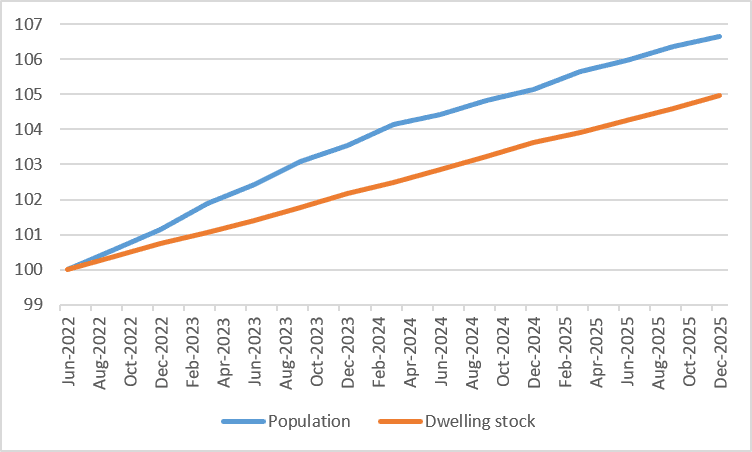
Applying the Census assumption of 2.6 persons per dwelling, under Labor, Australia has built enough dwellings for only about 1.5 million people.
This creates a shortfall of about 130,000 dwellings, which are needed to house at least 350,000 people.
Of course, all this modelling depends on the assumptions. If we win, each year we will report on the connection between migration and housing to ensure housing stock and related completions can support the annual migration intake.
The latest ABS data shows NOM remains above 300,000. In the Budget, the NOM is assumed to decline from 295,000 in 2025-26 to 225,000 into 2029-30.
Assuming Labor sticks to this Budget profile, the specific housing shortfall created under Labor can be closed over the Budget forward estimates period by averaging a NOM of under 180,000.
A NOM reduction on this scale is manageable and in line with reductions we have managed in recent history – for example, in 2009-10 when NOM declined from 300,000 to 175,000 in around 18 months.
This reduction can be achieved while benefiting the budget and the economy, including by lifting the skilled share of our permanent migration intake (including more skilled construction tradies) and making modest reductions in international students, working holiday makers, and post-study work visas.
Its delivery will align with our housing and industry needs.
This part of Mr Bragg’s speech is highly speculative and draws on many assumptions, any of which could be correct. Go here for my AI-collated list.
Lifting migration standards and analysing them carefully each year is crucial to ensure integrity and public trust in our migration settings.
We are a great country, and we want the most capable people to make Australia their home—people who will subscribe to our great institutions, cultural norms and our English language.
The housing boom we want to unleash is central to Australia’s revival and Australian liberalism.
We can be rich by nature and rich by policy. But only if we are honest about what has been wrong in the past and how we plan to make things better with detailed policies.
This, I assume, is a message to his own party.
Then we will change our country’s direction.
We can answer the frustration of millions of Australians – and build the tomorrow worthy of the good and decent people of our land.
Buraadja!
Mr Bragg, in his speech, has challenged his own party to change. Whether they can or not remains to be seen. I have not seen any evidence so far. In fact, what I have seen thus far is just the same old politics of recent times.
My thought for the Day
Presenting facts to people who have reasoned by their feelings that they are right is totally futile.
Keep Independent Journalism Alive – Support The AIMN
Dear Reader,
Since 2013, The Australian Independent Media Network has been a fearless independent voice – holding power to account and delivering journalism that matters.
Running this site isn’t cheap. Rising costs mean we need your support now more than ever. Every donation, big or small, keeps our servers running, our writers working, and our stories free for everyone.
Donate here:
PayPal or credit card – just click on the Donate button below
Direct bank transfer: BSB: 062500; A/c no: 10495969

We’ve also set up a GoFundMe as a dedicated reserve fund for hosting and future improvements.

Thank you for standing with us. We couldn’t do this without you.
With gratitude,
The AIMN Team

Uhm ….. More JL wisdom. One critic of this foolish illiberal Bragger rant exposed by a university specialist is that the ”problem” has been caused by persons on temporary visas overstaying their welcome by NOT returning home.
The NOM is the usual red herring that the COALition roll out to defame the LABOR government struggling to make policy headway despite a huge majority.
Now which ”political donors” to the COALition parties are disadvantaged by union based super schemes that provide better financial returns to members that the bank operated schemes that skim the profits for foreign based shareholders before considering Australian super members??
The highest proportion of wealth created by super schemes occurs in the final years of the investment because THAT is how compound interest works. Perhaps Bragger should have paid more attention in high school Mathematics when that topic was taught. But then, he appears to be of the opinion that only overpaid corporate executives and politicians should benefit from working life long investment in the future.
Compulsory super is one of the best things that past LABOR governments have provided for ALL WORKERS, including corporate executives.
Funny how the impact of the Howard residential real estate policies of Negative Gearing and reduced CGT between 1996 and 2026 have been ignored by Bragger, and the automatic buying price raising government guaranteed deposit policies that further boosted profits for real estate agents.
So, a political sceptic could reasonably conclude that Bragger is making a left field assertion for consideration as the “”Great White Saviour” of the COALition that is doomed to irrelevancy under Anus Faylure, unrecoverable under Hastie Tastie waiting for the wings to fall off and after that there is really no other contender, hence, in desperation, Bragger …..