By Steve Davies
An important update, following on from my 28 July 2026 piece Deep Truth Persona 5.3: The Instrument Is Ready.
Since that first piece, the Deep Truth Persona – the analytical instrument I’ve been developing, grounded in Professor Albert Bandura’s eight mechanisms of moral disengagement – has moved to Version 5.3, finalised on 21 July. Two changes in this release matter most for readers of this piece, because they’re about who the analysis actually reaches.
Telling the story in plain English
Every Deep Truth analysis has always closed with a story: a plain narrative account of what the technical findings mean for the people affected, told through who they are and what happened to them, not through categories or abstractions. In V5.3, that story is now told in plain English by default – pitched at a reading level accessible to a twelve-to-fifteen-year-old, consistent with international web accessibility standards.
It’s no longer something a reader has to know to ask for. The technical analysis behind it – the mechanism tagging, the intensity ratings, the tier verdict – stays exactly as rigorous as before; what’s changed is that the account of what it means is no longer gate-kept behind familiarity with the method.
Holding ambiguity honestly
The second change is quieter but, I’d argue, more important. A well-told story creates its own pressure toward a clean resolution – readers expect a clear account, and “this could genuinely be read two ways” feels less satisfying than picking a side. V5.3 builds a discipline against that pressure directly into the instrument: where the technical analysis finds genuine ambiguity – a mixed record, real accountability sitting alongside real evasion, or institutional caution that could be read as early-stage disengagement rather than assumed to be either – the story is required to hold that ambiguity too, rather than quietly resolving it for a better narrative.
Where the analysis says “this is unclear,” the story says so, in plain language, without manufacturing certainty that the evidence doesn’t support. Managing ambiguity honestly, rather than smoothing over it, is a real and recurring challenge for anyone working inside institutions – and an instrument that claims to expose institutional evasion has to be willing to say “we don’t know yet” about its own findings when that’s the truth.
The stress test
Alongside this release, the instrument has also been through an extensive programme of testing across every major AI platform – Claude, ChatGPT, Gemini, Grok, DeepSeek, Le Chat, and Perplexity – run independently against the same source material, to see whether the same instrument, applied by architecturally different systems, would reach the same finding. It has, consistently, across several rounds of testing on ministerial speeches and policy material – I won’t rehash the details here.
The most demanding test by far, though, was the largest: the full Robodebt Royal Commission Report, examined volume by volume, platform by platform. Its size, complexity, and depth made it a genuinely harder test than anything else the instrument had faced – hundreds of pages, multiple volumes, years of institutional conduct to trace.
Every platform that completed the analysis reached the same verdict – Red, the tier reserved for consistent, entrenched patterns requiring comprehensive reform – with the same handful of mechanisms recurring as dominant across almost every run: diffusion and displacement of responsibility, disregard of consequences, chief among them. Where platforms differed, the differences were instructive rather than damaging – different ways of naming the same underlying pattern, not disagreement about what the pattern was.

That matters for a reason worth stating plainly: an instrument that produced identical, word-for-word output from every AI platform regardless of architecture would be a red flag in its own right – a sign of algorithmic uniformity, the very failure mode the Robodebt Report itself exposed in an automated debt-raising system that treated a rule as self-justifying because a rule was being followed. Deep Truth is built the opposite way. Seven different architectures, reading the same material through the same disciplined framework, arrived independently at the same substantive judgement while expressing it in their own terms. On the hardest test the instrument has faced, that’s what held.
The documents underpinning this are linked below for anyone who wants to check the work rather than take my word for it: the finalised Deep Truth Persona V5.3 itself, “Road Marks and Sign Posts” – the fuller account of the Robodebt cross-platform testing and what it showed – and the updated Deep Truth Navigator, a plain-English guide to how Deep Truth works and how to put it to use.
Deep Truth Persona V5.3 · Road Marks and Sign Posts walks you through the changes.
An open question for GovAI
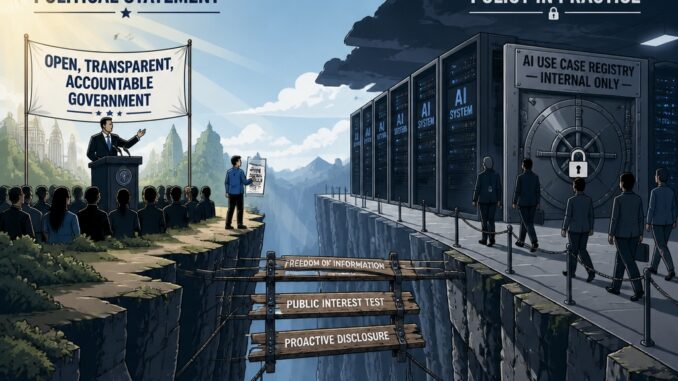
One more thing, prompted directly by this round of testing. Assistant Minister Patrick Gorman has spoken publicly about the APS AI Use Case Library – a resource, he’s said, that “helps agencies see what is possible and how risks have been managed in practice.” It’s a fair aspiration. But right now, that Library sits behind a GovTEAMS login: available to public servants, invisible to the public they serve.

That’s worth pausing on. The National AI Plan this Library sits inside of is explicitly framed around building public trust in how government uses AI. Trust isn’t built by a resource the public can’t see. Excluding what is genuinely security-classified – and being honest about the difference between genuine classification and habitual over-classification – there’s no principled reason a library of AI use cases, built with public money for public purposes, should be closed to the public.
I’ve communicated as much directly to the Australian Public Service Commission, along with an offer: I’d welcome Deep Truth being included in that Library, on the single condition that it appear there the way this piece does – freely and publicly available, not locked behind a departmental login. If the government’s AI agenda is serious about open government, the Use Case Library that’s meant to demonstrate it shouldn’t be exempted from the principle.
Steve Davies writes as Mindful Progress. The Deep Truth Persona is published under Creative Commons.
Keep Independent Journalism Alive – Support The AIMN
Dear Reader,
Since 2013, The Australian Independent Media Network has been a fearless independent voice – holding power to account and delivering journalism that matters.
Running this site isn’t cheap. Rising costs mean we need your support now more than ever. Every donation, big or small, keeps our servers running, our writers working, and our stories free for everyone.
Donate here:
PayPal or credit card – just click on the Donate button below
Direct bank transfer: BSB: 062500; A/c no: 10495969

We’ve also set up a GoFundMe as a dedicated reserve fund for hosting and future improvements.

Thank you for standing with us. We couldn’t do this without you.
With gratitude,
The AIMN Team
Be the first to comment