By Maria Millers
For many the first instinct on waking is to lean over for that rectangular piece of glass that has become a constant companion of modern living: the mobile phone.
But last Wednesday for Telstra customers came the rude shock that not only was the early morning temperature barely above zero but that their phones were not responding: no morning wakeup call, no time calls, no reminders, no notifications. There was no signal, the network had experienced a major outage and what followed was chaos.
Twenty years ago, losing your mobile phone signal was mostly an inconvenience. Today, telecommunications underpin almost everything we do.
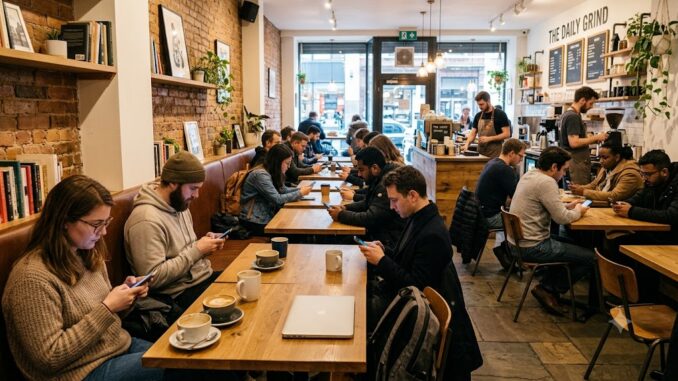
People stood in doorways
holding useless rectangles of glass,
waiting for a signal
that never came.Shops forgot how to sell.
Banks forgot who owned what.
Traffic lights blinked once, then slept,
while the city searched
for its own memory.
This recent Telstra outage is more than a story about a telecommunications company experiencing a technical glitch. It’s a wakeup call to all of us about how deeply dependent on interconnected digital systems we have become and how failures can trigger a raft of problems reaching out well beyond the original one and affecting so many daily experiences of our lives. Even threatening lives.
The Telstra outage, described as being triggered by a software defect affecting network time synchronization, left people with disrupted mobile services and then reached into most areas of our daily existence. The outage demonstrated that a fault in one network can ripple across multiple industries and services because they all depend on the same digital foundations
We have become less practised at operating without digital systems. The phone now holds much of what we used to commit to memory like phone numbers of close friends and relatives, their birthdays, important dates and vital appointments.
Now it has become central to our daily routines from paying for that morning coffee on – route to work to paying for purchases, making or cancelling medical appointments, accessing transport, filling up or charging cars, contacting customers, verifying identities and the list goes on.
In a society where cash is fast disappearing as we tap our phones at the servo, coffee shop, supermarket, doctor’s surgery and for a myriad of other daily transactions, the sudden withdrawal of being able to do so throws people into panic.
Add to the list banking and other electronic transactions, public transport, emergency services, healthcare, logistics and freight – all becoming inoperable. Small businesses across the country were immediately affected. Some taxi drivers lost fares that were worth hundreds of dollars.
Rail services in Victoria and NSW were halted for safety reasons causing chaos at terminals particularly for regional travellers.
Personal stories abounded: missed specialist appointments; a young woman could not get to her TAFE orientation day for a new course: a man missing his mother’s funeral; stranded Vic Rail passengers having to find and pay for hotel accommodation.
Distraught, unwell people found difficulties in getting through to 000. It was later confirmed that 600 triple zero calls failed. For a while it was feared that there could have been fatalities as more than 600 had attempted to call for help
Thankfully there were no direct fatalities as a result.
Also affected were those who have devices which enable them to function such as pacemakers, pressure machines for sleep apnea or monitoring blood glucose levels for diabetics
All this raises the thorny question of whether we are too dependent on new technologies and vulnerable when things go wrong. There is also the uncomfortable realization that increasingly we lack the resilience to cope with discomfort and disruption. Or how to plan for such eventualities.
People become moody aggressive and look for who to blame.
There is uncertainty in living through technological change particularly when change is more relentlessly rapid than is our ability to adjust and create structures and laws to soften transitioning through this liminal period.
This is of course not something that is new.
The healing power of nature has been the subject of much literature throughout the ages. From the first Industrial Revolution to the rise of electricity and mechanisation, and later during the nuclear and computer ages, it remains just as relevant in the era of artificial intelligence, cloud computing and globally interconnected digital networks. The technologies have changed, but the underlying human concern has not.
Back in the beginning of the 19th century poet William Wordsworth lamented:
The world is too much with us; late and soon,
Getting and spending, we lay waste our powers;
Little we see in Nature that is ours;
We have given our hearts away, a sordid boon!
Although he was reacting to the early Industrial Revolution not digital technology, his concern was that people had become disconnected from nature, contemplation, and deeper human values. One can easily read the poem as equally relevant today.
But modern poets like Mary Oliver dream of a future world where technology coexists harmoniously with nature:
I dream of a world where nature and technology thrive,
Where the stars are visible in the night sky,
And people gather to share their stories,
In a harmony of life and innovation.
(The Future, by Mary Oliver).
The poem encourages readers to imagine a future where technology serves to enrich our lives, promoting a balance between innovation and the natural world. Oliver’s looks hopefully to the possibilities that lie ahead and the role technology can play in fostering a more connected and compassionate society.
Other poets have tackled the problem of love and connection in a technologically driven world. For older people the modern dating scene often seems overwhelming by the presence of technology, yet poets like Anne Carson suggest that despite the presence of machines human emotions endure:
In the age of screens and machines,
I search for the heartbeat beneath the wires.
Connection lost in the digital haze,
Yet love persists, flickering like a candle.
The poem encourages readers to reflect on the importance of nurturing connections despite the distractions of technology, emphasizing that true intimacy transcends the digital realm.
One striking observation is that poets rarely opposed technology itself. Instead, they questioned what might be lost if technological capability advanced faster than wisdom, community, or moral imagination.
Perhaps it’s also time to consider whether utilities and services like telecommunication should be in private hands As private companies their primary aim is to maximise profit through efficiency rather than the common good.
For this we need leaders who can show us a common future that promotes enduring human values within a technology that enhances all aspects of our society
The outage also illustrated what some call the ‘fragility of complexity’. As societies become more interconnected, they often become simultaneously more capable and more vulnerable.
Every technological advance solves problems while introducing new dependencies.
Electricity enabled modern civilisation but created dependence on the power grid. The internet connected the world but made economies reliant on digital networks. Artificial intelligence promises further gains but may deepen dependence on complex systems that are difficult to audit or fully understand.
Artificial intelligence has the potential to improve human society by adding to human capabilities rather than simply replacing them. There are potential benefits in so many areas: health, education, scientific discovery, environmental management and economic productivity. But this must be embraced only with thoughtful governance, ethical standards and broad access to all for its benefits.
The Telstra outage reminds us that technology is not merely a collection of tools; it is the infrastructure upon which much of modern life depends.
The question, therefore, is not whether we should slow technological progress, but whether we are investing enough in resilience, redundancy and governance alongside innovation.
The Telstra outage is likely to prompt renewed scrutiny of Australia’s critical infrastructure, emergency communications and telecommunications resilience. If those lessons lead to more diverse networks, better contingency planning and stronger system design, the disruption may ultimately strengthen Australia’s digital infrastructure for the future
Perhaps this is the outage we had to have:
We stand on the brink of something great,
As machines hum and screens glow bright.
Yet in the midst of progress and change,
We must not forget the beauty of the night.
(The Future of Technology, by John Ashbery).
Woorilla Poetry Prize 2026 is now receiving entries via Submittable. Visit www.woorilla.com.au
Also by Maria
Never underestimate the power of a bowl of soup
Keep Independent Journalism Alive – Support The AIMN
Dear Reader,
Since 2013, The Australian Independent Media Network has been a fearless independent voice – holding power to account and delivering journalism that matters.
Running this site isn’t cheap. Rising costs mean we need your support now more than ever. Every donation, big or small, keeps our servers running, our writers working, and our stories free for everyone.
Donate here:
PayPal or credit card – just click on the Donate button below
Direct bank transfer: BSB: 062500; A/c no: 10495969

We’ve also set up a GoFundMe as a dedicated reserve fund for hosting and future improvements.

Thank you for standing with us. We couldn’t do this without you.
With gratitude,
The AIMN Team
Having lived thru manual, tech and now digital and the various aspects tied to all that, I still maintain paper-based options for those very reasons.
People would be well advised to think for themselves, learn and educate about their options, not the inbuilt addictions of BIG tech.
The fact that Telstra also suffered the same fate as Optus is not surprising at all, they all have the same liability when you think about big tech (control); outsourcing (multiple layers down); a contingent of youth who believe they know everything when nothing could be further from the truth and the deliberate flattening of ‘knowledge’ management by all tech and software providers.
E.G., browser options …..https://en.wikipedia.org/wiki/List_of_search_engines
Admittedly somewhat provocative and perhaps needlessly insensitive, but I have on occasion when confronted by someone in a public place walking towards me whilst transfixed / hypnotised by whatever it is they’re staring at on their phone, waited until the last moment before they collide with me then uttering a loud & forceful shout. Don’t know if it has any lasting positive outcomes… probably not, given the fixity of addiction. The reactions though, are always worthy of the effort.
The behaviour (mine) is rationalised by the view that if they were walking, say, in the bush, if they were staring at their phone would they walk into a tree, a creek, over a cliff, or step on a snake? I’ve seen video of a person in a shopping centre fall into a water feature whilst captured by whatever he was staring at on his phone, and as such I consider my behaviour a public service for the good of the people affronted.
Canguro:
I bark. Sometimes with added snarl. It gets their attention a whole lot more effectively.
This outage has made Telstra a triple winner;
1) The cause was failure of out of date routers long overdue for maintenance replacement, so saving Telstra the cost of replacement;
2) The compensation proposal is designed to ”encourage” disadvantaged users to list their alleged losses ….. that Telstra will determine are relevant or not, and offer a settlement. It would be usual for a corporation to be very conservative in similar circumstances.
3) By rejecting a suitable proportion of damage claims and relying upon many persons failing to claim for their damages.
All in all an example of how inefficiency can be converted into an asset and simultaneously protect the careers of the managers responsible for NOT carrying out the necessary maintenance of upgrading hardware. A wonderful example of modern capitalism in practice.
The other night on a rare treat at my favourite restaurant there was a young couple a couple of tables down obviously on their first date. The evening seemed to be going very well for them both until the conversation ran out. Then they reverted to their mobile phones, texting each other across the dinner table. The wonders of technology changing social customs.