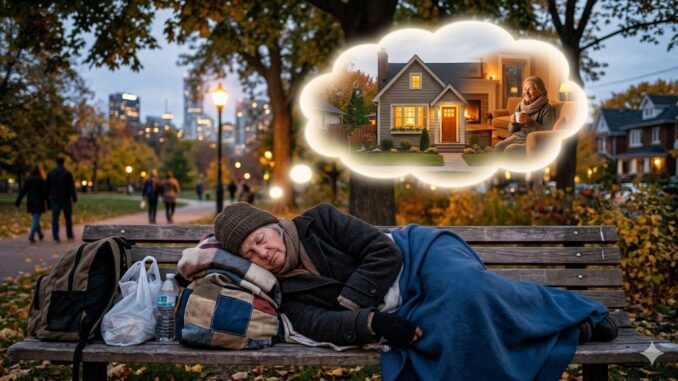
By Maria Millers
The city hums its endless song, while he builds a kingdom out of cardboard walls and yesterday’s news.
People pass like weather – some warm, some cold, most never stopping long enough to see the architecture of a life rebuilt each dawn.” Cardboard Kingdom.
One of the simple pleasures in winter is to slip into a pair of warm jammies and snuggle into bed with a good book or your favourite podcast.
But this simple pleasure during the cold months is not shared by a growing number of people.
Last year more than 105,000 Victorians sought homelessness assistance. As well as those who were rough sleeping many were living in cars or tents, couch surfing, staying in overcrowded dwellings or living in housing considered unsafe. Those who have made homes in caravan parks face uncertainty as owners, particularly those in suburban areas, look to capitalize on development possibilities.
Rough sleepers are difficult to count accurately but in some areas they are becoming increasingly visible and can face hostility from local residents. Sleeping in public parks and spaces is not just a today only problem. The Hunchback in the Park by Dylan Thomas, written after WW2 shows a lonely outcast sleeping in a park, probably in London:
A solitary mister
Propped between trees and water
From the opening of the garden lock
That lets the trees and water enterUntil the Sunday sombre bell at dark.
Eating bread from a newspaper
Drinking water from the chained cup
That the children filled with gravel
In the fountain basin where I sailed my ship
Slept at night in a dog kennel
But nobody chained him up.
Today we are living through a housing crisis with numbers most likely much higher than the official figures. As many people move frequently between temporary arrangements there is probably far more hidden homelessness
In Abraham Maslow’s hierarchy of human needs, shelter was a basic physiological need alongside air, water food and sleep. And without stable shelter, people often struggle to consistently meet higher-level needs like education, employment, relationships, mental wellbeing, or social participation.
And the right to adequate housing is recognised in international human rights law, including the United Nations Universal Declaration of Human Rights (Article 25), which says everyone has the right to an adequate standard of living including housing.
Culturally in Australia, owning your own house has been the aspiration for most: Almost a rite of passage from living at home to becoming an independent adult, to buying a house, starting and raising a family and being able to retire with dignity.
The detached suburban house became a symbol of success, but also conformity, materialism, and social anxiety but as Henri Thoreau warned back in the 1800s our houses are such unwieldy property that we are often imprisoned rather than housed in them.
The obsession with housing as real estate rather than shelter is embedded in our culture.
Buying, selling and renovating houses have been the staples of barbeque and dinner party conversations. Popular television shows whether with a real estate or renovation underpinnings always rate highly. Think of The Block and back to the long running Burke’s Backyard with its catchy signature tune:
Give me a home among the gum trees,
with lots of plum trees
A dog or two and a barbecue
flowers down the side
And veggies by the fence
all in Burke’s Backyard.
But for many today this romantic vision of owning a house is fast disappearing. Many see it as a betrayal of the promise of the Australian Dream. Others are looking to new ways of living.
Yet this is not the first time that there have been periods of housing shortages. Going back to WW1, the Depression of the 30s and post WW2 – these were all times when there were shortages in housing. But Governments were then more motivated to take an active role in solving the crises with positive intervention.
Initiatives like the Commonwealth Housing Commission and the Commonwealth State Housing Agreement funded massive public constructions. Large areas of land for suburbs were opened up and construction of prefabricated and standardized housing was employed. Not McMansions, but homes that provided shelter to many with the shortage resolved by the 1960s.
The suburb of Doveton was established in the 1950s by the State Housing Commission to provide housing for the employees of what used to be known as The Big Three industrial companies: International Harvester, HJ Heinz and General Motors Holden. Two thousand houses at a cost of 7 million pounds (£7M).
Many like Richard Glover – who grew up in one of these houses – have fond memories of living there. He has gone on to become an academic, a speechwriter of note and author of books on politics, as well as novels.
Today there is a shortage of affordable dwellings available for sale or rental. The post WW2 boom in building new homes and social housing has petered out. Back then it was within the reach of most to have a modest home on one permanent full time wage. Today many are in uncertain employment with a looming threat of the impact of AI.
House prices have increased faster than wages and so have the costs of education, insurance, utilities, healthcare, groceries and because most women have to work, also childcare,
This has led to increasing concerns about accessibility to house ownership, particularly for younger generations and low-income families, creating a sense of urgency and debate surrounding housing policy which we can see being played out today.
The notion of owning a house as a home to provide a safe haven for the family began to change as politicians encouraged buying a house as an investment. For many Australians, owning a house is now one of the primary means of wealth accumulation. Real estate is viewed as a stable investment, providing both financial security and a potential source of income through capital gains.
And various government have encouraged home ownership with schemes such as the First Home Owner Grant and various tax incentives, the latest being now debated in Parliament
And yet we have one of the he highest house debts out of developing countries.
A new social divide is being created with young people central to the ongoing debate on the Budget initiatives. They often lack the support systems and financial resources needed to secure stable housing or don’t have the back-up from the Bank of Mum and Dad.
People with Mental Health and disability challenges also face barriers to accessing stable housing, often resulting in higher rates of homelessness.
Women now make up almost 60% of homelessness in Victoria. Domestic violence remains the leading cause but it can also be a late in life marriage break up, inadequate super and the road from suburban respectability to sleeping in a car to rough sleeping can be very short and bumpy.
It is no surprise that Indigenous Australians are disproportionately affected by homelessness. As are those from culturally and linguistically diverse backgrounds, particularly refugees who may lack resources and social networks,
The Australian Dream has become a nightmare for a growing number of Australians. And it’s not just about owning a house but also about finding affordable rentals.
Unlike other countries we do not have a culture of renting and investment in social housing whether it be public housing owned and managed by state governments, or community housing managed by not for profit organizations is slow.
However, a growing number of younger Australians, especially millennials and Generation Z, are more likely to rent due to financial constraints and shifting priorities. Many in these generations prioritize flexibility, lifestyle choices, and job mobility over traditional home ownership. Renting is sometimes viewed as a lifestyle choice that allows for greater freedom and adaptability.
Bruce Dawe: homo suburbensis
One constant in a world of variables
A man alone in the evening in his patch of vegetables,
and all the things he takes down with him thereWhere the easement runs along the back fence and the air
smells of tomato-vines, and the hoarse rasping tendrils
of pumpkin flourish clumsy whips and their foliage sprawls
Maybe that suburban life so portrayed by shows like Burke’s Backyard and in Bruce Dawe’s homo suberbensis has lost its appeal. Or perhaps having travelled overseas and seen the many countries that do not have the same obsession with house ownership as does Australia.
Renting in most European cities is not seen as a stop gap measure or a social marker but accepted as a normal option.
The difference is that tenants’ rights are protected and governments often are involved. Tenants can live their whole lives in an apartment and are free to renovate, have pets etc. And no stigma is attached to renting
For many young people this is a more attractive option; in fact, a more environmentally considered one, limiting urban sprawl and the use of resources needed for new builds.
Governments are slowly recognizing the legitimacy of renting but still have to navigate the resistance of those who can’t let go of the emotional hold of house ownership or those who have been conditioned to view it only in terms of wealth accumulation.
Those advocating for affordable housing and against homelessness, have articulated a philosophical stance that frames housing as a human right. Organizations like Shelter Australia focus on policy advocacy and raising awareness about housing inequalities. There has also been a growing movement towards sustainable housing: smaller houses with energy efficient design, sensitive densification.
Media representation and cultural narratives are slowly beginning to celebrate diverse housing arrangements and lifestyles, recognizing renting as a legitimate and sometimes preferred choice.
It’s important that we have conversations at all levels from the barbeque to boardrooms to governments about the possibilities of change in the way we view housing and the possibilities open to achieve a better way.
Buddhist meditation teacher, Phillip Moffitt said: “A house is a home when it shelters the body and comforts the soul.” And it doesn’t have to have five toilets, butler’s pantry, cinema room. It can be an environmentally sound small dwelling or apartment and can be either rented or owned.
Also by Maria Millers:
A house is more than a home… if you’re lucky enough to have one
As a community we must help our youth make the right choices for life
“I’ll be right after a good night’s sleep… if I ever get one”
Keep Independent Journalism Alive – Support The AIMN
Dear Reader,
Since 2013, The Australian Independent Media Network has been a fearless voice for truth, giving public interest journalists a platform to hold power to account. From expert analysis on national and global events to uncovering issues that matter to you, we’re here because of your support.
Running an independent site isn’t cheap, and rising costs mean we need you now more than ever. Your donation – big or small – keeps our servers humming, our writers digging, and our stories free for all.
Join our community of truth-seekers. Please consider donating now via:
PayPal or credit card – just click on the Donate button below
Direct bank transfer: BSB: 062500; A/c no: 10495969

We’ve also set up a GoFundMe as a dedicated reserve fund to help secure the future of our site.
Your support will go directly toward covering essential costs like web hosting renewals and helping us bring new features to life. Every contribution, no matter the size, helps us keep improving and growing.

Thank you for standing with us – we truly couldn’t do this without you.
With gratitude, The AIMN Team
The Gold Coast City Council, I think it is, has rangers stealing the tents of the homeless, with all their belongings, and throwing them away at the tip, then the council threatens the homeless with jail if they don’t find a home.
That apparently is the solution to homelessness in Australia.
Councils have limited revenues, where is evidence of any national framework dealing with homelessness.
What was in this federal budget for the homeless? nothing I could find.
… Thommo… to be fair, that’s the Gold Coast approach, and I understand there’s no golf course coming to justify the exorbitant price of real estate… must be true, I read it in the news…
There is no national framework for homelessness, that’s a can of worms no one wants to open. After all, that’s a state issue, then you get that whole native title malarkey thrown in, and all it ends up being is a feast for anyone with a law firm on retainer…
Pardon my cynicism…
The simple fact of the matter is that everyone is missing the point….
“Australia’s housing crisis reflects not just a shortage of homes but the structural limits of a system that relies overwhelmingly on private developers and speculative market incentives to deliver essential social infrastructure.”
As I keep posting, get rid of Negative Gearing, no grandfathering clauses at all, Christ they had 30 years of ripping off the public with gargantuan greed.
When your snouts in the trough, it’s not ignorance, it deliberate!
https://pearlsandirritations.com/post/2026/05/australia-keeps-feeding-a-housing-system-that-cannot-deliver/