Annual budgets are consistently subject to criticism, particularly regarding contentious tax policy issues. In 2026-2027, debate focused on the government’s commitment to reform negative gearing – a policy permitting property investors to deduct rental property losses from taxable income – and to introduce a capital gains tax on specific assets. The capital gains tax applies to profits realised from the sale of investments, taxing only the increase in value at the point of sale.
In response to these concerns, Mr Chalmers asserted that breaking a promise to voters may be justified if undertaken for “right and justifiable reasons.” Public opinion on this issue remains divided. Proponents argue that breaking promises can be necessary to adapt to evolving circumstances, address unforeseen challenges, and prioritise the broader public interest.
Building on this discussion, shifting economic conditions or increased housing-market pressures may warrant reconsideration of prior commitments. Conversely, critics argue that breaking promises undermines trust in government, diminishes public confidence, and establishes problematic precedents for accountability. Weighing these perspectives demonstrates that decisions to alter policy direction are complex and require careful evaluation of both ethical and practical consequences.
“It would have been easy but wrong to see the way the housing market is developing, to see the way the pressures on young people are intensifying and to leave some of these structures unattended to.” (Jim Chalmers).
Meanwhile, the Opposition rejected these justifications and condemned Labor for breaking promises made during the past two elections. Such actions may have significant consequences, as broken promises can erode public trust in government and intensify political cynicism. Furthermore, a perceived lack of integrity or follow-through may influence voter behaviour and potentially affect election outcomes, underscoring the relevance of this issue for political leaders and analysts.
Against this political backdrop, the National Herald editorial discusses issues with the Liberals’ stance on tax arrangements.
Shadow Treasurer Tim Wilson has accused the Albanese government of “deceit and betrayal” regarding Labor’s anticipated reforms in the forthcoming federal budget. These reforms address negative gearing, capital gains tax concessions, and discretionary trusts, which are financial structures commonly utilised for investment and tax management.
Yet, for millions of ordinary Australians struggling through a housing crisis and increasing living expenses, the greater betrayal, as some see it, has been decades of political protection for a tax system increasingly tilted toward the wealthy. For example, first-home buyers often find themselves competing with investors who can claim tax deductions on losses from negatively geared properties, pushing property prices further out of reach for those trying to enter the market.
Renters, too, have felt the impact; as property prices rise, landlords may raise rents, making it harder for low- and middle-income families to afford stable housing.
Many young Australians who do not already own a home feel locked out, facing tighter household budgets and fewer opportunities to build wealth than those who benefit from existing tax arrangements.
Wilson’s remarks indicate support for maintaining current tax policies. Critics argue that these policies disproportionately benefit property investors, asset holders, and higher-income individuals, while making it more difficult for others to access the housing market.
The Coalition asserts that these measures are intended to support aspiration. However, some experts contend that they have contributed to increased investment activity, elevated property prices, and widening disparities between asset owners and non-owners.
Negative gearing is estimated to result in significant tax expenditures annually and to be associated with increased investor demand for existing properties. Some say that if it continues, it will eventually cost as much as the pension.
The capital gains tax discount allows individuals to reduce tax on profits from selling investments. Discretionary trust arrangements allow income to be distributed to beneficiaries, providing tax benefits predominantly to those with substantial investment portfolios.
Simultaneously, working Australians are informed that the nation cannot afford enhanced public services, increased housing investment, or substantial cost-of-living relief.
According to some analyses, these concessions significantly reduce federal revenue each year, diverting resources that could otherwise be allocated to housing supply, healthcare, education, and infrastructure.
Wilson’s remarks regarding support for “self-starters” illustrate the ongoing debate within the Liberal Party. Analysts observe divergent perspectives within the party concerning economic opportunity and wealth distribution. Read the full story here.
In this context, the accusation of a “broken promise” has been raised, though there is debate about its significance as an allegation of dishonesty. According to the Parliamentary Budget Office, Labor has previously proposed policies such as removing negative gearing and halving the capital gains tax discount in recent elections. Party representatives say policy adjustments are necessary due to changing circumstances.
Expanding on this argument, adapting policies to reflect evolving conditions may be regarded as a reasonable and responsible course of action for the government.
Should Prime Minister Anthony Albanese and Treasurer Jim Chalmers advance reforms to negative gearing, capital gains tax concessions, or family trusts, such actions are likely to provoke strong resistance from vested interests and opposition parties.
Some stakeholders interpret tax system reform as an act of responsible governance rather than a violation of public trust.
Altering policies that influence structural inequality may be perceived as more advantageous than preserving measures that benefit specific groups to the detriment of others.
However, breaking political promises is not without precedent.
For example, the “L-A-W” tax cuts broken promise refers to the 1993 federal election when Prime Minister Paul Keating legislated personal income tax cuts, famously telling voters, “They are not a promise, they are law.” Following the election, Keating reneged on the second round of these tax cuts, citing changing fiscal conditions.
Former Australian Prime Minister Julia Gillard’s legacy is heavily defined by a few high-profile backflips. These broken pledges were heavily leveraged by her political opponents to challenge her trustworthiness, particularly the “no carbon tax” promise, which has been widely analysed by commentators. Historic context for these events is available in resources such as the National Library of Australia, as the immediate political fallout is documented in retrospectives.
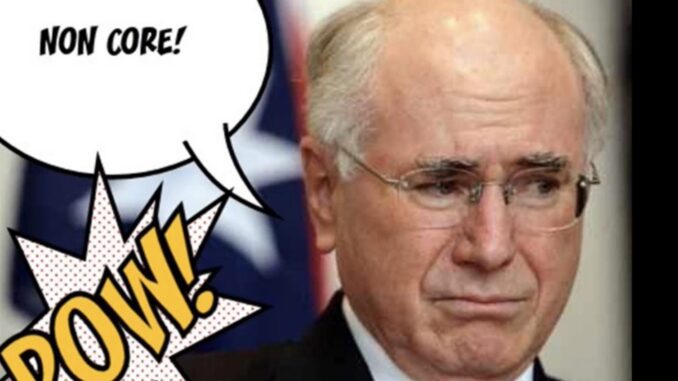
If there is one word that will be tied inexorably to the Howard government in historical memory, that word is “non-core”. Indeed, the word is so closely associated with Howard that it’s surprising to recall that he never uttered it. Rather, having ditched a large number of inconvenient promises after the 1996 election, Howard proudly announced that he had implemented all his core promises. The implication that the broken promises were non-core was left to the electors.
This quote highlights a defining moment in Australian political history when Prime Minister John Howard introduced the controversial distinction between “core” and “non-core” promises after winning the 1996 federal election.
The process by which Howard came to this point is instructive. In 1975, the Whitlam government had come to grief by sticking rigidly to its platform commitments even when market shocks rendered a change of course vital. Subsequent governments, starting with that of Malcolm Fraser, learned the lesson too well, becoming increasingly willing to promise whatever was required to win an election, then renege when the election was over.
This has been a cruel hoax for health consumers in my electorate of Grayndler in the same way the Howard Government has broken its promises on interest rates and on sending more troops to Iraq.”
Anthony Albanese said in 2005 that:
“John Howard and Peter Costello will say anything and do anything to get elected. Now, after the election, Australian families have been told by John Howard they will be forced to pay more for their health care.”
A review of public records and media coverage reveals numerous instances of broken political promises. The discourse surrounding such promises in Australia is significant, as a breach of one commitment may further erode trust. While honesty and accountability are fundamental to democracy, it is important to consider the consequences when political outrage distracts from addressing the structural challenges that impact daily life.
Issues such as housing stress, insecure employment, rising living costs, healthcare pressures, and increasing inequality cannot be resolved solely through political discourse or media attention.
Nevertheless, Australia possesses the resources, expertise, and monetary sovereignty necessary to construct a more secure and equitable society. The central challenge is whether citizens can redirect public debate from transient distractions toward enduring national priorities.
If public attention remains primarily fixed on political disputes, fundamental societal issues may remain inadequately addressed over time.
My thought for the Day
It is better to be comforted with the truth than be controlled by lies.
Author’s Note: AI has been used in this article to gather facts only.
Keep Independent Journalism Alive – Support The AIMN
Dear Reader,
Since 2013, The Australian Independent Media Network has been a fearless voice for truth, giving public interest journalists a platform to hold power to account. From expert analysis on national and global events to uncovering issues that matter to you, we’re here because of your support.
Running an independent site isn’t cheap, and rising costs mean we need you now more than ever. Your donation – big or small – keeps our servers humming, our writers digging, and our stories free for all.
Join our community of truth-seekers. Please consider donating now via:
PayPal or credit card – just click on the Donate button below
Direct bank transfer: BSB: 062500; A/c no: 10495969

We’ve also set up a GoFundMe as a dedicated reserve fund to help secure the future of our site.
Your support will go directly toward covering essential costs like web hosting renewals and helping us bring new features to life. Every contribution, no matter the size, helps us keep improving and growing.

Thank you for standing with us – we truly couldn’t do this without you.
With gratitude, The AIMN Team

It is obvious the right wing media have taken this ball and run with it.
Here in WA, the media controlled by our mining zillionaires has been relentless in their attack of the budget.
We are a wealthy society that has let the financial savvy rise to the top with little regard toward the less fortunate.
Thank you for independent media.
Even Peta Credlin – the person who most vociferously pushed the carbon tax line – has admitted that it wasn’t a tax and Gillard never broke that promise.
You want broken promises? How about LJH saying he wouldn’t make cuts to the ABC and then gutting it? Just for starters, because that shitstain broke more promises than he kept.
I missed a few leefe otherwise l would have gone on forever.
I can quote a number of other items in our taxation that badly need changing. For instance that no one over 60 whose receives income from a superannuation fund in its pension stage has to pay tax on that income. I am one who benefits from that ruling but consider it is wrong, wrong and wrong again. Re broken promises re changing taxation on negative gearing and CGT to me they were answers to gotya questions from the media.
This is so difficult, we can see what has happened in the USA. And that is not going too well either. As the rich feeding frenzy continues. And corruption running rampant. And the so called party of change adopts the slowly slowly tactic. Dont scare the horses. Far out they are already stampeding anywhere they can to find for answers. And so true One Nation is not the answer, as in the USA MAGA is not the answer. The power of our corporate barons of the 4th estate are wilfully blinding the majority of people. Where do we go from here, I just dont know. Seems like a big ask for such huge changes without things like a revolution. France did it in the 1700s. Could it happen again….????
Fitting image, of someone who has been disappeared by the RW MSM with his long term influence over the Liberal Party and coalition for Atlas Koch, Tanton and Murdoch agitprop, catering to a heaving mass of middle aged & older skips.
They may dominate regions with now RW MSM & ON guidance (or delivery system?), the past and present, but not the future, while Howard’s urban Liberal Party implodes……
If the body politic in general want to talk about broken promises, then its high time that each and every one puts their hands up in terms of the damage that they are doing to the social contract, environment and climate!
The innocuous practise of recycling general waste and bottles is for want of a better word, rubbish!
The belief that the upper strata of society bear the responsibility for taxes is wrong footed when any person with an enquiring mind can see it’s the lowest strata of society that pays the highest taxes for everyone and everything. Not every wealthy person is that parsimonious, they actually pay their fair share, they are just few and far between.
We regularly consume a variety of fast foods, which many agreed to for higher income and negative gearing benefits at others expense, an assortment of acidic beverages, continue with questionable lifestyle choices, refuse to desist with fossil fuels that harm the environment and causes disease and degradation to the air, water and soil, continue to use pesticides in agriculture, aquaculture and livestock practices and we wonder why we are faced with such destruction?
All enabled by Liberal governments own ‘deceit and betrayal’ for profit whilst you have poisoned water and air and interfered with job security, community environments between city and regional and natural weather cycles.
Economist Saul Eslake, who in my opinion is impartial and non-partisan, has said of the Budget Tax changes:
“The tax reforms announced in last week’s federal budget aren’t perfect. And they are nowhere near as comprehensive as the reforms introduced by John Howard and Peter Costello in 2000, or by Bob Hawke and Paul Keating in the mid-1980s. But they represent material improvements to the tax system which we now have: and for that reason are to be welcomed.”
I agree with his analysis :https://www.theguardian.com/australia-news/commentisfree/2026/may/19/death-tax-startups-and-a-rent-spike-its-time-to-correct-misleading-claims-about-labors-budget
heather, re. your comments on usage – fossil fuels, pesticides etc. in agrarian practices – it’s the devil’s bargain, to be sure. Yes, the costs are significant per environmental harm and they’re not diminishing. Incremental changes have occurred, for example in the cotton industry less water is currently used than formerly, fewer pesticides than in the earlier years of that crop’s lifetime in Australia, smarter use of technology and so on, but the point of all of this being a devil’s bargain, whether in cropping or livestock, is that without the continued usage of herbicides, pesticides, fungicides, artificial fertilizers, along with a large suite of adjunct medicines aimed at the animal farming sector, the current rates of production could not be sustained, ergo, the amount of food into the retail sector would be insufficient to feed the nation, the amounts of grain exported would fall, same for oilseeds, sugar cane and other industrial crops and so on.
Organic farming is utopian in a modern society with a farm gate to table production line, as is permaculture. Both are best-practice but neither are suitable for large scale production. Monoculture fails in principle at many levels yet is the only system (apart from hydroponics) capable of delivering in appropriate quantity for demand satisfaction. Where it all ends is anybody’s guess. Science continues to tell us that we’re all being poisoned one way or another, whether by microplastics, organic & inorganic chemicals, air & water pollution, PFAS ‘forever chemicals,’ TV and right-wing rabid politics et alia. Make the best of what you’ve got.