In 1969, the British theatre critic Kenneth Tynan devised a nude theatrical revue that he titled after a phonetic French pun. The title was taken from a 1946 painting by the French surrealist Clovis Trouille, a portrait of a reclining nude, in which the inscription on the canvas was a pun: quel cul t’as! An admiring exclamation on the woman’s backside.
The title plays on the French phrase O quel cul t’as, what an arse you have.
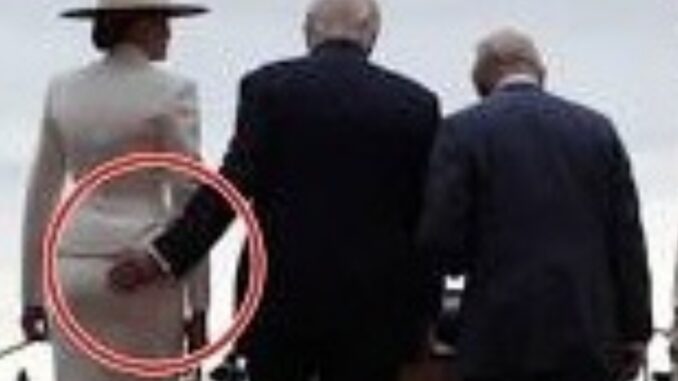
Kenneth Tynan would have enjoyed April 28, 2026. He would have recognised it immediately for what it was: a man, in full view of a king and queen and the assembled press of the civilised world, patting his wife on the backside on the South Lawn of the White House.
O quel cul t’as, Donald. What a moment to have chosen.
A body language expert called it a gesture of appreciation and pride. Which it was, in the same way that a man placing his hand on the bonnet of a Bentley he has just acquired expresses appreciation and pride. You are appreciating what you own. You are proud of owning it. The sentiment is entirely genuine. Its object is the problem.
Trump was performing, as he always performs, for the largest available audience. The King of England was watching. Cameras were rolling. The diplomatic machinery of the Atlantic alliance was in full ceremonial flight. And in the middle of all of it, the forty-seventh president of the United States reached across to his wife and said, in the universal language of the proprietary gesture: she is mine.
Look.
This is not incidental to the politics. It is the politics.
What we are watching in the Trump administration is not merely a policy agenda. It is the restoration of a social order. The gender pay gap is widening, not narrowing. Reproductive rights have been dismantled state by state. Women in the public sphere are subjected to a quality of abuse and diminishment that would have been remarkable even a decade ago.
And at the apex of this restored order stands the First Couple: the dominant man and the decorative wife, publicly positioned, publicly patted, publicly owned.
The 1950s did not simply return. They were re-installed with the industrial-strength pretence that this was the new women’s liberation. Project 2025, the Heritage Foundation’s blueprint for the administration, mandates heterosexual marriage and parenthood, proposes camps to prepare couples for marriage, and explicitly criticises finding fulfilment through career and public life, suggesting that prioritising family life is in tension with obtaining professional credentials and higher education. This is not the language of nostalgia. It is the language of policy. And it arrived wearing a frock.
Embedded in the framework of Project 2025 is a vision of social overhaul that centres the kind of gender roles that tradwives have been promoting all along, a definition of family rooted in Christian fundamentalism, a sentiment tacitly echoed by most tradwife content, which shows women embracing their supposed god-given role as home-maker and child-rearer above all else.
The tradwife. The word alone is a masterpiece of rebranding. Submission dressed as choice. Domesticity dressed as feminism. The apron as a statement of liberation.
Critics warn that beneath the delicate fabrics of the tradwife aesthetic lies a more complicated narrative, one where submission is recast as empowerment, and deeply conservative ideals are glamorised under a glossy guise. The fashionistas, naturally, have made a mint out of it. Google searches for “trad wife” rose steadily throughout 2023 and 2024, spiking to an all-time high in late July 2024, following a pattern almost identical to searches for “old money fashion”, both trending simultaneously, both evoking a past in which women knew their place and the place was decorative. Brands capitalised immediately, offering collections that blend vintage charm with contemporary comfort: full skirts, Peter Pan collars, delicate prints, frilly blouses and tea-length dresses marketed as sartorial echoes of restraint and elegance. The bullet bra made its comeback. The 1950s silhouette returned, rebranded as confidence.
As one observer put it, the tradwife is the latest variation on women who achieve fame and fortune by telling other women to stay at home. The irony is exquisite and entirely deliberate. The most visible tradwives are not staying at home. They are building brands, signing sponsorship deals, monetising their domesticity on platforms owned by the very attention economy they claim to have escaped.
Hannah Neeleman, known as Ballerina Farm, has captivated over ten million followers with content spanning home births, milking cows, and baking from scratch, yet publicly distances herself from the tradwife label. She has ten million reasons to.
What Trump’s pat on the backside represents is not merely one man’s reflex. It is the gestural summary of a movement with a nine-hundred-page policy document, a fashion industry, a social media ecosystem, and the full apparatus of the federal government behind it. The hand on the derriere. The floral dress. The Heritage Foundation blueprint. Different registers, identical politics.
But here is where it becomes genuinely interesting, and genuinely revealing. Because the gesture does not demonstrate power. It demonstrates its opposite.
Trump expert and journalist Michael Wolff, the author of four books on the phenomenon, has said plainly that the Trumps are effectively separated, that they live separate lives and do not in any way inhabit a marriage as we define marriage. Their separate bedrooms at the White House were accidentally confirmed by the 2026 “Melania” documentary. During the state visit to Windsor Castle in September 2025, palace insiders confirmed that they slept in separate suites, with their own bed linen shipped in from the United States. A courtier noted with English understatement that had Melania requested a water bed, she could have effortlessly drifted apart from Donald. Windsor Castle has more than a thousand rooms. They required two.
The man who pats his wife in front of a king does not do so from a position of settled marital confidence. He does it because the marriage is a performance and the pat is a line of dialogue. Without the performance, there is no marriage, only an arrangement, managed by two people who have calculated, independently and exactly, what they require from each other and what they do not.
Melania’s calculation is not difficult to read. She makes select public appearances: the Kennedy Center Honours, Fort Bragg, the Easter Egg Roll, the New York Stock Exchange. She arrives. She wears the clothes, always extraordinary clothes, chosen with the eye of a woman who has made her appearance her instrument. She occupies the frame. She endures the hand on the back, the hand on the waistline, occasionally the hand lower still. And she departs, into her “I-don’t-really-care” own vast personal indifference, back to New York or Palm Beach or whichever address is not his.
She is not powerless. She is contracted.
There is one occasion, however, when Melania’s calculation produced something beyond mere endurance. In June 2018, she boarded a plane to visit a migrant children’s detention centre on the Texas border, where fifty-five children separated from their parents under her husband’s immigration policy were being held. She wore a green Zara jacket, thirty-nine dollars from the fast-fashion rack, with the words “I really don’t care, do u?” printed in white graffiti lettering across the back. The same woman who had worn a fifty-one-thousand-dollar Dolce and Gabbana coat to Sicily the previous year chose Zara for the migrant children.
The White House spokeswoman insisted it was just a jacket. There was no hidden message. Trump himself then tweeted that the message referred to the fake news media, that Melania had learned how dishonest they were and truly no longer cared. In her 2024 memoir, Melania confirmed the jacket was aimed at the media rather than the children, that she wanted to show critics their commentary would never deter her from doing what she believed was right. Three explanations. None of them compatible. All of them, in their way, revealing.
What the jacket actually said, to anyone willing to read it plainly, was this: do not look to me for the compassion this moment requires. Do not expect this marriage, this administration, this performance of power and family and devoted wifehood to have anything behind it but arrangement. She wore it on the way there and she wore it on the way back. She changed into a pale yellow jacket for the visit itself, for the cameras inside the detention centre, for the children whose faces would appear in photographs. Then she put the green jacket back on. The artifice was not incidental. It was the whole point. Trump pats her on the backside to show the world he owns her. She wears the jacket to show the world she is not there. Between the pat and the jacket lies the entire truth of this marriage, and of the politics it serves.
Now consider the other couple on that South Lawn. King Charles III and Queen Camilla, who arrived to reinforce what their presence was designed to reinforce: that the bond between Britain and America is stronger than the political turmoil of the moment. Charles, natty and gracious, the custodian of an institution built on performance far older and more elaborately maintained than anything Trump has managed. And beside him, Camilla, a woman whose face has launched a thousand snips, the resurgent industry of cosmetic revision having found in her a subject of particular professional interest.
Here is what the photograph of Trump and Melania inadvertently reveals about Charles and Camilla: they are the same arrangement in a different costume. A marriage conducted substantially in public, for institutional purposes, by two people who came to it late and under circumstances that required, and continue to require, careful management of the optics. Charles places his hand on Camilla’s back too. He guides her through doors. He performs the attentive husband with the slightly strained enthusiasm of a man who knows the cameras are always present and that his mother spent seventy years teaching the world what a royal marriage is supposed to look like.
The difference is that Charles’s marriage replaced a fairytale with a reality, while Trump’s marriage replaced a reality with a fairytale. Charles and Diana was the performance. Charles and Camilla is, by all accounts, the actual relationship, conducted in matching wellies and shared silences and the genuine companionship of two people who chose each other at cost. Trump and Melania, by contrast, began as a transaction and remain one.
What the two couples share, standing on that South Lawn, is the performance itself. The hand on the back. The managed adjacency. The public enactment of conjugal unity in the service of a larger institutional fiction, whether that fiction is the monarchy or the presidency or the idea that the most powerful man in the room is also a devoted husband.
Tynan’s great contribution was to strip the performance bare. To insist that what people did in private was worth examining in public, that the body and its gestures carried political meaning, that the hand on the back and the hand lower still were never merely personal.
He was right in 1969. He is right in 2026.
O quel cul t’as, Donald. Kenneth Tynan sees you.
Keep Independent Journalism Alive – Support The AIMN
Dear Reader,
Since 2013, The Australian Independent Media Network has been a fearless voice for truth, giving public interest journalists a platform to hold power to account. From expert analysis on national and global events to uncovering issues that matter to you, we’re here because of your support.
Running an independent site isn’t cheap, and rising costs mean we need you now more than ever. Your donation – big or small – keeps our servers humming, our writers digging, and our stories free for all.
Join our community of truth-seekers. Please consider donating now via:
PayPal or credit card – just click on the Donate button below
Direct bank transfer: BSB: 062500; A/c no: 10495969

We’ve also set up a GoFundMe as a dedicated reserve fund to help secure the future of our site. Your support will go directly toward covering essential costs like web hosting renewals and helping us bring new features to life. Every contribution, no matter the size, helps us keep improving and growing.

Thank you for standing with us – we truly couldn’t do this without you.
With gratitude, The AIMN Team

Malaria will be looking forward to a huge payday when the orange anus carks it,with the added bonus of not having to put up with his feeble pinkies going for a sneaky feel.
Drumming the wife’s date in public.., Dogshit Trump, the vile vomity vain vacant vicious vandal of morals, ethics, decencies, lawfulness, attitude.
Not only does he not control his choice of words, he cannot control his wandering hands. And we can only surmise to what depths his misogynous mind is descending.
Oh America. What did you do that for?
In your elected president #47, “o quel cul t’as”
May he soon be given the LXXXVIing that he so richly deserves.