By Denis Hay
Description
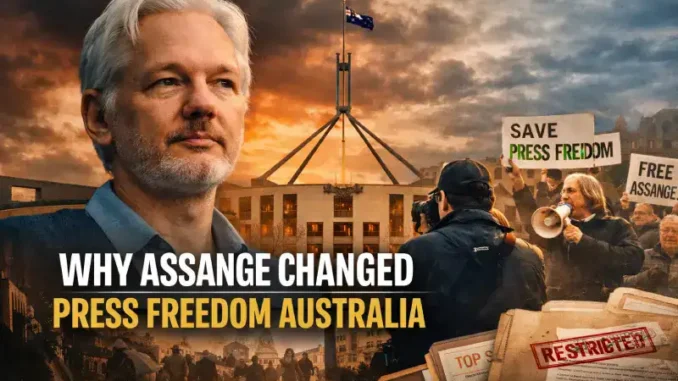
Julian Assange changed press freedom in Australia and has reshaped journalism, secrecy laws, and accountability. What this means for Australians today
Introduction
Julian Assange press freedom in Australia has become one of the most important issues shaping modern democracy. His case has reshaped how governments, journalists, and citizens understand the limits of publishing classified information. It raises a clear question: can reporting in the public interest still be protected when secrecy laws continue to expand?
Julian Assange and press freedom in Australia are now central to debates about accountability, transparency, and the role of media in a democratic society. This article explains how his case has influenced Australian laws, why whistleblowers face increasing risks, and what this means for everyday Australians. It focuses on the broader implications rather than the legal details of his prosecution, offering a clear view of where Australia stands and what can be done next.
The Problem – Press Freedom Under Pressure
1. Expanding Secrecy Laws
The prosecution of Julian Assange under the Espionage Act signalled a shift in how governments treat publication of classified information. Traditionally, journalism that exposed wrongdoing was treated as part of democratic accountability. That line is now less clear.
Australia has followed a similar path through national security legislation that broadens what can be classified and who can be prosecuted. This affects press freedom in Australia by increasing legal risk for journalists who report on defence, intelligence, and foreign policy.
2. Whistleblowers Facing Prosecution
The cases of David McBride and Richard Boyle show how individuals exposing wrongdoing can face criminal charges.
These cases show that whistleblower laws in Australia remain limited in practice. While protections exist on paper, they often fail when disclosures involve national security or government misconduct.
Internal link example: https://socialjusticeaustralia.com.au/social-justice-in-australia-start-here/
The Impact – What Australians Are Experiencing
3. Reduced Transparency in Public Decisions
As secrecy increases, Australians receive less information about how major decisions are made, including defence spending, foreign policy commitments, and regulatory actions.
This affects everyday life more than it appears. When decisions involving billions in public money are shielded from scrutiny, it becomes harder for citizens to evaluate whether those decisions serve the public interest.
Internal link example: https://socialjusticeaustralia.com.au/
4. Who Benefits from Reduced Scrutiny
Reduced transparency benefits those with decision-making power. Governments face less pressure, large contractors operate with fewer questions, and policy outcomes are less contested.
This is not the result of cultural decline. It reflects structural incentives where secrecy reduces accountability and protects existing power arrangements.
The Solution – Reclaiming Press Freedom
5. Strengthening Legal Protections
Reform must focus on ensuring that whistleblower laws in Australia function in practice, not just in theory. This includes:
• Clear legal protection for public interest disclosures
• Independent oversight of classification decisions
• Limits on prosecuting journalists for publication
These reforms build on existing institutions rather than requiring entirely new systems.
6. Supporting Independent Journalism
Australia already has the capacity to support stronger public interest journalism through:
• public broadcasting institutions
• grants for investigative reporting
• legal defence support for journalists
These are practical measures that can be implemented using existing frameworks.
Where Australia Stands
Australia is a mixed performer. The country has strong institutions, skilled journalists, and established media organisations. However, execution falls short where secrecy laws and enforcement practices limit transparency.
The gap is not due to a lack of capability. It is the result of policy choices that prioritise control of information over public accountability.
What This Makes Possible
If reforms are implemented, Australians would see:
• greater transparency in major policy decisions
• improved trust in institutions
• stronger protection for those who expose wrongdoing
• more informed public debate
These outcomes strengthen democratic confidence and reduce the distance between citizens and decision-makers.
Lived Experience Translation
For an ordinary Australian, the difference would be clear. Instead of hearing about major decisions only after they are finalised, there would be earlier access to information in the process. Concerns could be raised before outcomes are locked in. Trust in institutions would feel grounded in visibility, not assumption.
Proof of Feasibility
Australia already has key elements needed for reform:
• existing whistleblower legislation
• independent courts and oversight bodies
• public broadcasters capable of investigative work
Countries such as Norway and Canada have implemented stronger protections for public-interest disclosures, demonstrating that reform is achievable within comparable systems.
External sources:
- https://www.amnesty.org/en/latest/news/2024/06/julian-assange-release/
- https://www.humanrights.gov.au/our-work/rights-and-freedoms/whistleblowers
- https://www.theguardian.com/media/press-freedom
Frequently Asked Questions
Is Julian Assange a journalist or activist?
He is often described as both. The key issue is whether publishing leaked information in the public interest should be treated as journalism.
Are whistleblowers protected in Australia?
Protections exist but are limited in practice, especially in national security cases.
Why does press freedom matter?
It allows citizens to understand how decisions are made and hold institutions accountable.
Conclusion
Julian Assange’s press freedom in Australia is not just about one individual. It stands for a broader shift in how information, accountability, and power interact within modern democracies.
The direction Australia takes from here will decide whether transparency strengthens or continues to narrow. The tools for improvement already exist. What matters is how they are used.
Call to Action
If this article helped you better understand how Australia really works, do not leave it here. Please share it with others who are asking the same questions.
Your voice matters. Your experience matters. And your participation matters.
➡ Share this article with family, friends, and your community
➡ Leave a comment below and join the discussion
➡ Visit the Reader Feedback page and share your view
➡ Share a testimonial if our content has helped you think differently
➡ Connect with us on TikTok, LinkedIn and X
Discuss this article in our Facebook group, where Australians share perspectives and ask questions in a calm, respectful space.
A more informed Australia begins with people willing to discuss the issues that shape our future. You can help lead that change.
Support independent journalism
Operating this site costs approximately $2,000 per year, and reader donations have covered $807 so far. Every contribution helps keep this work online, accessible, and independent.
If you find value in these articles, please consider supporting the site. Even a few dollars help keep this work going.
Donate now, one time or monthly.
Already donated? A quick Google review helps others discover the site.
This article was originally published on Social Justice Australia
Keep Independent Journalism Alive – Support The AIMN
Dear Reader,
Since 2013, The Australian Independent Media Network has been a fearless voice for truth, giving public interest journalists a platform to hold power to account. From expert analysis on national and global events to uncovering issues that matter to you, we’re here because of your support.
Running an independent site isn’t cheap, and rising costs mean we need you now more than ever. Your donation – big or small – keeps our servers humming, our writers digging, and our stories free for all.
Join our community of truth-seekers. Please consider donating now via:
PayPal or credit card – just click on the Donate button below
Direct bank transfer: BSB: 062500; A/c no: 10495969

We’ve also set up a GoFundMe as a dedicated reserve fund to help secure the future of our site.
Your support will go directly toward covering essential costs like web hosting renewals and helping us bring new features to life. Every contribution, no matter the size, helps us keep improving and growing.

Thank you for standing with us – we truly couldn’t do this without you.
With gratitude, The AIMN Team
“…..Julian Assange changed press freedom in Australia and has reshaped journalism, secrecy laws, and accountability. …”
I think that Julian actually shocked the media oligarchs and politicians into a panic mode to close off what were obvious weaknesses in their credibility. Australia, and the rest of the so-called Western World ,quickly devised legislation to tighten eligibility for FOI requests and censorship designed to shut down organised criticism of governance by concerned citizens. Over-all however Julian Assange is/was a fresh breeze that gave us some relief from the stench emanating from the narratives of the establishment.
The article asks — “Is Julian Assange a journalist or activist?”
An explanatory/complementary question would be — “Is a journalist who is not an activist merely a reporter?”
Not about whether Assange was a journalist or activist, but fact that he threw many ppl under a bus once Wikileaks became a Krmelin cut out (also noted drops similar to Epstein files, lots of low level comms BS and ‘curation’).
This included liaising with Trump campaign ppl 2016, alleged Russian asset Nigel Farage and stating objective to stymie Hilary Clinton and the Democrats to help Trump in ’16 election, well done, mission accomplished*?
*(Similar to leveraging Putin’s Ukraine invasion, his chum Netanyahu’s Gaza invasion & Netnayhu/Trump Iran War vs Democrats & the centre).
It’s in plain sight if anyone bothers to follow analysis of the Mueller Report, but not popular with the right or left?
Mediocrates:
You raise an important point. What Assange exposed did create a strong reaction from governments and media institutions, and we have seen tighter secrecy and FOI limitations since then.
At the same time, it is worth separating two things. One is the immediate political response, which often moves toward control. The other is the longer-term impact, which has been to increase public awareness about how information is managed and withheld.
In Australia, the issue now is less about one individual and more about whether our laws strike the right balance between national security and the public’s right to know. Cases like David McBride and Richard Boyle suggest that balance is still not right.
If anything, the real test is what happens next. Do we continue down a path of increasing secrecy, or do we strengthen protections for public interest journalism and whistleblowers?
That is where the conversation needs to go.
That’s a good way to frame it, Steve.
There’s a useful distinction here. A reporter can focus on relaying events as they are presented, often staying within accepted boundaries. Journalism, at its strongest, goes further. It questions, investigates, and sometimes challenges power when the public interest is at stake.
That does not automatically make a journalist an activist. The difference usually comes down to intent. Activism aims to drive a specific outcome. Journalism aims to reveal information so the public can decide.
In practice, the line can blur, especially in cases involving classified material or wrongdoing. Assange sits right in that grey area, which is why the debate continues.
The key issue is not the label, but whether publishing information in the public interest should be protected.
Andrew, you raise concerns that have been widely debated, particularly around the 2016 election and the handling of leaked material.
At the same time, it is important to separate the two issues. One is the question of Assange’s judgment, choices, or associations. Reasonable people can disagree on that. The other is the principle at stake, which is whether publishing information of public interest should be protected under law.
The Mueller Report did examine Russian interference, but it did not establish that Assange was acting as a Russian agent. That distinction matters when we are talking about legal precedent.
If we allow the publication of leaked information to be treated as espionage, it sets a standard that can apply to any journalist or publisher, regardless of political context.
So while people may differ on Assange personally, the broader issue is about protecting press freedom and ensuring that exposing wrongdoing does not become a criminal act.
That is where the long term implications sit.
Politely disagree on your interpretation, facts are in the open offshore….
David Corn, Mother Jones in ‘Denounce Julian Assange. Don’t Extradite Him. Dec ’21
…..The United States has suffered greatly because of Assange. In 2016, he collaborated with the Russian attack on the US election to help Trump win. As has been detailed by several government investigations—including in special counsel Robert Mueller’s final report and in a bipartisan report issued by the Senate Intelligence Committee last year—after Russian intelligence teams hacked Democratic targets, they passed the stolen emails and documents to WikiLeaks, which then publicly disseminated the material.’