By James Moore
(We seem to have skipped spring down here in Texas and slipped directly into the 90s. The summer is likely to be more searing than ever, but the sun is still slowly moving north of the Mason-Dixon Line to warm the Midwest and the rest of the country for baseball. This coming week is Opening Day for the big leagues, so, given how busy I’ve been of late, I thought I’d revisit and revise a piece I wrote about a Texan baseball player, who is one of the greatest to ever lace up a pair of spikes – JM).
“You spend a good piece of your life gripping a baseball and in the end it turns out that it was the other way around all the time.” (Jim Bouton, professional baseball pitcher and author of “Ball Four.”)
While the Indian paintbrush and bluebonnets still color the banks of the Colorado River through Central Texas, may I suggest you follow old Webberville Road east of Austin out where the river makes a few horseshoe twists coming down from the Hill Country and marking its water course through the black land prairie out toward the Coastal Bend. This little ride, for me, is a rite of passage when the seasons change. Make sure you look for a sign indicating the Hornsby Bend Cemetery, or stop and ask directions. Everybody who has lived there a while knows its location. Significant people in the history of Texas rest there not far from the river. One of them is, arguably, the greatest baseball player to ever put on a big league uniform.
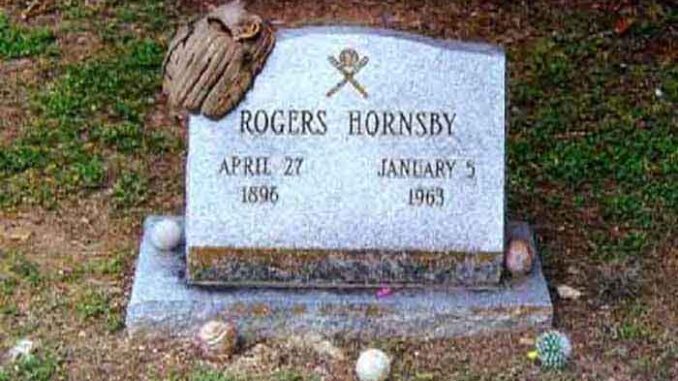
Spring is the optimal time to visit the grave of Rogers Hornsby, who still retains the highest batting average ever recorded in the big leagues. He is buried in a modest cemetery not far from the bend in the Colorado, which is named after his family. Often, an admirer will have left a perfectly useful baseball glove atop Hornsby’s grave [see main photo], and his headstone will be easy to spot.
The Hornsbys were important actors in the founding and development of Texas, though the state takes little note of their history. Rogers, whose first name was his mother’s maiden surname, rests not far from Reuben Hornsby, the family patriarch, and one of the founding Texas Rangers. Reuben had been given a grant of land in Texas by Stephen F. Austin. He was a surveyor and with his wife Sarah settled there along the river and established the first community in what later became Travis County. Hornsby, who, eventually, helped to survey Austin for the capital of the Texas Republic in 1839, also was father to the first Anglo child in the county, sat on the initial jury in Travis County, and even grew the first corn. Twelve members of Hornsby’s family became Texas Rangers and are also buried in the cemetery. And one of Reuben Hornsby’s descendants became a player many baseball experts argue is possibly the best ballplayer to pick up a bat, run out a ground ball, or make a diving catch.
Rogers Hornsby was born in Winters, Texas, a dusty spot on the Edwards Plateau, just over forty miles south of Abilene. After his father’s death when Rogers was just two years old in 1898, his mother moved the family to the Austin area, which was just a few miles up the Colorado from where his grandfather had settled Hornsby’s Bend. The family, eventually, returned to Fort Worth for work but by the time he was fifteen, Rogers was playing semi-pro. When he entered major league baseball still in his teens, he helped to launch the managerial career of Branch Rickey, the man who later made Jackie Robinson the first African American in pro baseball.
Hornsby, who said he could remember nothing about his life before he held a baseball in his hand, played in the “dead” and the beginning of the “live ball” eras. But he hit most everything, regardless of its resilience against wood. Only Ty Cobb has a higher career batting average of .367, and Oscar Charleston of the Negro Leagues, who hit for a 364 mark. Hornsby batted .358 over his career of 23 seasons and earned two Triple Crowns, batted .400 or better three times, and in 1924 hit a .424 average, which remains the highest B.A. in MLB history. He is also the only player to hit .400 and get 40 home runs in a single season.
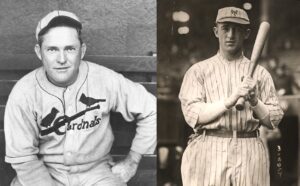
But he was not a considered much of a convivial or pleasant fellow. Teammates didn’t care for Hornsby, who never drank, smoke, or went to the movies. His belief was that the moving pictures might damage his eyesight.
“I’ve never seen a movie,” he said. “I don’t want to see one.”
Hornsby gambled on horses, though, and lost a lot of his earnings as a ballplayer, and was married three times, but lived for baseball. No less a legend than the “Splendid Splinter,” Ted Williams said Hornsby was the greatest hitter for power and average who had ever played the game, and Frankie Frisch, a player and manager in the big leagues, described Hornsby as the “only guy I know who could probably hit .350 in the dark.”
“The first day I played professional baseball,” Hornsby said, “I learned that you can’t hit the ball if you’re thinking about anything but hitting the ball.”
He won seven batting titles and one World Series, which ended when Hornsby tagged out Babe Ruth trying to steal second base. The Texan was sufficiently obsessed with baseball that when his mother died during the World Series, he had her funeral delayed until the contest had concluded.
There are ball diamonds along Webberville Road today, not far from where Rogers Hornsby rests, and there are boys and men still playing the game on them that Hornsby loved. Many of those players have no idea of the greatness that once passed through that little settlement on the Colorado River, not much more than a long throw from where they are shagging fly balls each Spring. My senior men’s team, a few years back, took our spring training on a nice private field only a few miles from where the great second baseman is buried.
I was always hopeful, as baseball will make a man, of a good season, warm weather, and a happy life every spring as I drove through Hornsby’s Bend on my way to practice and joyful hours taking infield, batting practice, and chasing fly balls. I wondered what Rogers might think of our skills after our too many decades but I am sure he would have understood our undying love of a game that connected us to our youth and the power of hope. I also frequently thought of what Rogers told a sportswriter that kept pestering him about who he was and what he did to occupy his time when the weather was cold and he wasn’t playing the game.
“People ask me what I do in winter when there’s no baseball,” he said. “I’ll tell you what I do. I stare out the window and wait for spring.”
There was a time when the game didn’t follow you everywhere, no highlights in your pocket, no endless noise. Just the waiting.
And now the waiting is over and spring has arrived. Thankfully, so has baseball.
This article was originally published on Texas to the world.

James Moore is the New York Times bestselling author of “Bush’s Brain: How Karl Rove Made George W. Bush Presidential,” three other books on Bush and former Texas Governor Rick Perry, as well as two novels, and a biography entitled, “Give Back the Light,” on a famed eye surgeon and inventor. Mr. Moore has been honored with an Emmy from the National Academy of Television Arts and Sciences for his documentary work and is a former TV news correspondent who has traveled extensively on every presidential campaign since 1976.
He has been a retained on-air political analyst for MSNBC and has appeared on Morning Edition on National Public Radio, NBC Nightly News, Last Word with Lawrence O’Donnell, CBS Evening News, CNN, Real Time with Bill Maher, and Hardball with Chris Matthews, among numerous other programs. Mr. Moore’s written political and media analyses have been published at CNN, Boston Globe, L.A. Times, Guardian of London, Sunday Independent of London, Salon, Financial Times of London, Huffington Post, and numerous other outlets. He also appeared as an expert on presidential politics in the highest-grossing documentary film of all time, Fahrenheit 911, (not related to the film’s producer Michael Moore).
His other honors include the Dartmouth College National Media Award for Economic Understanding, the Edward R. Murrow Award from the Radio Television News Directors’ Association, the Individual Broadcast Achievement Award from the Texas Headliners Foundation, and a Gold Medal for Script Writing from the Houston International Film Festival. He was frequently named best reporter in Texas by the AP, UPI, and the Houston Press Club. The film produced from his book “Bush’s Brain” premiered at The Cannes Film Festival prior to a successful 30-city theater run in the U.S.
Mr. Moore has reported on the major stories and historical events of our time, which have ranged from Iran-Contra to the Waco standoff, the Oklahoma City bombing, the border immigration crisis, and other headlining events. His journalism has put him in Cuba, Central America, Mexico, Australia, Canada, the UK, and most of Europe, interviewing figures as diverse as Fidel Castro and Willie Nelson. He has been writing about Texas politics, culture, and history since 1975, and continues with political opinion pieces for CNN and regularly at his Substack newsletter: “Texas to the World.”
Keep Independent Journalism Alive – Support The AIMN
Dear Reader,
Since 2013, The Australian Independent Media Network has been a fearless voice for truth, giving public interest journalists a platform to hold power to account. From expert analysis on national and global events to uncovering issues that matter to you, we’re here because of your support.
Running an independent site isn’t cheap, and rising costs mean we need you now more than ever. Your donation – big or small – keeps our servers humming, our writers digging, and our stories free for all.
Join our community of truth-seekers. Please consider donating now via:
PayPal or credit card – just click on the Donate button below
Direct bank transfer: BSB: 062500; A/c no: 10495969

We’ve also set up a GoFundMe as a dedicated reserve fund to help secure the future of our site.
Your support will go directly toward covering essential costs like web hosting renewals and helping us bring new features to life. Every contribution, no matter the size, helps us keep improving and growing.

Thank you for standing with us – we truly couldn’t do this without you.
With gratitude, The AIMN Team
Be the first to comment