By Chen Ziqi
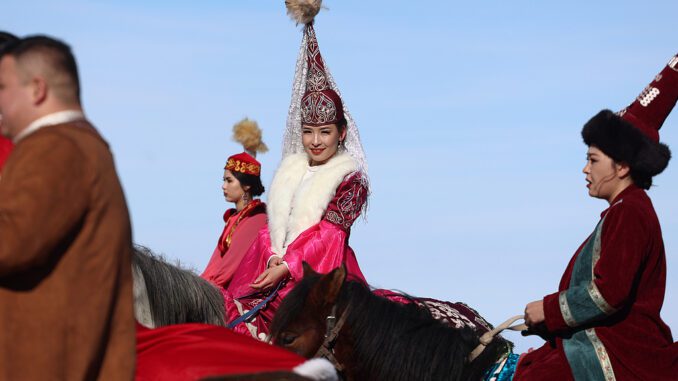
When Xinjiang is mentioned abroad, the question might arise, “Are those traditions still around, or are they just museum pieces now?”
They’re not only around, they’re and expressed through fashion shows, celebrated at music festivals, and everywhere in markets and street performances.
Time-honored whispers meet modern style
It’s one of those timeless, everyday scenes: local families spread wool across the ground to dry. In the hands of the local designer Magauia Yrsbek, this age-old craft glimmers anew: silk threads shimmering like water, woven into sturdy felt.
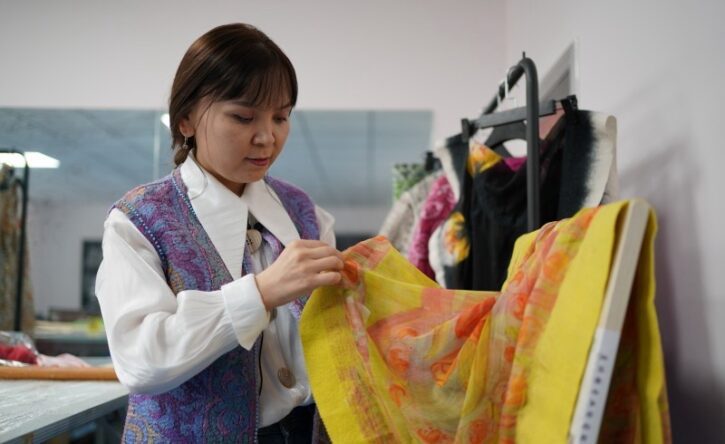
But she didn’t stop there. Magauia brings Kazakh embroidery into contemporary fashion. The embroidery patterns her mother once stitched onto pillowcases and wedding dresses, flowers, feathers, and the famous sheep-horn spiral, are now added onto chic modern coats and dresses. The result? Ancient nomadic vibes meet cosmopolitan cool.

“For me, craftsmanship is not just repeating the past,” she says. “It’s daring to innovate.” She believes heritage is a memory, carried in the strength of felt and the care of mothers. Her work keeps these stories alive, so the world can see not just clothing, but the life of people. Each experiment proves that heritage can be both preserved and re-imagined.
Rocking the epic
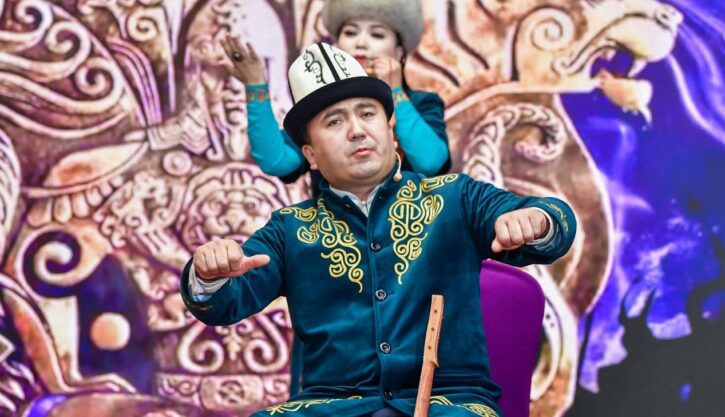
At the heart of their performance was The Epic of Manas, a Kirgiz tale comparable to Homer’s epics, now energized with rock beats. It tells the story of Manas and seven generations of his descendants, who led their people in battles against invaders. With a history of more than a thousand years, the epic remains a cultural cornerstone for the Kirgiz in China and a shared heritage with the people of Kyrgyzstan.
And today, it is remixed with electric guitars, pounding drums, and Kirgiz flutes. This storytelling which once echoed in yurts and pastures, are now shaking up music festivals in Nanjing.
Memet, a nationally recognized inheritor of Manas singing, grew up on the pastures of the Kirgiz Autonomous Prefecture.
As an oral tradition, The Epic of Manas had to be learned firsthand. When young, Memet and 20 other children often traveled over 50 kilometers by truck to a master’s home to study. Today, his own son, eight-year-old Mayken, is already belting out the songs at home.
And the crowds love it. At the 2024 Spring Festival Gala (China’s biggest TV show), his band blasted The Tales of Manas across millions of screens. Turns out, a thousand-year-old tale plus some shredding guitar solos equals pure fire.
Tradition lives in daily life
The best way to keep a tradition alive is to let it flow into everyday life.
On Kashgar’s bustling streets in western Xinjiang, passersby can still step into small shops and pick up a Yengisar knife, a handmade blade with centuries of history.
In Aksu in central Xinjiang, instrument makers have brought their craft into the modern market, offering time-honored santurs and drums among other instruments in local shops and even online, making them accessible to music lovers everywhere.
In Hami in the eastern part of the region, young women in flowing Etles silk skirts dance to lively rhythms, accompanied by the drum beats. Amazon might deliver faster, but you can’t beat the soul of a handmade Xinjiang drum.
Still living, not just remembered
Chinese civilization is built on the rich and diverse cultures of its many ethnic groups, as President Xi Jinping noted during his first visit to Xinjiang in 2022. Here in Xinjiang, those cultures aren’t fading into memory. They are worn, sung, baked, and danced into the present.
So, the next time someone wonders whether Xinjiang’s traditions are endangered, the answer is clear: they’re rocking festivals, strutting fashion shows, and delighting taste buds around the world.
About the author: Chen Ziqi is a reporter from CGTN Radio, China
Dear reader, we need your support
Independent sites such as The AIMN provide a platform for public interest journalists. From its humble beginning in January 2013, The AIMN has grown into one of the most trusted and popular independent media organisations.
One of the reasons we have succeeded has been due to the support we receive from our readers through their financial contributions.
With increasing costs to maintain The AIMN, we need this continued support.
Your donation – large or small – to help with the running costs of this site will be greatly appreciated.
You can donate through PayPal or credit card via the button below, or donate via bank transfer: BSB: 062500; A/c no: 10495969

Great article.
The focus here was on local traditions and crafts, but the government also invests heavily in infrastructure in the distant regions to ensure that they do not get left behind as development continues apace the coastal strip.
This post is supported by Danny Haiphong’s YouTube video of his investigation into the current state of Uighur communities. Western msm needs to lift it’s journalistic standards and not bow to globalist influences
It’s lovely, balanced, informative, clear, useful, and thus, another article to occupy a standard too far for, say, Murdoch focus.
I enjoyed that.
Sinjiang. That used to be Sinkiang, way out near Tibet.
The Chinese used to do nuclear bomb tests there…their Maralinga?
Love the story of the renewal of the customs of the old cultures of now far western China – beautifully revived and modernized from Silk Road days to today’s Belt & Road.
Xinjiang is huge, almost twice the size of South Australia. Lop Nur, where China did nuke tests (undergoing clean-up) is in the far east of the Xinjiang huge lake-dessert. The nearest population centres (north & east) are about 400km upwind, and about 1,000km downwind (south & west) to population centres of old Tibet and far western China.
Interesting article from Pepe Escobar, who is traveling the Silk Roads right now.
https://strategic-culture.su/news/2025/10/16/two-foreign-guys-walk-into-a-barber-shop-in-xinjiang/