By Denis Hay
Description
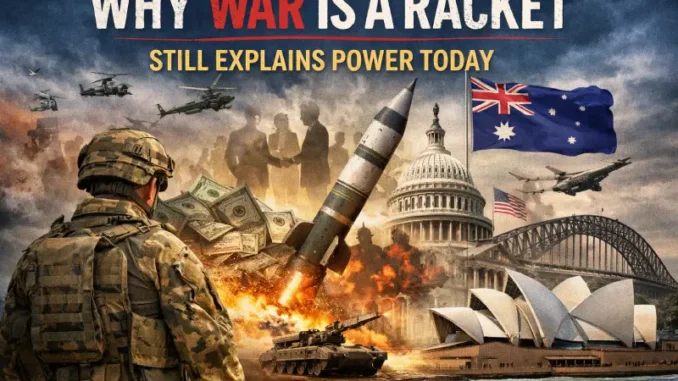
War Is a Racket exposes how war profits elites while citizens pay the price. A factual guide with lessons for Australia today.
Introduction
Published in 1935, War Is a Racket remains one of the most straightforward explanations of how modern warfare operates. Written by retired U.S. Marine Corps Major General Smedley D. Butler, the book argues that war is not primarily about defence or freedom, but about profit. Butler described war as a racket where a small group benefits financially while ordinary people pay the cost in lives, trauma, and public money.
A century later, the same dynamics Butler exposed continue to shape global conflicts. For Australia, his warnings are especially relevant as successive governments have followed the United States into every major war of aggression since World War II, often with devastating consequences and little public debate.
The Problem: War as a Business Model
War Is a Racket by Design
Butler used the word racket deliberately. He meant an enterprise that enriches insiders while disguising its true purpose behind patriotic language. In war, profits flow to arms manufacturers, financiers, contractors, and political careers, while losses are measured in human suffering and long-term social damage.
He argued that war profiteering was not accidental. It was built into the system. Governments borrow, industries expand, contracts multiply, and risk is socialised across the population.
This framework explains why wars continue even when their stated goals collapse. When war becomes profitable, ending it threatens powerful interests.
Who Pays and Who Benefits
The beneficiaries of war are consistent across history:
- Defence contractors and arms manufacturers.
- Financial institutions underwriting war spending.
- Political leaders who gain power and prestige
- Media outlets that amplify official narratives
Those who pay are equally predictable:
- Soldiers and their families, through death, injury, and lifelong trauma.
- Civilians in war zones, through displacement, destruction, and loss of life.
- The public, through the diversion of public money away from social needs.
- Future generations, who inherit instability, damaged systems, and lost opportunities.
This imbalance sits at the heart of Butler’s argument and remains unchanged today.
The Impact: Australia Following U.S. Wars
Automatic Alignment with U.S. Wars
Since 1945, Australian governments have followed the United States into every major conflict, including Korea, Vietnam, Iraq, Afghanistan, and Syria. In many cases, these wars were later shown to be based on false premises, exaggerated threats, or outright deception.
The Iraq War is the clearest example. Australia joined despite the absence of weapons of mass destruction and without any threat to Australian security. The outcome was regional chaos, mass civilian deaths, and long-term instability.
This pattern reflects alliance obedience rather than national interest.
The Cost to Australia
Human cost: Australian veterans continue to suffer high rates of PTSD, suicide, injury, and long-term illness. Families bear lifelong consequences for wars that did not defend Australia.
Economic cost: Hundreds of billions in public money have been spent on foreign wars, weapons systems, and U.S. defence contractors. This is money not invested in housing, healthcare, aged care, education, or climate resilience.
Loss of sovereignty: Facilities such as Pine Gap, permanent U.S. force rotations, and commitments like AUKUS bind Australia to U.S. war planning. Decisions about war increasingly occur outside democratic scrutiny.
Internally link: Why Australia Supports U.S. Wars
Why Governments Keep Doing This
Australian governments continue this alignment for structural reasons:
- Fear of media attacks, labelling leaders weak on defence
- Heavy lobbying from defence and security industries
- Career pathways tied to U.S. strategic institutions.
- Political comfort in outsourcing strategic thinking
- A failure to assert independent foreign policy.
This behaviour mirrors exactly what Butler warned about. When war serves powerful interests, political courage disappears.
The Military Industrial Complex Becomes Global
Although Butler wrote decades before the term existed, his work foreshadowed what later became known as the military-industrial complex. This system links governments, defence contractors, financial institutions, and media into a self-reinforcing cycle that normalises permanent war.
Australia is now deeply embedded in this system. AUKUS does not represent defence, but full integration into the U.S. military strategy in the Indo-Pacific.
The Solution: How Australia Can Step Away
Take Profit Out of War
Butler argued that removing profit incentives would dramatically reduce war making. For Australia, this means:
- Ending guaranteed profits on defence contracts
- Breaking the revolving door between politics and defence corporations
- Refusing procurement decisions driven by alliance politics
Reassert Independent Foreign Policy
Australia must require parliamentary approval for overseas deployments and reject automatic participation in U.S. wars. Defence should mean defending Australia, not projecting power abroad.
Use Dollar Sovereignty for Peace
As a currency issuing nation, Australia is not financially constrained in the way households are. Public money can be directed toward diplomacy, regional cooperation, disaster relief, veteran care, and climate resilience.
This is a political choice, not an economic limitation.
Internally link: Public Money for Public Purpose
Redefine Defence
True defence focuses on:
- Territorial protection
- Cybersecurity
- Disaster response
- Regional stability
Australia does not need nuclear submarines or a forward strike capability to remain secure.
Frequently Asked Questions
What is the central message of War Is a Racket?
War primarily serves economic and political elites, not ordinary citizens.
Is War Is a Racket still relevant today?
Yes. The same profit-driven structures Butler described continue to shape modern conflicts.
How does this apply to Australia?
Australia has repeatedly joined wars that did not defend the nation, due to alliance pressure and defence industry influence.
Final Thoughts
War Is a Racket is still confronting because it strips away comforting myths. It shows that war persists not because it is necessary, but because it is profitable. For Australia, the challenge is to break free from automatic obedience, reclaim sovereignty and redirect public money toward peace and public purpose.
What Is Your Experience
Do you believe Australia should continue following U.S. wars, or is it time for an independent, peace-focused foreign policy?
Call to Action
If this article helped you better understand how Australia really works, do not leave it here. Please share it with others who are asking the same questions.
Your voice matters. Your experience matters. And your participation matters.
➡ Share this article with family, friends, and your community
➡ Leave a comment below and join the discussion
➡ Visit the Reader Feedback page and tell us your view
➡ Share a testimonial if our content has helped you think differently
➡ Connect with us on TikTok, LinkedIn and X
Discuss this article in our Facebook group, where Australians share perspectives and ask questions in a calm, respectful space.
A more informed Australia starts with people willing to talk about the issues that shape our future. You can help lead that change.
Support independent journalism
Running this site costs around $2000 a year, and reader donations have helped cover $807 so far. Every contribution helps keep this work online, accessible, and independent.
If you find value in these articles, please consider supporting the site. Even a few dollars help keep this work going.
Donate now, one time or monthly.
Already donated? A quick Google review helps others discover the site.
This article was originally published on Social Justice Australia
Keep Independent Journalism Alive – Support The AIMN
Dear Reader,
Since 2013, The Australian Independent Media Network has been a fearless voice for truth, giving public interest journalists a platform to hold power to account. From expert analysis on national and global events to uncovering issues that matter to you, we’re here because of your support.
Running an independent site isn’t cheap, and rising costs mean we need you now more than ever. Your donation – big or small – keeps our servers humming, our writers digging, and our stories free for all.
Join our community of truth-seekers. Donate via PayPal or credit card via the button below, or bank transfer [BSB: 062500; A/c no: 10495969] and help us keep shining a light.
With gratitude, The AIMN Team


The answer to your question; is the USA most if not all Australia’s weaponry is purchased of them. Plus, every “defence” personnel we send to assist them, is one less of theirs they have to send, so Australia’s contribution is both money and lives.
Prior to following uncle Sam, we obeyd mother Britain, Australians are a very obedient people.
So, ask yourself why AUKUS is being supported by Labour?
It’s a dog of a deal with more than just fleas.