By James Moore
(Below is a rework of a piece I wrote several years ago about the border, Mexico, “Black Jack” Pershing, and politics, an earthy mix of incompatible parts. But a story worth telling. – JM).
Whenever I ride the motorcycle along River Road 170, which traces the southwestern border between Texas and Mexico, I always wonder about the times when both sides of the Rio Grande were sovereign Mexican territory. The U.S. took control of the Southwest after an imperialist war in 1848. A young congressman from Illinois, Abraham Lincoln, called it unconstitutional and based upon a lie, which made it, he argued, a “war of conquest.” President James Polk had insisted Mexicans had “invaded U.S. territory and had shed American blood on American soil.” Lincoln’s argument, which ought to have won the day, was that the location of the dust-up, north of the Rio Grande, was on land being disputed by Mexico and the newly-independent Republic of Texas.
President Polk did not care. He declared war on Mexico, ignored congress, and Americans ended up taking possession of what became the Western United States with the subsequent Treaty of Guadalupe Hidalgo. Sixty plus years later we were back doing foolish things in Mexico, pursuing the ephemeral Poncho Villa, and today we are chasing Mexican-Americans around within our borders, pretending they were not here before us and are not as good as us and need to go back home. If you spend time on the border, you learn the Rio Grande has nothing to do with defining what is “home.” And we once more have one of our many presidents who thinks congress has nothing to do with government.
If only the landscape could tell us the true stories. I know there is smooth, flat rock on the bottom of the Rio Grande, near where the river makes a bend toward the walls of Santa Elena Canyon. The water is shallow on that stretch of the water course, which turned it into a natural crossing point. Indigenous peoples like the Comanche and Apache used the location to hunt on both sides of the river before there were governments and countries with names and borders and flags and armies. Eventually, Mexicans and Americans found the spot convenient for conducting trans-border business and congregating with friends and families living on both sides of the river.
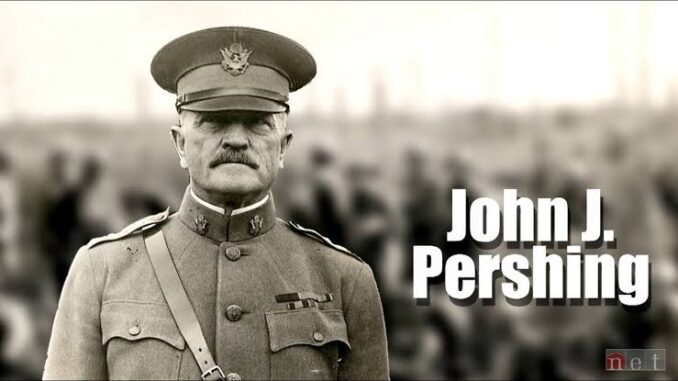
Shortly after the beginning of the Twentieth Century, soldiers in uniforms of the United States military were bivouacked on a hill downstream from the crossing. They were under the command General John “Black Jack” Pershing, who had been given his nickname because he had served with Black soldiers in the Tenth Cavalry during the Santiago Campaign of the Spanish-American War in Cuba, another capricious American adventure without basis in international law. Pershing, tall and patrician in bearing, had been given orders by President Woodrow Wilson to pursue Pancho Villa in Mexico, and put an end to his depredations on the U.S. side of the Mexican border.
Pershing, who had been promoted to Brigadier General by Teddy Roosevelt, had taken command of Fort Bliss outside El Paso. Not many miles distant, Villa had sacked the Southern New Mexico town of Columbus, killing 17 Americans and setting flame to the community’s structures. Villa was trying to overthrow his country’s government with a revolution but consistently viewed the U.S. as intervening and causing further military and political challenges. We almost certainly were. Pershing crossed the border heading south toward the Sierra Madre Occidental, determined to pacify the outlaw and his bandits. Villa was to be captured or killed. That was just a theory, though.
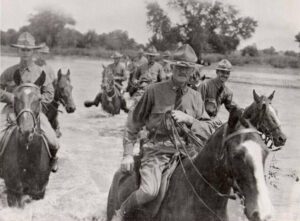
The general reportedly took 9,000 soldiers with him and, prior to his departure, as many as 50,000 U.S. National Guard troops had lined the border to protect Texas from Villa. Now there is a new generation of U.S. soldiers and national guardsman down there to protect us from Mexicans who want jobs and a better life in our country. Back in 1916, an unknown number of them were stationed just west of Santa Elena Canyon in a location later to be known as Lajitas, which refers to “little, flat rocks.” The low spot with the flat-rocked riverbed, which was where the troops crossed into Mexico on their pursuit of Villa, became known as “Black Jack’s Crossing.” Whether the general was ever present to lead those men across is not known for certain, though there are several photos of him riding his horse into the river and southward. His original campaign launched near the Texas-New Mexico line, not far from Columbus on March 16, 1916.
The Mexican Revolution lasted ten years from 1910-1920, and there were concerns early that the political leadership of Mexico was clandestinely getting military assistance from Germany, which was poised to launch the first global war in Europe. Pershing, meanwhile, who later became the commander of the Allied Expeditionary Force confronting the Kaiser’s soldiers, never even caught sight of Pancho Villa even as talk of international wars escalated. His interdiction south of the border resulted in skirmishes, and one disastrous loss of men, horses, and materiel in a battle at Carrizal, less than two weeks after he had crossed the frontier. Villa had also plundered Nogales, Arizona and stopped a train carrying American railroad surveyors. He promptly executed seventeen men, without expressing remorse or facing punishment.
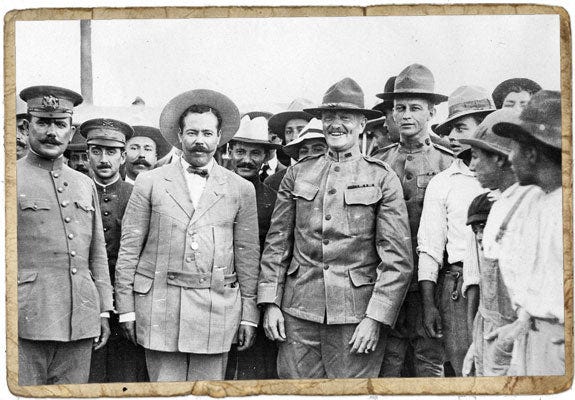
Villa’s ability to disappear into the mountains around Chihuahua made Pershing’s task almost impossible. The general was the first American military commander, however, to deploy aircraft to conduct reconnaissance to find roads and trails and signs of the evasive revolutionary. Heavy trucks used by Pershing to haul ammo and supplies were never able to move sufficiently fast enough over Mexico’s mostly dirt roads and could not close on the rebel and his men. The U.S. was also never able to press an advantage using the airplanes. Although “Black Jack” spent only about eleven months in pursuit of Villa, he publicly claimed a putative victory by scattering the “Villistas,” revolutionaries who had followed Villa. The general in a letter to a friend, though, acknowledged the failure of his massive endeavor.
“When the true history is written, it will not be a very inspiring chapter for school children, or even grownups to contemplate. Having dashed into Mexico with the intention of eating the Mexicans raw, we turned back at the first repulse and are now sneaking home under cover, like a whipped curr with its tail between its legs.”
Villa lived on without worrying about Pershing’s “Punitive Expedition,” but met his fate in 1923. A former Mexican congressman, who had been pistol whipped by Villa in an argument over a woman, led an assassination squad that killed him in an ambush as he drove to meet a lawyer in Parral. The revolutionary leader was on his way to have his will rewritten.
Pershing, though, had been picked by President Woodrow Wilson to lead American forces in World War I and played a role in the framing of the Treaty of Versailles when Germany finally sued for peace. The general was disinclined to accept the offer and wanted to continue prosecuting the war because he believed its leaders would not be politically chastened unless the conflict was punitive to conclusion, and the Kaiser’s army was destroyed. Although he might have been motivated by his failure in Mexico, Pershing’s instincts proved to be finely attuned to history.
His belief was that the Germans had to be eliminated on the battlefield, troops and weapons, or they would be back to arms in another generation, which, obviously, turned out to be correct. The treaty provided Hitler with leverage to make his claims that the German people had been historically wronged and needed to ascend to their rightful place of power, which had been abrogated by peacemaking. He convinced his nation that the armistice was unfair to the German people and that they had been betrayed by politicians who had assented to its terms, which amounted to “stabbing the army in the back.”
Down on the Rio Grande today, where Black Jack’s men crossed the river, the residents of both countries are developing traditions to heal the wounds of politics even as the American government thinks crises are solved with fences. The spot just west of Lajitas, which was once an official border crossing, has become the site of a frequent gathering of friends and families that live with a river in their midst. In the Voices from Both Sides celebration every spring, people gather in the river and on both banks, north and south, to renew friendships and reconnect their families and enjoy the desert beauty. There is food and music and swimming, maybe a beer or two, and on the hill not too distant, the Border Patrol watches with a discerning eye. The ghosts of Pershing and Villa are likely around, too, baffled by the human behavior.
When Villa died in the ambush, he was armed with two .45 pistols and accelerated his car into the gunfire. What’s left of that moment, and his legend, is the story, and a blackened finger sitting in the window of an El Paso pawn shop. The owner claims it is Pancho Villa’s trigger finger, and he’s been trying for years to sell the human remains for $9500 dollars. No takers. Villa never got around to using it when he was assassinated, and the pawn shop owner cannot guarantee the digit’s provenance.

On the bend in the river today, a golf course resort bears the name of Black Jack’s Crossing, which is actually just upstream from the green fairways and tee boxes set in the brown and ochre desert rock. Private aircraft fly duffers to the 18-hole course from the major Texas metros. Some stay in hotel rooms that are located on a spot where Pershing’s men were bivouacked in canvas tents while awaiting orders to run the revolutionary to ground. They would probably be unsurprised to learn the world makes even less sense now than it did back when they were mounting up.
This article was originally published on Texas to the world.

James Moore is the New York Times bestselling author of “Bush’s Brain: How Karl Rove Made George W. Bush Presidential,” three other books on Bush and former Texas Governor Rick Perry, as well as two novels, and a biography entitled, “Give Back the Light,” on a famed eye surgeon and inventor. Mr. Moore has been honored with an Emmy from the National Academy of Television Arts and Sciences for his documentary work and is a former TV news correspondent who has traveled extensively on every presidential campaign since 1976.
He has been a retained on-air political analyst for MSNBC and has appeared on Morning Edition on National Public Radio, NBC Nightly News, Last Word with Lawrence O’Donnell, CBS Evening News, CNN, Real Time with Bill Maher, and Hardball with Chris Matthews, among numerous other programs. Mr. Moore’s written political and media analyses have been published at CNN, Boston Globe, L.A. Times, Guardian of London, Sunday Independent of London, Salon, Financial Times of London, Huffington Post, and numerous other outlets. He also appeared as an expert on presidential politics in the highest-grossing documentary film of all time, Fahrenheit 911, (not related to the film’s producer Michael Moore).
His other honors include the Dartmouth College National Media Award for Economic Understanding, the Edward R. Murrow Award from the Radio Television News Directors’ Association, the Individual Broadcast Achievement Award from the Texas Headliners Foundation, and a Gold Medal for Script Writing from the Houston International Film Festival. He was frequently named best reporter in Texas by the AP, UPI, and the Houston Press Club. The film produced from his book “Bush’s Brain” premiered at The Cannes Film Festival prior to a successful 30-city theater run in the U.S.
Mr. Moore has reported on the major stories and historical events of our time, which have ranged from Iran-Contra to the Waco standoff, the Oklahoma City bombing, the border immigration crisis, and other headlining events. His journalism has put him in Cuba, Central America, Mexico, Australia, Canada, the UK, and most of Europe, interviewing figures as diverse as Fidel Castro and Willie Nelson. He has been writing about Texas politics, culture, and history since 1975, and continues with political opinion pieces for CNN and regularly at his Substack newsletter: “Texas to the World.”
Dear reader, we need your support
Independent sites such as The AIMN provide a platform for public interest journalists. From its humble beginning in January 2013, The AIMN has grown into one of the most trusted and popular independent media organisations.
One of the reasons we have succeeded has been due to the support we receive from our readers through their financial contributions.
With increasing costs to maintain The AIMN, we need this continued support.
Your donation – large or small – to help with the running costs of this site will be greatly appreciated.
You can donate through PayPal or credit card via the button below, or donate via bank transfer: BSB: 062500; A/c no: 10495969

Viva Mexico!