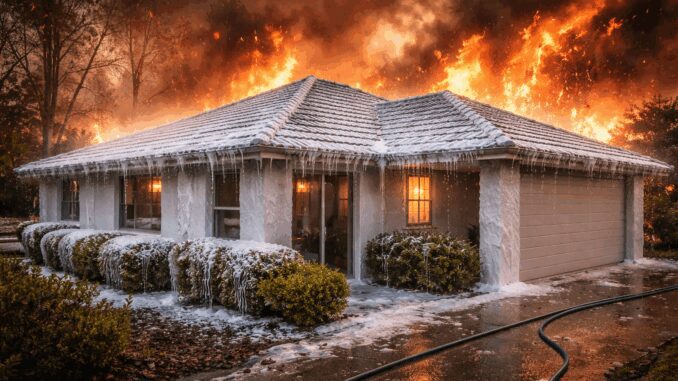
Australia is rightly having another conversation about bushfires, housing vulnerability, and what can realistically be done to reduce loss. A recent article in The Age argued for a “simple system”: a standardised way to assess and rate how well homes can withstand bushfires, paired with incentives to improve the worst performers.
That proposal is sensible. In fact, it is overdue.
But assessment alone does not stop houses burning.
Ratings tell us where the risk is. They do not, by themselves, remove it.
The uncomfortable truth is this: we already know how most houses burn, and we already have tools that can dramatically reduce that risk – yet we are barely using them.
How houses actually burn (and why this matters)
Decades of post-fire analysis show that most homes are not lost because a wall of flame engulfs them. They burn because of:
- Ember attack (burning debris entering roofs, gutters, vents and gaps), and
- Radiant heat, which preheats materials until ignition occurs.
This matters because it means bushfire loss is not purely random or inevitable. It is driven by specific, repeatable ignition pathways. If those pathways are disrupted, many houses survive even in extreme fire conditions.
That is the logic behind resilience ratings – and it is sound. But it is also incomplete.
The “simple system” is a good start – but not the finish line
The Age proposal focuses on identifying vulnerable homes and encouraging incremental upgrades: sealing gaps, clearing fuels, installing screens, improving materials. All of this helps.
What it does not fully confront is that some of the most effective protective measures already exist, are comparatively low-cost, and can be deployed immediately, particularly for existing homes that cannot easily be rebuilt to modern standards.
One of those measures has been hiding in plain sight.
The forgotten technology: spray-on fire-retardant gels
For years, fire services, researchers and even television demonstrations have shown the effectiveness of spray-on fire-retardant gels, typically based on super-absorbent polymers (SAPs) – the same class of material used in nappies, medical dressings and agricultural water-retention products.
When mixed with water and sprayed onto a surface, these polymers form a water-rich gel that clings rather than running off. When exposed to heat:
- The trapped water absorbs enormous amounts of energy as it warms and evaporates,
- Radiant heat is buffered before it reaches the structure underneath, and
- Embers landing on the gel are extinguished rather than igniting the surface.
These gels have been used to protect structures, equipment and even film sets. They are not experimental in principle, even if they remain underused in residential fire protection.
For example:
Overview of fire-retardant gels
Australian commercial home-scale products (example)
The physics is straightforward. The results are repeatable.
Cost: prevention is cheap, rebuilding is not
This is where the economics become stark.
A typical homeowner-scale gel setup – product plus basic spraying equipment – can cost hundreds to a few thousand dollars, depending on house size and coverage. Even at the upper end, it is trivial compared with:
- $400,000-$1 million rebuild costs,
- Temporary accommodation,
- Claims handling and reinsurance impacts, and
- The social cost of entire neighbourhoods being wiped out.
From a purely financial perspective, preventing one total loss pays for hundreds of protective applications.
Which raises an obvious question. If this works, why aren’t insurers embracing it?
The answer is not that insurers are stupid or malicious. It is that insurers rely on standards, verification and predictable behaviour.
Historically, gel systems have faced three objections:
- “They rely on homeowners applying them at the right time.”
- “We can’t easily verify they were active at the time of loss.”
- “There’s no recognised certification standard.”
These are governance problems, not physics problems – and they are increasingly solvable.
The timing problem – and why it is no longer decisive
A common criticism of gels is that they “dry out”. This is true, but incomplete.
SAP-based gels do not disappear when they dry. If the polymer residue remains adhered to the surface, it can be re-hydrated, swelling again into a protective gel layer when water is reapplied. This behaviour is well-established in other SAP uses.
Newer research goes further. Recent materials science work – including research from Stanford University – has demonstrated gels that:
- Adhere more strongly to surfaces,
- Resist UV degradation for longer periods, and
- In some cases form porous insulating layers under extreme heat after the water phase has evaporated.
See, for example:
Stanford Report, New gels could protect buildings during wildfires.
This matters because it weakens the argument that gels must be applied at the last possible moment. Earlier application and re-wetting during escalating fire danger becomes feasible, reducing reliance on perfect timing.
A system insurers could trial tomorrow
This is where The Age “simple system” and gel technology should meet.
A practical, insurer-friendly framework could include:
- Certification of approved gel products,
- Defined coverage standards (which surfaces must be treated),
- Activation tied to official fire danger ratings or emergency warnings,
- Simple verification (timestamped photos, receipts), and
- Modest premium discounts or excess reductions.
This would transform gels from an ad-hoc homeowner choice into a recognised loss-prevention tool.
Insurers already offer discounts for security systems and cyclone shutters. A certified, verifiable ember-suppression system is not radical – it is overdue.
Beyond homes: firefighter and vehicle safety
The implications extend beyond residential property.
If a coating can:
- Adhere to metal and composite surfaces,
- Retain or re-absorb water, and
- Buffer radiant heat without continuous pumping,
Then it is reasonable – and responsible – to explore its use on:
- Fire appliance exteriors,
- Temporary refuge zones, or
- Critical equipment housings.
Patents and operational trials already describe SAP-based fire-blocking gels for protective applications.
This is not a claim of invincibility. It is an argument for risk reduction in catastrophic conditions, where escape routes fail and seconds matter.
Environmental reality, not myth
Environmental concerns deserve to be taken seriously – and put in context.
SAP-based gels are:
- Generally low in toxicity,
- Widely used in agriculture and medicine,
- Degradable over time through UV and microbial action.
Used at homeowner scale, their environmental footprint is orders of magnitude smaller than that of a burned house, which releases plastics, treated timber toxins, metals and debris into soil and waterways.
Best practice matters – avoiding direct stormwater flushing, for example – but the idea that gel use is environmentally reckless does not survive comparison with the alternative.
Why we keep rebuilding instead of preventing
So why aren’t these systems mainstream?
Because prevention:
- Is less visible than heroic response,
- Sits awkwardly between government, insurers and homeowners,
- And lacks a single institutional owner.
We accept suburb-scale destruction, then rebuild with public money, while hesitating over temporary, targeted measures that could have prevented many losses in the first place.
What we should be doing now
We cannot stop all bushfires. No serious person claims we can. But we can:
- Combine resilience ratings with immediate protective tools,
- Trial certified gel systems through insurers,
- Fund further research into long-lasting, re-wettable coatings,
And treat loss prevention as seriously as response.
The technology exists.
The economics make sense.
The missing piece is coordination and will.
Bushfires are inevitable. Total loss does not have to be.
References & Further Reading
Bushfire loss mechanisms & resilience
Your Home (Australian Government). Bushfire Protection.
(Government-backed guidance on how homes ignite and how ignition pathways can be disrupted.)
Fire-retardant gels: fundamentals
Wikipedia. Fire-retardant gel. (Overview of super-absorbent polymer gels, mechanisms, and historical use in fire protection.)
National Fire Protection Association (NFPA). Water Enhancers and Firefighting Additives. (Background on polymer-based water enhancers used in wildfire suppression.)
Commercial availability (Australia)
Fire Defender Australia. Thermo-Gel Bushfire Protection – Home Kit. (Example of homeowner-scale spray-on gel system currently available in Australia.)
(Note: inclusion does not imply endorsement; demonstrates market existence.)
Australian trials & agency evaluation
ABC News. CFA trials polymer gel to fight fires. (2017) (Reports on CFA and CSIRO-linked trials of polymer gels in operational contexts.)
Next-generation gel research
Stanford University. New gels could protect buildings during wildfires. (2024). (Peer-reviewed materials science research on gels that form insulating aerogel-like layers under extreme heat.)
Zhang et al. Fire-resistant hydrogel coatings for wildfire protection. (Preprint detailing improved adhesion, durability, and thermal performance of advanced hydrogel systems.)
Patents & protective applications
US Patent US20070001156A1. Fire-blocking gel compositions and methods. (Describes SAP-based gels for protective coatings on objects and potential personnel shielding.)
Environmental considerations
Queensland Government, Department of Agriculture and Fisheries. Fire retardants and water enhancers. (Government assessment of environmental considerations for firefighting additives.)
Wikipedia. TetraKO. (Example of biodegradable, food-grade fire-retardant gel used internationally.)
Insurance & policy context
Insurance Council of Australia. Catastrophe resilience and mitigation. (Industry acknowledgement that mitigation and loss prevention reduce systemic risk.)
Media reference acknowledged
The Age. The simple system that could stop houses burning in bushfires. (2026)
Notes
Claims regarding re-wetting behaviour are grounded in established SAP chemistry and supported by materials science literature.
Claims regarding firefighter or vehicle applications are framed as research-supported possibilities, not deployed solutions.
Cost comparisons are illustrative and conservative, not vendor-specific.
What we learned in 2020 – and what we still refuse to accept
During the Black Summer fires of 2019–20, one of the clearest and most confronting arguments published was by Michael Taylor, who wrote that Australia had sidelined Aboriginal land management knowledge at its peril. His article, Never has there been a greater need for Aboriginal fire-stick farming, argued that low-intensity, culturally informed burning had sustained this continent for tens of thousands of years – and that dismissing that knowledge was both arrogant and dangerous.
The substance of that argument has since been repeatedly supported. Cultural burning programs, where they are properly led by Traditional Owners and resourced appropriately, have been shown to:
- reduce fuel loads without ecological devastation,
- preserve habitat complexity,
- and lower the intensity of subsequent fires.
Yet the reaction to Michael’s article was revealing. Alongside thoughtful engagement came predictable hostility – denial, deflection, and in some cases outright racism – much of it framed around the same tired myths: that cultural burning is impractical, that climate change makes it irrelevant, or that modern Australia is “too complicated” to learn from First Nations expertise.
That response pattern matters, because it shows how easily fire management debates are derailed by culture-war reflexes, rather than grounded in evidence.
This was never an either/or choice
One of the most damaging legacies of the 2020 debate was the false binary it created: either we embrace Indigenous land management or we pursue modern science and technology.
That is a category error.
Aboriginal fire stewardship operates at the landscape scale, over seasons and decades. It shapes fuel structure, biodiversity, and fire behaviour long before a fire front appears.
By contrast, the protective systems discussed in this article – building resilience ratings, ember protection, sprinkler systems, and spray-on fire-retardant gels – operate at the structure and human safety scale, often in the hours or days before impact.
They are not substitutes.
They are complements.
Cultural burning can reduce the severity and spread of fires. Structural protection can prevent homes, vehicles, and lives being lost when fires inevitably occur.
Australia needs both.
Why the hostility matters
The backlash to Michael’s 2020 article was not just offensive – it was instructive. It showed how quickly evidence-based proposals are undermined when:
- they challenge settler assumptions about expertise,
- they require institutional humility,
- or they imply that modern systems have failed.
That same dynamic helps explain why practical, non-heroic prevention measures – from Indigenous land management to building-level fire protection – struggle to gain traction. They don’t fit the mythology of emergency response. They require planning, trust, and shared responsibility.
And they don’t offer anyone a culture-war victory.
A more honest synthesis
If Australia were serious about reducing bushfire harm, the conversation would look different. It would say:
- Yes, climate change is worsening fire conditions.
- Yes, Indigenous fire knowledge remains essential.
- And yes, we must also protect people and property using every proven tool available — especially where landscape-scale change will take decades.
The lesson of 2020 was not that cultural burning failed. It was that we failed to listen — and then failed to build on what we heard.
This article does not replace that argument. It extends it.
The oldest “system” is knowing what cannot be defended – and where safety really is
In bushfires, one of the deadliest lies people tell themselves is: “We can defend this.” Sometimes the truth is simpler and harsher: some sites cannot be defended under catastrophic conditions, no matter how brave, prepared, or well-equipped the people are.
A documentary I watched years ago captured this with unnerving clarity. Before a catastrophic fire arrived, a local First Nations person with deep knowledge of that specific country told the property owner two things:
- the house and block could not be defended, and why; and
- exactly where on the property would remain safe as a refuge when the fire arrived.
Both pieces of advice proved 100% correct, and the person survived because they listened.
That story matters because it captures what policy debates often miss. “Preparedness” is not just buying equipment. It is having the courage to accept that the landscape has physics, not opinions: slope, wind funnels, radiant heat exposure, vegetation type, ember pathways, access/egress, and the time it takes a fire to go from “over there” to “on top of you”.
Modern agencies increasingly formalise this idea as a backup plan and a last resort option – because in real fires, plans fail. CFA’s guidance explicitly warns that fires are unpredictable and that identifying shelter/last resort options can save lives. Universities and bushfire researchers have also documented how “where to shelter” is a critical survival question when people cannot leave in time.
But the deeper lesson is this: local knowledge can be more specific than generic advice. People who understand a particular country can sometimes identify, with frightening accuracy, the places that will become death traps – and the places that won’t.
This doesn’t replace modern planning. It strengthens it. It argues for something Australia still under-invests in: supporting Traditional Owner leadership not only in cultural burning, but in local bushfire safety mapping identifying indefensible sites, likely wind-driven runs, and realistic refuge options on specific landscapes.
We need ratings and tech. We also need hard local truth and a refuge plan.
CFA Back Up Plans (last resort options)
University of Sydney: Where to take refuge in your home during a bushfire.
Cultural knowledge link “saved property” framing: ABC report on cultural burning helping save a home (different mechanism, reinforces “knowledge applied locally works”).
Keep Independent Journalism Alive – Support The AIMN
Dear Reader,
Since 2013, The Australian Independent Media Network has been a fearless voice for truth, giving public interest journalists a platform to hold power to account. From expert analysis on national and global events to uncovering issues that matter to you, we’re here because of your support.
Running an independent site isn’t cheap, and rising costs mean we need you now more than ever. Your donation – big or small – keeps our servers humming, our writers digging, and our stories free for all.
Join our community of truth-seekers. Donate via PayPal or credit card via the button below, or bank transfer [BSB: 062500; A/c no: 10495969] and help us keep shining a light.
With gratitude, The AIMN Team


I have just read a very comprehensive book on forests and logging. The forest wars by David Lindenmayer.He debunks all the myths about logging native forests. Logging is making fires much worse. Even though we have bushfire the logging quotas do not get reduced. Logging even occurs near water catchments. I highly recommend reading this book with its extensive evidence base.