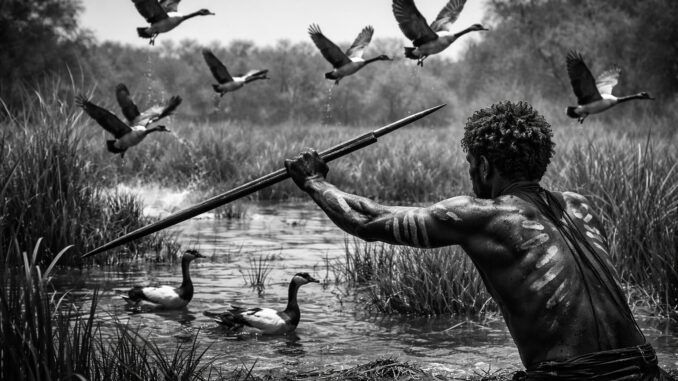
It is 1806 in the place now called West Lakes, Adelaide. For thousands of years, a Kaurna community – perhaps a hundred souls strong – has thrived here on the Adelaide Plains. In the driest state of the driest inhabited continent, they have flourished beside the reedbeds and brackish lagoons, where fresh water meets tidal flows and the land offers abundance.
Life here is harmonious, finely tuned to the rhythms of Country.
At first light, a father slips quietly away to hunt. He takes from the only what is needed: three magpie geese, enough to nourish his growing family through the day. (Some say the flesh carries a strong, almost muddy flavour from the birds’ wetland diet, but sustenance outweighs taste; provision always comes first.)
The hunt complete, the day unfolds further.
With bellies full, he gathers his three sons. They set out not for more food, but for school – the school of life. Today’s lesson: hunting kangaroo. The finest hunting ground lies a half-hour’s steady walk from his community. The journey itself becomes the classroom. Every step teaches: What bird calls from that sheoak? Which plant heals a wound or quenches thirst? What Dreaming story lingers in the shape of these plains?
A kangaroo appears on the rise ahead. They will not take it today; the geese already hang ready for preparation back home. This is practice, not harvest. The father demonstrates: how to read the wind so it carries scent away, how to shape the body for a clean boomerang throw, the precise angle to drive a spear for a quick, respectful kill.
The morning has been rich. The boys listen with the fierce attention of those who know these lessons are survival itself. On the long walk home they play at hunters – miming spear throws and boomerang arcs, leaping with imaginary triumph each time their “weapon” finds its mark.
By the time they return, lunch waits: baked magpie goose. One bird shared among them, the meat tender and sustaining.
The afternoon brings division by knowledge and gender. The girls follow the women into the bush to learn the language of plants – which yield the sweetest fruit, which mend broken bones or soothe fever, which hold value in trade with neighbouring groups. The boys join the elders for something deeper still: stories of the Dreaming. These are not mere tales; they are maps – living, unerasable charts binding past, present, and future, guiding how life has always been lived and must continue to be lived.
Such a full, vivid day calls for celebration at dusk. The third goose is prepared in the family’s favourite way: wrapped in mud, buried in earth beneath glowing coals, slow-cooked until the flesh falls from the bone in succulent strands.
It is an idyllic existence, yet never idle. Customary law stands firm and unquestioned. Every person contributes; every person matters. Elders are revered as repositories of wisdom; youth are cherished as the future providers, teachers, and elders yet to come.
Society here is in balance – a perpetual, carefully shaped harmony that simply works.
Then, one idyllic day, the white man came.
These newcomers – perhaps explorers, sealers, or early stragglers – had met Aboriginal people before. They knew to expect curiosity, not spears. As they gazed upon the community – men, women, and children moving freely in the warm light, unclothed or lightly clad in the manner of their Country, tending fires and gathering without the frantic haste of industry – one of the white men spat the words: “Bloody savages.”
Life in London in 1806 was anything but idyllic. The city choked on coal smoke and despair. Crime festered in narrow lanes; disease – typhus, smallpox, cholera – swept through overcrowded tenements. Children as young as five or six were sent into factories or mills, labouring twelve to sixteen hours a day amid clattering machines and whipping overseers. Desperate fathers sometimes bound their sons as apprentices for a pittance, knowing a lash might be needed to drive them back to work. Many boys simply vanished into the fog – runaways, lost forever.
The very man who had sneered “Bloody savages” might have had a cousin like young James, ten years old, who disappeared one smoggy morning into London’s underbelly. His mother still waited by the door each night, eyes red, listening for the soft knock that never came.
Those without children to sell into labour begged on the streets, dodging the shadows of Bakers Close, where the week before a beggar had been knifed for two pennies scraped from strangers’ pity – pennies that were already rare.
In London’s rigid class system, the poor were invisible, the infirm discarded, the healthy fodder for the army (England in 1806 was locked in the long struggle of the Napoleonic Wars – there was always a war), or the workhouse. No elder was revered; no youth groomed as future leader. Survival was solitary, brutal, and merciless.
That was the world of 1806 England – a world that would one day look upon a thriving Kaurna community, living in balance with land and kin, and pronounce them savages.
I ask you: Who were the savages?
Keep Independent Journalism Alive – Support The AIMN
Dear Reader,
Since 2013, The Australian Independent Media Network has been a fearless voice for truth, giving public interest journalists a platform to hold power to account. From expert analysis on national and global events to uncovering issues that matter to you, we’re here because of your support.
Running an independent site isn’t cheap, and rising costs mean we need you now more than ever. Your donation – big or small – keeps our servers humming, our writers digging, and our stories free for all.
Join our community of truth-seekers. Please consider donating now via:
PayPal or credit card – just click on the Donate button below
Direct bank transfer: BSB: 062500; A/c no: 10495969

We’ve also set up a GoFundMe as a dedicated reserve fund to help secure the future of our site.
Your support will go directly toward covering essential costs like web hosting renewals and helping us bring new features to life. Every contribution, no matter the size, helps us keep improving and growing.

Thank you for standing with us – we truly couldn’t do this without you.
With gratitude, The AIMN Team

Fascinating, thoughtful, compassionate read.
Thank you, Paul. I’ve been meaning to write this for years – but compelled to today because of all the racism and hatred filling our media.
It is a story told to me by an Aboriginal lecturer at UniSA thirty years ago.
Very moving Michael,and so searingly juxtaposes that time with our “superior” civilisation.I had the privilege of visiting many remote communities in the top end through a mate who was a director of Territories Parks and Wildlife over many years.I saw the best and worst of our interference.
When you look at the brainless slaughter in the Middle East, it’s not hard to work out who the savages are.
Thanks for the reminder.
Agree all round Canguro,we,ve apparently learned nothing..history. etc.
I’m afraid this is just another misguided interpretation of language and history .
The word savage is derived from the French word sauvage meaning wild. It was used long before any French speakers discovered primitive people living in the wild. And please don’t be offended by the word primative. It just means the first stage of development, like primary education is the first stage followed by secondary, tertiary and quaternary.
After those Frenchified Viking settlers called the Normans conquered England the word entered the English language as savage and it still meant nothing more offensive than wild like wildlife or wildflowers.
So it became customary in the English language to refer to people who live in the wilds of nature as savages. There is no offence intended because there was nothing offensive about the word. It was descriptive. It was informative. It told you that savages were people who lived in the wild.
It didn’t become a synonym for visciousness until civilised people (who live in cities – see my earlier posted comment) came into contact with savages(people who live in the wild) and experienced viscous treatment from those savages. I’m sure the city people were just as viscious as the savage people, and perhaps there is an Aboriginal (Unoffensive word meaning original inhabitant) word in one of the hundreds of Aboriginal languages which uses an Aboriginal word for white people as a synonym for visciousness as a consequence of the treatment they witnessed and experienced from white people.
if aboriginals did not viciously attack white settlers for some perceived but not necessarily intended slight they might not have been viciously slaughtered in return.
As there is in essence no difference except artificial culture between humans there is no reason to assume that any group of humans are more or less viscious than anybody else.
Artificial cultures on the other hand may have developed to be intentionally viscous. The Aztec civilisation was undoubtedly a great civilisation with its Capitol being the largest city in the world at that time. However their practice of mass human sacrifice was undeniably cruel and viscious and in spite of the fact that they didn’t live in the wild they are likely to be described by English speakers today as savage.
Like a true nature’s child we were born, born to be savage.
“I’m afraid this is just another misguided interpretation of language and history.”
Wow. What an insult to the author. FYI, regarding the origins of the word ‘savages’:
15th Century: Developed into a pejorative term for “uncivilized” or “barbarous” people.
Colonial Usage: From the 17th century, it was used by Europeans to describe Indigenous peoples as lacking civilization
An excellent sensitive article, well done!!
@ B Sullivan: Perhaps you could read some of the enormous volume of literature on the Anglo-Celtic-European interaction with Aboriginal communities dating from 1788, before adopting the Little Johnnie Howard view of colonisation/settlement and pontificating about the Papal policy of White Supremacy to justify imperialistic ”conquest”(or the too often preferred Aboriginal genocide).
I find the ongoing cud chewing with regard to “colonization” futile in the extreme, I’d ask, what country of people have never been “colonized”?
Dear Michael, when you write these musings from time to time,they are like novellas, cinematic in scope, panoramic to the extent that I am even smelling the fire smoke.
The rather fanciful, misleading interpretation of the word ‘savage’ by B Sullivan at once made me think of another fanciful interpretation of reality by alleged civilised savages. That of Australia being ‘ terra nullius ‘ despite the original owners, black savages, being in plain sight.
More please, Michael.
Steve, based on this post of yours, you seem to know more about “twisted thinking” than I do!!!
But in answer to your question; I’m not even German and the Nazi were, after all, their elected government, weren’t they?
jonangel, I was hoping to provoke some self-reflection, some self-examination.
I do it constantly.
It’s not a weakness.
It’s a strength.
As Socrates said — the unexamined life is not worth living.
If we don’t question our thinking, question our sources of information, we can easily drift off into easy answers to problems.
Answers that don’t require much thinking.
In short, One Nation type thinking.
Steve:
Don’t bother. jonangel is not into self-reflection; his sense of his own rectitude and superiority is as certain and grandiose as Trump’s.
Canguro
Good post, that..
Steve, your not ducking and weaving are you? Just answer the question, Socrates is dead,try thinking for youtself.
Leefe, where have you been? I’ve missed you, your reflections on the world’s situation make Trump look good. Welcome back.
*you’re
Poor old B Sullivan, still under the delusion of racial superiority, wrapping themselves in colonialist bigotry in an attempt to keep that cold heart warm. Poor fella.
Nice story Michael, evocative.
IMO doesn’t need picking apart.