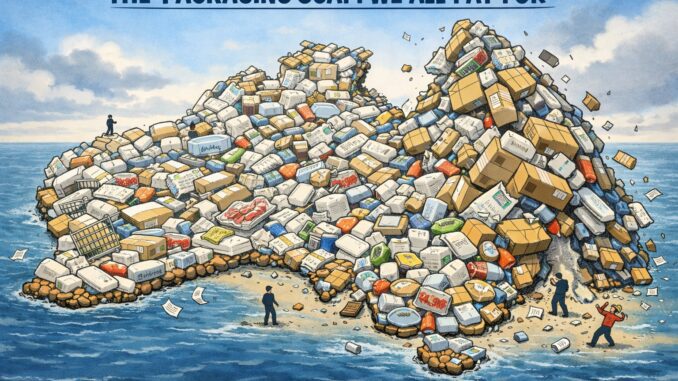
We’re paying more for packaging than the product – and it’s costing us the planet.
You go to the supermarket to buy food.
You come home with plastic, cardboard, film, trays, wraps, seals, labels, inserts – and somewhere inside all that, a tomato.
We don’t just buy products anymore. We buy the packaging around them.
And we pay for it twice.
First at the checkout. Then again through rates, taxes, landfill, pollution, and the slow clean-up bill that never quite arrives as a line item – but always shows up somewhere.
Globally, packaging accounts for around 40% of plastic use, yet only about 9% of plastic is actually recycled.
That’s not just waste.
That’s a system.
The quiet cost nobody talks about.
Packaging isn’t just rubbish. It’s an embedded cost structure.
Manufacturers pay for it.
Retailers design around it.
Consumers unknowingly fund it.
Councils clean it up.
Taxpayers carry the rest.
And the system is remarkably efficient at one thing: moving the true cost somewhere else. That’s not accidental. That’s design.
Australia knew. Australia delayed. Australia has had packaging targets for years.
It missed them.
It had a voluntary system to reduce waste.
It didn’t work.
It had a review telling it reform was needed.
It agreed.
And now after consultations, frameworks, summaries, and more summaries— we are still “considering options.”
Meanwhile:
- Plastic recycling targets are nowhere near being met—and we knew they wouldn’t be.
- Large volumes of packaging still go to landfill.
- Problematic materials remain in circulation.
At some point, “under consideration” stops being a process and becomes a strategy.
The myth of “it’s too complicated”
You’ll hear that packaging reform is difficult.
- Food safety.
- Supply chains.
- Consumer behaviour.
- Industry transition.
All true. And yet:
- Germany recycles more and landfills almost nothing.
- South Korea uses pricing signals to cut waste dramatically.
- Switzerland charges for residual waste and people respond.
- Japan runs a tightly regulated, shared-responsibility system.
None of these countries solved the problem by asking nicely. They regulated it.
The real problem: we made waste invisible.
When waste is invisible, it multiplies. When it’s priced, it changes. When something is free to throw away, we throw it away. When something is easy to over-package, we over-package. When the cost is pushed onto councils and taxpayers, the system quietly optimises for more of it.
Because behaviour follows incentives – every time.
Yes, there are trade-offs (and that matters).
Not all packaging is bad.
For some foods – especially meat, dairy, and fragile produce – better packaging can reduce spoilage. And when food waste drops, total environmental impact can actually go down.
That’s why blunt “less packaging” policies can backfire – especially for high-impact foods.
But that’s not what most packaging is doing. A lot of it is:
- Marketing
- Convenience theatre
- Shelf differentiation
- Or just habit.
The evidence is clear: Some packaging protects food – most packaging protects margins.
Ø The packaging isn’t protecting the product.
It’s protecting the business model.
The “PAYT panic” is overblown.
One of the standard arguments against reform is that if people pay for waste, they’ll just dump it illegally.
The evidence doesn’t support that.
Well-designed “pay-as-you-throw” systems:
- Reduce waste significantly
- Do not lead to widespread dumping
- Only show issues when badly implemented
And when problems occur, they are predictable:
- Poor access to legal disposal
- Weak enforcement
- Badly designed pricing
The problem isn’t the policy. It’s the execution.
What actually works
We don’t need theory. We have working models. The best-performing systems combine:
- Mandatory producer responsibility → shifts cost upstream
- Design rules → remove what shouldn’t exist
- Pricing signals → make waste visible
- Convenient infrastructure → make the right choice easy
- Real enforcement → make the wrong choice expensive
- Reuse systems → remove the problem entirely
What if people pushed back – properly?
Policy sets the rules. But systems don’t move on policy alone. They move when pressure builds from below.
Packaging is one of the rare areas where consumer behaviour can send a direct signal – fast.
Not through guilt. Through friction. Buy the product. Return the waste.
If a product is overpackaged, don’t reward it.
Leave it on the shelf.
Retailers don’t respond to frustration. They respond to unsold inventory. If you do buy it, hand the excess back.
At the checkout:
Ø “I don’t want this packaging.”
Not aggressively. Just consistently. It creates:
- Handling cost
- Visibility
- Internal reporting
Multiply that across thousands of customers, and it stops being a nuisance. It becomes a pattern.
Ask the question they don’t want to answer
Ø “Do you have a way to return unnecessary packaging?”
Not once. Repeatedly.
Questions travel further inside organisations than complaints.
Make it visible
- Product reviews calling out packaging
- Photos
- Comparisons
- Not outrage – evidence.
Because once something becomes visible, it becomes harder to ignore.
Shift the norm
Packaging doesn’t change when people care. It changes when people stop accepting it as normal.
The uncomfortable truth
We don’t have a packaging problem because we don’t know what to do. We have it because we’ve tolerated a system where:
- Costs are externalised
- Responsibility is diluted
- Voluntary change replaces actual rules
… For years.
The scam
You buy the product.
You pay for the packaging.
You pay to dispose of the packaging.
And then you pay again when the system fails to manage it properly.
And none of those costs are shown on the price tag.
All while being told: “This is the most efficient system we have.”
Efficient for who?
The fix is not radical
It’s overdue.
Australia doesn’t need to reinvent anything. It needs to:
- Move from voluntary to mandatory packaging rules
- Enforce design standards
- Expand reuse systems
- Introduce smart pricing where appropriate
And stop pretending the current model just needs a bit more time.
Final thought
Not every product needs three layers of plastic, a cardboard sleeve, and a moral crisis. And not every problem needs another consultation.
Some just need a decision. Because right now, the system works exactly as designed:
- You buy the product.
- You fund the packaging.
- You pay to clean it up.
And if nothing changes…
So will the bill.
📚 Sources
OECD, Global Plastics Outlook
Australian Senate Inquiry, Waste Reduction and Recycling Policies
DCCEEW: Reforming Packaging Legislation
APCO, National Packaging Data
UNEP, Life Cycle Initiatives
University of Michigan, Center for Sustainable Systems
US EPA, PAYT Program Evidence
European Environment Agency (EEA), Waste Profiles
Keep Independent Journalism Alive – Support The AIMN
Dear Reader,
Since 2013, The Australian Independent Media Network has been a fearless voice for truth, giving public interest journalists a platform to hold power to account. From expert analysis on national and global events to uncovering issues that matter to you, we’re here because of your support.
Running an independent site isn’t cheap, and rising costs mean we need you now more than ever. Your donation – big or small – keeps our servers humming, our writers digging, and our stories free for all.
Join our community of truth-seekers. Please consider donating now via:
PayPal or credit card – just click on the Donate button below
Direct bank transfer: BSB: 062500; A/c no: 10495969

We’ve also set up a GoFundMe as a dedicated reserve fund to help secure the future of our site.
Your support will go directly toward covering essential costs like web hosting renewals and helping us bring new features to life. Every contribution, no matter the size, helps us keep improving and growing.

Thank you for standing with us – we truly couldn’t do this without you.
With gratitude, The AIMN Team

We grow our own strawberries, and other fruits, here and although they might only be considered small by the now Americanised bigger is better bullshit standards the smell and flavour is incredible. They also last longer when stored in the fridge which is a big bonus.
Diced strawberries mixed with proper Greek yoghurt can’t be beaten in the morning.