In the quiet hours of reflection, a simple truth often emerges: we become what we study. For centuries, humanity has looked to the natural world to understand its own origins and instincts. But what if, in choosing our mirror, we inadvertently chose our destiny?
A years-old note resurfaced recently, posing a question that holds the key to our civilisation’s trajectory: “It could well be a more peaceful world had humanity studied ‘Bonobo‘ apes rather than ‘Chimpanzees.'”
This is not merely a thought about primatology. It is a profound commentary on the stories we tell ourselves to justify our behavior. We do not simply observe nature; we selectively resonate with the aspects that reflect our pre-existing desires, and then use that “data” to build a societal framework. The difference between choosing the chimpanzee or the bonobo as our closest mirror is the difference between building a world on the principle of conflict or the principle of connection.
The Two Mirrors: A Tale of Two Primates
The comparison between these two primates is not just biological; it is a philosophical fork in the road for humanity.
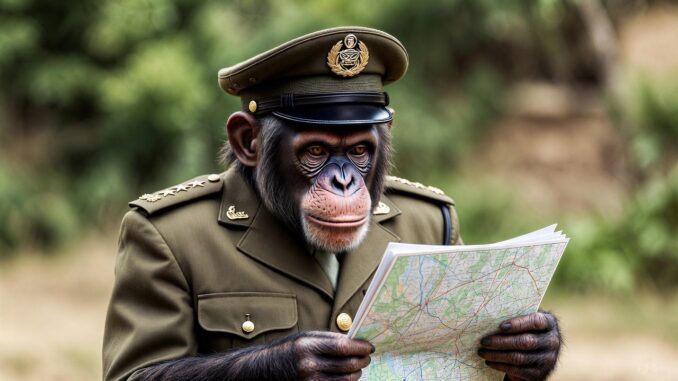
On one path, we have the Chimpanzee Model – the Path of Conflict. This model is defined by a social structure that is male-dominated, hierarchical, and fiercely territorial. Status is maintained through aggression and coalitionary violence. In this world, conflict is resolved through displays of power, dominance, and physical force. Humanity has overwhelmingly used this model to rationalise what we call “alpha” dominance, territorial wars, toxic competition, and the deeply ingrained idea that “might makes right.” It has provided a biological alibi, framing violence as a natural and inevitable part of the human condition. The resulting worldview is one of inherent scarcity, perpetual competition, and the elevation of the “Art of War” as the supreme logic of life.
On the other path lies the Bonobo Model – the Path of Connection. This model presents a radically different blueprint. Its social structure is matriarchal, egalitarian, and deeply cooperative. Status is derived not from brute force, but from social intelligence and the ability to forge strong alliances. Crucially, tension and conflict are diffused through empathy, sexual bonding, grooming, and the sharing of food. This model has been largely ignored or dismissed as irrelevant by mainstream thought, precisely because it challenges the very foundation of the power-based structures that dominate our societies. Embracing it would lead to a worldview centered on abundance, collaboration, and intelligent conflict resolution – a world where the “Art of Peace” is the operative principle.
Resetting Our Cultural Operating System
By focusing so intensely on the chimpanzee, we received a scientific-sounding excuse for our worst impulses. We built economic systems that reward ruthless competition, political systems based on domination, and a history that glorifies conquerors. The bonobo model offers a proven, yet unchosen, alternative. It demonstrates that social cohesion can be built from the bottom up through empathy and shared pleasure, and that a community can prioritise collective well-being over the dominance of any single individual.
This is not a call for a simplistic return to nature, but a call to consciously choose which aspects of nature we emulate and elevate. The “Bonobo Principle” is a metaphor for a society that consciously chooses empathy over ego, collaboration over competition, conflict resolution over conflict victory, and stewardship over dominion.
The challenge before us is to shatter the old mirror and consciously select a new reflection. We must integrate this principle into our institutions, our economies, and our daily interactions. This means teaching empathy and cooperative problem-solving as core skills in our schools, valuing bridge-builders over bombastic strongmen in our politics, and rewarding businesses that create shared value for all.
The path of the chimp has led us to the brink. The path of the bonobo – the path of connection, care, and intelligent collaboration – is the one we must now make irresistible. It is not a softer path; it is a smarter, more resilient, and ultimately more successful one.
We have studied the chimp for long enough. It is time to graduate to a higher understanding of our own potential. The mirror is in our hands. What will we choose to see?
Keep Independent Journalism Alive – Support The AIMN
Dear Reader,
Since 2013, The Australian Independent Media Network has been a fearless voice for truth, giving public interest journalists a platform to hold power to account. From expert analysis on national and global events to uncovering issues that matter to you, we’re here because of your support.
Running an independent site isn’t cheap, and rising costs mean we need you now more than ever. Your donation – big or small – keeps our servers humming, our writers digging, and our stories free for all.
Join our community of truth-seekers. Donate via PayPal or credit card via the button below, or bank transfer [BSB: 062500; A/c no: 10495969] and help us keep shining a light.
With gratitude, The AIMN Team


Such a fascinating essay! It provides a solution to the questions I’ve been pondering for decades.
It is food for thought, but you can suspect that the enviro changes imposed on chimps over millions of years, as with humans, seems to have required eventually a more pro-active (perhaps) sense out on the plains,(where a big cat is a constant danger), than still within the comfort and shelter of the trees.
I like the Bonobos
Chimpanzees and Bonobos only “split” a million years ago, and we wonder, who split from who? Or who split from who 7 million years ago.
I think how superficial, when you look at things like the Gaza horror; coming down from the trees did not mean we were rid of irrational, unintelligent aggression just made it more “cosmetological”, more “air brushed”.
Chimps attack stuffed leopard decoys with sticks out of fear, but we have advanced ourselves to the point where we can wipe out millions in one hit on the most infantile of disagreements
No. We got smart enough to the build our own urban jungles; we don’t need all these other furry pests, so we are going thru an extinction phase with even considering logically what it is we just witlessly cast aside on the whims of the even more ignorant “few”.
Didn’t the changes that happened over millions of years, through the modest Australopithecines, to relatively sophisticated Homo Erectus also change behaviors, things like bipedality, line of sight, and higher intelligence demanding and sometimes gaining, different ways of doing things and responding to situations? But like it or not, aggression, sometimes irrational, seems a possibly necessary part of the species make up and will last as long as fear itself.