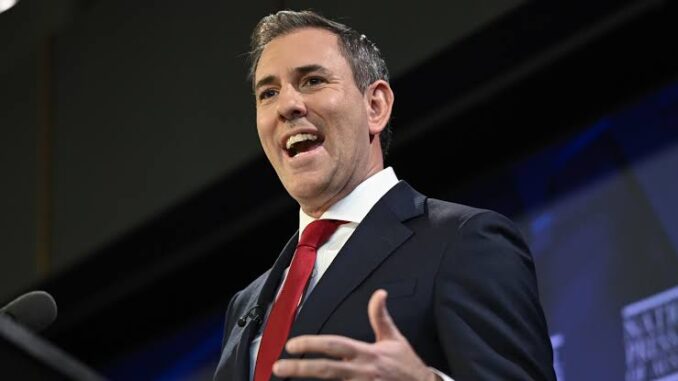
Productivity roundtable an opportunity to raise living standards for all

A man in a suit speaking passionately with a smile.
Treasurer Jim Chalmers (Image from Sky News Australia Facebook page)

Australian Council of Social Service (ACOSS) Media Release

ACOSS welcomes the opportunity to participate in the Treasurer’s Productivity Roundtable, a forum that can help shape a more inclusive and equitable approach to national prosperity.

“This is an opportunity to explore how macroeconomic and social policy settings can improve productivity and boost living standards, particularly for those who have fallen behind,” said ACOSS CEO Dr Cassandra Goldie.

”Major reforms are needed to ensure we can meet the needs and expectations of the community for services and support into the future and close the existing gaps in the safety net. This will involve difficult policy decisions and require us to build consensus across differences.

“We look forward to engaging with colleagues across business, unions, and our own sector to build public support for necessary reforms to ensure our economy is working for all members of our community.”


Dear reader, we need your support

Independent sites such as The AIMN provide a platform for public interest journalists. From its humble beginning in January 2013, The AIMN has grown into one of the most trusted and popular independent media organisations.

One of the reasons we have succeeded has been due to the support we receive from our readers through their financial contributions.

With increasing costs to maintain The AIMN, we need this continued support.

Your donation – large or small – to help with the running costs of this site will be greatly appreciated.

You can donate through PayPal or credit card via the button below, or donate via bank transfer: BSB: 062500; A/c no: 10495969

Donate Button

4 Comments

  1. Productivity improvements need educated innovators to succeed, so refreshing the funding of tertiary centres is required. In 1996, Howard took $1 BILLION OUT of university research and gifted it to US ”research corporations” that then subcontracted the same work to Australian researchers for a fraction of that grant plus the resulting free gratis & for noting boost to their bottom line.

    The COALition politicians usually attend private schools that lack any academic tradition but excel in ”games”, hence they ignore Australian R&D when in office because ”everybody knows that unions run the universities, Australians have long established ”cultural cringe” to everything England & Europe, and all improvements will change the world as we know it and want to keep it for out grandchildren”.

    Well ….. ya gotta make haste slowly so that the world can get ahead of us in every field and prove our assertions correct.

  2. COALition UNDERMINED TERTIARY EDUCATION SLASHING RESEARCH FUNDING & CASUALISING TEACHING – WHILE VCs SALARY PACKAGES SKY-ROCKETED AFTER DAWKINS ”REFORMS”

    Opinion
    ‘A kind of monster’: Why does everyone hate universities?
    Jordan Baker SMH
    Chief Reporter
    June 28, 2025 — 5.00am

    In the lead-up to the federal election, university administrators were chilled by the messages they were hearing from the conservative side of politics: that research was an indulgence, that academics should just focus on teaching, and – a comment said to have been addressed to post-doctoral candidates – that a PhD didn’t necessarily confer expertise. “The hostility was so great,” said one senior administrator.
    But if they had hoped for a warm embrace from Labor, they haven’t got it. The much-hyped University Accord has fizzled. The hikes to humanities fees have not been rolled back. The main funders of research, international students, have been in the government’s sights. “Labor in the last term of government was hostile, too,” said the administrator. “Not as hostile as the Coalition, but they were hostile.”
    Illustration: Simon LetchCredit:
    Universities, it seems, have no friends.
    Not the government, which sees no votes in tertiary education and seems unwilling to waste political capital on serious reform. Not the Coalition, which uses them as fuel for its culture wars, dismisses their management as overpaid fat cats, and, during the Morrison-Dutton era, seemed to confect a Marx-style class war between the “quiet [presumably uneducated] Australians” and the intellectual “elites”.
    But universities’ traditional friends have turned on them too. Tertiary unions are furious about chronic staff underpayment. Academics are leaving, exhausted by stifling workloads and casualised jobs. Students are unhappy; they’re paying through the nose for an insipid version of the rich experience their parents enjoyed.
    Related Article

    Opinion
    University
    Dumb, dumber, dumberer: Time for Australia to wise up on international students

    Nicholas Reece
    Lord Mayor of Melbourne
    We’re so busy beating up universities that we forget what a disastrous own goal we’re kicking as we do it. The accord was plain about what will happen if Australia doesn’t have a healthy tertiary education system – we will not have the skills we need, our economy will suffer, and we will stifle the potential of our children. We need high-quality research too, to keep up with the rest of the world and to protect our sovereign interest.
    The unis don’t deserve all that hate. While they are certainly not helping themselves, they’re not the ones who caused the mess, and they’re going to need some friends, somewhere, to help them out of it.
    Emeritus Professor Graeme Turner, who drove the development of cultural and media studies in Australia, has laid out the dire state of the sector in his new book, Broken: Universities, Politics and the Public Good (to be released on Tuesday). “I think it is reaching crisis point,” he said. “It’s really affecting the knowledge infrastructure that’s available in this country.”
    Advertisement
    As with most things, the problem boils down to money. In the 1980s, the federal government contributed three-quarters or more of the sector’s funding. Now, it’s about 40 per cent. As governments cut their contribution, they told universities to raise their own money.
    The only real option was international student fees (commercialising research simply doesn’t raise enough money). Some say universities have gone too far down this road. They’ll respond that the student fee business is like a hamster wheel with mortarboards. To attract those students, you need to be high on international rankings; to do well on international rankings, you need high-quality research (which has the added benefit of public good); and to pay for that research, you need international students.
    Politicians told them to raise money like a business, yet criticise them for operating like a business. When you create a market situation, the natural result is that universities will compete for market share and advocate for their own institution’s interests – which, says Turner, “have been progressively redefined as commercial rather than public”.
    If Australia wants to do research – it does more of it within universities than most OECD countries – it has to pay for it. It’s a binary decision; either the government lets universities raise their own money, or it stumps up the money itself.
    Another issue Turner traces back to the 1980s is the tension over teaching versus research. Back then, vocational technical institutes – teaching colleges, for example – were separate from universities, where students got a broad education in arts and sciences as well as in disciplines such as medicine and engineering.
    Labor’s John Dawkins, federal education minister from 1987 to 1991, merged them all, creating long-standing tension over how institutions should balance teaching and research. Some say a university in which students are taught by an academic who’s not engaged in research is just a fancy version of a school. Others say the mergers put too much theory into practical degrees; the modern teaching degree, for example, is widely criticised for sending students into the workforce with few practical skills.
    Related Article

    University
    Lack of higher education vision will ‘kill’ universities, says vice-chancellor
    But the trend has been towards making degrees vocational. The Coalition’s Job Ready Graduates policy – which hiked the cost of humanities degrees – was a big push in that direction, even though employment outcomes for arts graduates is strong. “Our universities have been transformed from institutions devoted to educating our citizens, with all that entails, into institutions that train individuals for the workforce,” says Turner.
    That’s looking like a short-sighted move. Artificial intelligence poses a threat to traditional skills. Students may be better prepared for the changing workforce with a broader education. And yet, Macquarie University is cutting half its arts majors and gutting others, citing the prospect of international student caps.“The attack on generalist degrees that educate people in a way that’s going to make them able to deal with change … that’s kind of dumb,” says Turner.
    There’s another challenge posed by AI. The systems are being developed in China and the United States. Should Australia not have its own AI system, to protect its national interest? If so, we will need our own experts to create it. And they will need research funding.
    To say the mess is not the universities’ fault is not to deny that they have frequently and spectacularly shot themselves in the foot. Vice chancellors are renowned for talking down to their ministers as they put their hands out for money (or that’s the way the ministers have seen it). “Vice chancellors high and mighty,” said another senior administrator, who, like all the senior university figures who spoke to this masthead, did so on the condition of anonymity, so they could freely critique their bosses, the government and the system. “‘What you need to understand, minister, is …’ They think they are right all the time.”
    Related Article

    Education
    ‘Wake-up call’ as Australian universities slip in world rankings
    Politicians have been rolling their eyes for decades. They “have got sick of the universities whingeing”, says Turner. “They’ve tended to turn away.”
    Universities have failed to summon a unified front, denying themselves the power of a lobby such as mining or banking. They bicker among themselves. “It’s a bit of a dog-eat-dog world,” says Turner. Even if they agreed, the voices representing the sector, such as Universities Australia, don’t have the weight of a single sandstone vice chancellor.
    VCs might look down on MPs, but they’ve also been timid about challenging them. The sector was quietly scathing about the Jobs Ready Graduates package – “philistines”, said one VC – but few actually spoke publicly about it. They feared the government would forsake them. In fact, it forsook them a long time ago. All the silence has done is turn them into punching bags.
    Universities could take a hard look at how they advocate for themselves. They could cop fair criticisms and find solutions to them – salary underpayments, muddled handling of the Gaza conflict, the ballooning size of some universities and the damage that does to the student experience – and muscle up in areas where they have strong moral authority, such as the value of humanities, the interests of students, and the expertise of their extraordinary workforce.
    Related Article

    Medicine
    Defying expectations, inspiring Richard Scolyer reaches another goal
    As one of the senior administrators put it, “I don’t think the government makes the link between [world-famous melanoma researchers] Richard Scolyer and Georgina Long, and a healthy higher education system.”
    Perhaps they also need to dig deeper to find the kind of support that will make politicians tune back in. Despite all the criticism, many Australians still want their children to obtain a degree.
    The sector usually addresses problems by asking for more money. But that’s not enough now. There needs to be sweeping and genuine reform, which will be hard and will put noses out of joint. Maybe we don’t need as many universities? Maybe we duplicate too much research? Maybe they need to stop trying to be everything to everyone?
    But politicians should stop using rhetoric that devalues universities.
    “It’s more fundamental than [money],” Turner says of the change required. There has to be a re-think of “what the sector is for, what they want universities to do, and to remind themselves that there’s a democratic function that the university plays. Trump attacks universities because they are a repository of the democratic, critical values that societies need.
    “The policy settings that were put there piece by piece since Dawkins have produced a kind of monster. I don’t think anybody intended to see the kind of consequences that they have, but I don’t think there’s a lot of care about those consequences now.”

  3. My deep thanks to the Cocky for endurance, stamina, skill, for useful info and leads. Too much is wrong, was so designed and it is self destructive for this nation. Bitter and twisted misfit Jack Howard (an old classmate) knew little, corrupted, damaged. There were others. Can better policy and attitude now prevail? This nation does not value education enough.

Leave a Reply

Your email address will not be published.


*