By Denis Hay
Description
Discover how privatisation in Australia transformed public assets, shifted wealth, affected costs, and changed the nation’s future.
Privatisation in Australia: What the Great Sell-Off Cost
Introduction
Imagine if Australians collectively owned a portfolio of valuable businesses.
Those businesses generated reliable income year after year. They helped fund public services, build infrastructure, and support national development. They belonged to everyone.
Now imagine selling those businesses.
The sale delivers billions of dollars upfront. Governments celebrate the windfall. Budgets improve. Debt figures look better.
But decades later, the profits continue flowing, just not to Australians.
Instead, they flow to shareholders, investment funds, and corporations.
This is the story of Australia’s great sell-off.
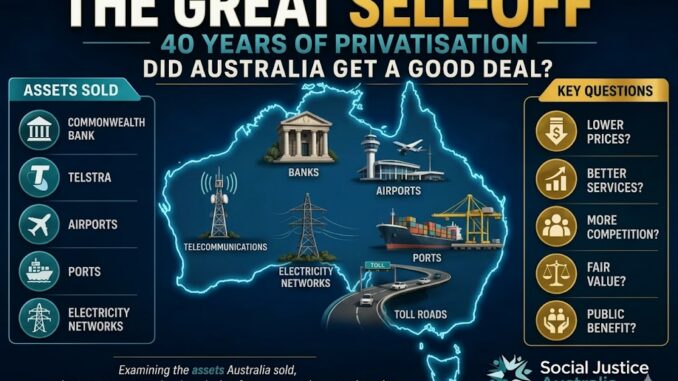
Over the past forty years, governments of both major political parties privatised banks, telecommunications networks, airports, ports, electricity systems, and many other public assets. Australians were promised greater efficiency, lower prices, increased competition, and better services.
Some of those promises were fulfilled.
Others remain fiercely debated.
Today, as Australians face rising living costs, housing pressures, expensive utilities, and growing concerns about corporate power, many people are asking an important question:
Did Australia get a good deal from privatisation?
To answer that question, we need to understand what was sold, why it was sold, who benefited, and what future generations may have lost.
The Australia That Built Public Assets
For much of the twentieth century, governments played a significant role in building Australia.
Public ownership was not viewed as unusual. It was considered practical.
Private investors often lacked the resources, patience, or incentive to build infrastructure that might take decades to deliver returns.
Governments stepped in.
They created:
- The Commonwealth Bank,
- Telecom Australia,
- State electricity commissions,
- Public rail networks,
- Public ports,
- Public airports,
- Water utilities,
- Large public housing programs.
These assets were more than services.
They were productive investments.
They generated income while providing essential infrastructure.
Profits flowed back into government budgets, helping fund hospitals, schools, roads, and community services.
Many Australians viewed these institutions as part of the nation’s shared wealth.
That philosophy would change dramatically from the 1980s onwards.
The Rise of Privatisation
During the 1980s and 1990s, economic thinking changed across much of the Western world.
Governments increasingly embraced market-based solutions.
Economic rationalism and neoliberalism became influential.
Supporters argued that governments should focus on regulation rather than ownership.
Private businesses, they claimed, would operate more efficiently.
Competition would improve services.
Consumers would benefit.
Governments would receive large financial returns from asset sales.
Both Labor and Coalition governments embraced aspects of this approach.
Privatisation gradually became one of the most significant economic transformations in Australia’s modern history.
What Australia Sold
Australia’s privatisation program covered a remarkable range of assets.
Commonwealth Bank
Established in 1911, the Commonwealth Bank was created to support Australia’s economic development.
Unlike private banks, it had a broader public purpose.
The bank was progressively privatised between 1991 and 1996.
Today it is one of Australia’s most profitable corporations.
Telstra
Originally known as Telecom Australia, Telstra connected one of the world’s largest and most geographically dispersed populations.
Privatisation occurred in stages between 1997 and 2006.
Supporters argued competition would improve efficiency and innovation.
Airports
Major airports including Sydney, Melbourne, Brisbane, Perth, and Adelaide were privatised through long-term leases.
These assets continue generating substantial revenue every year.
Ports
Ports are critical gateways for Australian trade.
Governments sold or leased major facilities including:
- Port of Brisbane
- Port Botany
- Port of Melbourne
These assets remain central to Australia’s economy.
Electricity Networks
Electricity generation, transmission, and distribution assets were sold in several states.
Supporters argued competition would improve outcomes.
Critics continue to question whether consumers received the benefits promised.
Public Housing
Governments gradually reduced direct investment in public housing and increasingly relied on private markets to meet housing needs.
The consequences remain visible through growing waiting lists and affordability pressures.
Did Australia Sell These Assets Too Cheaply?
This is the most important question in the entire privatisation debate.
Governments argued they achieved fair market value.
Supporters point out that sales were conducted through formal processes involving valuations, advisers, and competitive bidding.
Critics remain unconvinced.
Their argument is not necessarily that corruption occurred.
Rather, they question whether many assets were valued correctly.
A port, airport, electricity network, or bank is not simply a collection of buildings and equipment.
Its value lies in the income it can generate over decades.
Estimating that value is extremely difficult.
The result is a debate that continues today.
Did Australians receive fair compensation for surrendering ownership of highly profitable assets?
Asset Sales and Their Long-Term Value
The following table highlights why the debate remains so important.
| Asset | Sale Proceeds | Current Situation | Key Question |
| Commonwealth Bank | Approx. $8 billion across stages | One of Australia’s most profitable banks | Would public ownership now generate more value? |
| Telstra | Approx. $60 billion across stages | Major telecommunications giant | Was future value underestimated? |
| Sydney Airport | Privatised through long-term lease arrangements | Generates substantial annual revenues | Did Australians receive enough? |
| Port of Melbourne | $9.7 billion lease | Critical national trade gateway | Was long-term income sacrificed? |
| Electricity Assets | Billions raised through various sales | Essential monopoly infrastructure | Did consumers benefit? |
Viewed this way, privatisation becomes more than a question of efficiency.
It becomes a question of intergenerational wealth.
One generation received large financial windfalls.
Future generations surrendered ownership of assets capable of generating income for decades.
Reality Check
The scale of Australia’s privatisation program is difficult to appreciate without looking at a few examples:
- The Commonwealth Bank was progressively privatised between 1991 and 1996 and is now one of Australia’s most profitable corporations.
- Telstra’s privatisation raised around $60 billion through multiple share sales.
- The Port of Melbourne was leased for $9.7 billion in 2016.
- Major airports including Sydney, Melbourne, Brisbane, Perth and Adelaide are now privately operated under long-term lease arrangements.
- Electricity asset sales generated billions of dollars for governments but remain among the most debated privatisations in Australia.
Were These Assets Worth More Than Their Sale Price?
Many critics argue that privatised assets were often valued primarily as physical infrastructure.
They believe greater attention should have been paid to future revenue streams.
Supporters respond that governments received market value at the time and transferred significant risks to private investors.
Both perspectives deserve consideration.
What is clear is that many privatised assets subsequently became extraordinarily valuable.
This does not automatically prove they were sold too cheaply.
However, it does explain why the debate remains alive decades later.
The question is not simply:
“What did governments receive?”
The bigger question is:
“What did Australians give up?”
The Transfer of Wealth
Whether every asset was sold below its true value may never be fully resolved.
However, one fact is beyond dispute.
Ownership changed.
Infrastructure built by generations of Australians moved from collective ownership into private ownership.
Future profits that once belonged to the public increasingly flowed to:
- Shareholders,
- Investment funds,
- Financial institutions,
- Large corporations,
- International investors.
This represents one of the largest transfers of economic ownership in modern Australian history.
For supporters of privatisation, this transfer created efficiency and investment opportunities.
For critics, it shifted wealth away from citizens and towards investors.
Regardless of perspective, the change was profound.
The effects continue to shape Australia’s economy today.
Support Independent Analysis: If you value independent research into issues such as privatisation in Australia, please consider supporting Social Justice Australia. Your donation helps keep this work available to everyone.
What Governments Received
Supporters of privatisation point to the substantial sums governments received.
Asset sales generated billions of dollars.
These proceeds were used to:
- Reduce reported debt,
- Fund infrastructure projects,
- Improve budget positions,
- Support new spending initiatives.
These benefits were real.
However, there is another side to the ledger.
Selling an asset provides a one-off payment.
Keeping an asset can provide income indefinitely.
This distinction lies at the heart of the privatisation debate.
Did Australia exchange long-term prosperity for short-term financial gains?
Many Australians believe that question deserves far more attention than it receives today.
How Privatisation Affects the Cost of Living
For many Australians, privatisation is not an abstract economic debate.
It appears every month in household budgets.
Electricity bills, toll road fees, airport charges, telecommunications costs, and housing affordability all influence how much money families have left at the end of the week.
Supporters of privatisation argue that competition and private investment help keep costs down.
Critics argue that many privatised services operate as monopolies or near-monopolies, allowing owners to generate substantial profits from essential services that citizens have little choice but to use.
The reality varies from industry to industry.
However, one thing is clear.
When infrastructure shifts from public ownership to private ownership, the objectives often change.
Public entities typically balance financial performance with social outcomes.
Private corporations must also deliver returns to investors.
Those different objectives can produce very different outcomes.
As Australia’s cost-of-living pressures continue to grow, increasing numbers of Australians are questioning whether privatisation has delivered the benefits they were promised.
Case Study: The Commonwealth Bank
The Commonwealth Bank demonstrates how dramatically the value of a public asset can grow after privatisation.
For decades, the bank served both commercial and public purposes.
It generated profits while supporting national development.
Following privatisation, it became a highly successful private corporation.
Today it ranks among Australia’s most profitable companies.
The bank’s market value has grown enormously since privatisation. Supporters argue this demonstrates that private ownership helped unlock value and improve efficiency.
Critics see the same outcome differently.
They argue that if the Commonwealth Bank had remained publicly owned, billions of dollars in profits could have flowed back to the Australian people rather than primarily to private shareholders.
This difference in perspective lies at the heart of the privatisation debate.
Supporters argue that privatisation improved efficiency and competitiveness.
Critics point out that the profits generated by one of Australia’s largest financial institutions now flow primarily to shareholders rather than to the Australian public.
The bank’s success raises an important question.
If the Commonwealth Bank had remained publicly owned, how much income would it now be generating for Australians?
Internal Link: Australians interested in alternative banking models may also wish to read Building Financial Power Locally: Community Banks After the Election.
Case Study: Telstra
Telecommunications are essential to modern economic life.
Australia’s vast geography has always made telecommunications infrastructure expensive.
When Telstra was publicly owned, governments could justify investment in regional and remote areas even when commercial returns were limited.
Private ownership changed the equation.
Investment decisions increasingly reflected commercial priorities.
Although telecommunications technology has improved dramatically, concerns remain about service quality and infrastructure investment outside major cities.
The debate highlights a broader question.
Should essential infrastructure be judged primarily by profitability or by the service it provides to citizens?
Case Study: Electricity Privatisation
Few privatisation debates generate stronger opinions than electricity.
Australians were promised greater efficiency and lower prices.
Instead, many households experienced substantial increases in electricity costs.
The reasons are complex.
Energy prices are influenced by:
- Fuel costs,
- Network investment,
- Government policy,
- Renewable energy transitions,
- Market design,
- Global economic conditions.
Privatisation is only one factor.
Nevertheless, critics argue that essential electricity infrastructure should not operate primarily to maximise profits.
Supporters maintain that private ownership improved investment and operational efficiency.
The debate continues because electricity remains essential to every Australian household and business.
Case Study: Toll Roads
Toll roads have become one of the most visible examples of privatisation and public-private partnerships.
Motorists often have little choice but to use them.
Private operators frequently receive long-term rights to collect toll revenue.
These arrangements can generate billions of dollars over many decades.
Supporters argue that private investment enables major infrastructure projects to be delivered sooner than governments might otherwise achieve.
Critics argue that the public often pays multiple times through taxes, registration charges, and tolls.
The result is an ongoing debate about whether essential transport infrastructure should primarily serve investors or the broader public.
Case Study: The Port of Melbourne
In 2016, the Victorian Government leased the Port of Melbourne for approximately $9.7 billion.
Supporters argued that the lease unlocked capital for infrastructure investment and transferred operational risks to the private sector.
Critics questioned whether the long-term value of Australia’s busiest container port exceeded the price received.
Because ports generate revenue for decades and occupy strategic positions in national trade networks, some economists argue that future income streams may have been undervalued.
The Port of Melbourne remains one of the clearest examples of the broader debate surrounding privatisation.
Did Governments Need to Sell These Assets?
One of the least discussed questions in Australia’s privatisation story is whether asset sales were financially necessary.
Governments often justified sales by arguing that funds were needed for other priorities.
This argument appears logical.
However, Australia’s monetary system operates differently from household finances.
Internal Link: This issue is explored further in Where Does the Money Go? Understanding Australias Billions, which examines how government spending actually operates in Australia.
The Australian Government issues the Australian dollar.
Unlike households, businesses, and state governments, the federal government cannot run out of Australian dollars.
The real constraints on spending are:
- Available workers,
- Skills and expertise,
- Materials and resources,
- Technology,
- Productive capacity,
- Environmental limits.
This does not mean governments can spend without consequences.
If spending exceeds the economy’s productive capacity, inflation can result.
However, it does mean that governments do not necessarily need to sell profitable public assets simply because they require Australian dollars.
This raises an important historical question.
Were some asset sales driven more by ideology than financial necessity?
Many economists continue to debate that issue today.
International Lessons
Australia is not alone in reassessing privatisation.
Several countries have reconsidered earlier asset sales.
In some cases, governments have returned water systems, transport networks, or energy assets to public ownership.
The reasons vary.
Common concerns include:
- Rising prices,
- Service quality,
- Accountability,
- Long-term planning,
- Public dissatisfaction.
These experiences demonstrate that ownership models should be judged by outcomes rather than ideology.
Public ownership is not automatically superior.
Private ownership is not automatically superior.
The real test is whether citizens receive affordable, reliable, and accountable services.
Should Australia Reclaim Public Ownership?
This question is becoming increasingly relevant.
Some assets would be extremely expensive to reacquire.
Others may continue operating effectively under private ownership.
However, future governments may need to examine whether strategic infrastructure should remain permanently outside public control.
Attention could be given to:
- Electricity networks,
- Water utilities,
- Public housing,
- Strategic ports,
- Telecommunications infrastructure,
- Essential transport systems.
The objective should not be ideological purity.
The objective should be achieving the greatest long-term public benefit.
Australians built many of these assets over generations.
Future governments must decide whether public ownership still has a role in nation-building.
Internal Link: Readers interested in practical options for returning strategic infrastructure to public ownership may also find our article on Reclaiming Public Assets: A Post Election Mandate for Change useful.
Lessons From Forty Years of Privatisation
Australia’s experience offers several important lessons.
Short-Term Revenue Can Create Long-Term Costs
Large sale proceeds may look attractive today.
Lost future income may be felt for decades.
Natural Monopolies Are Different
Competition works best when consumers have genuine alternatives.
Many infrastructure assets do not operate in competitive markets.
Public Ownership Has Benefits Beyond Profit
Some assets provide economic, social, and strategic benefits that cannot be measured solely in financial terms.
Transparency Matters
Citizens deserve clear information about the long-term consequences of major asset sales.
Future Generations Matter
Governments should consider not only immediate financial gains but also the opportunities available to future Australians.
Conclusion: The Real Cost of the Great Sell-Off
Australia’s privatisation story is neither a complete success nor a complete failure.
Some industries became more efficient.
Some services improved.
Governments received billions of dollars.
Yet Australians also surrendered ownership of assets built through generations of public investment.
Future profits increasingly flowed to private investors rather than to the public.
Whether assets were sold below their true value remains debated.
What is not debated is that ownership changed.
The great sell-off fundamentally reshaped Australia’s economic landscape.
Forty years later, Australians are still living with the consequences.
As governments confront rising living costs, infrastructure challenges, housing shortages, and economic uncertainty, the lessons of privatisation deserve renewed attention.
The question is not whether privatisation happened.
The question is not whether privatisation happened. The question is whether Australia would make the same decisions again knowing what we know today.
If Australia still owned assets such as the Commonwealth Bank, major airports, ports, and electricity networks, how much additional public revenue might be available today for housing, healthcare, education, transport, and other essential services?
That question may ultimately determine how future generations judge Australia’s great sell-off.
Frequently Asked Questions
What is privatisation in Australia?
Privatisation is the transfer of government-owned assets or services into private ownership or management.
Why did governments privatise assets?
Governments argued privatisation would improve efficiency, increase competition, reduce public debt, and improve services.
Which major assets were privatised?
Examples include the Commonwealth Bank, Telstra, major airports, ports, electricity assets, and various transport services.
Did privatisation lower prices?
Results were mixed. Some industries became more efficient, while many Australians experienced rising costs for essential services.
Could governments have retained ownership?
Yes. Governments had alternative options available. The debate centres on whether long-term public ownership would have produced greater benefits.
Is privatisation still occurring?
Some governments continue using privatisation and public-private partnerships, although public scepticism has increased.
Call to Action
If you found this article insightful, explore more about political reform and Australia’s monetary sovereignty on Social Justice Australia: https://socialjusticeaustralia.com.au/
Share this article with your community to help drive the conversation toward a more just and equal society.
Support Independent Analysis
Producing well-researched articles like this takes significant time and ongoing costs. Social Justice Australia is independently run and relies on reader support rather than corporate sponsors or political funding.
If you value fact-based analysis that examines issues often overlooked by mainstream media, please consider making a donation: https://socialjusticeaustralia.com.au/support-social-justice-australia/
Every contribution helps keep independent research, writing, and public-interest advocacy available to all Australians.
Click on our Reader Feedback menu. Let us know how our content has inspired you. Submit your testimonial and help shape the conversation today.
Additionally, leave a comment about this article below.
Remember: as a nation with dollar sovereignty, Australia can invest public money to serve public purpose. Tell your MP you support that.
Question for Readers
If Australia still owned the Commonwealth Bank, Telstra, major airports, and electricity networks, how would you like the profits from those assets to be used today?
References
Productivity Commission
Australian Bureau of Statistics (ABS)
Reserve Bank of Australia (RBA)
Parliamentary Library – Parliament of Australia
Infrastructure Australia
Australian Competition and Consumer Commission (ACCC)Permalink: privatisation-in-australia-great-sell-off
This article was originally published on Social Justice Australia
Keep Independent Journalism Alive – Support The AIMN
Dear Reader,
Since 2013, The Australian Independent Media Network has been a fearless voice for truth, giving public interest journalists a platform to hold power to account. From expert analysis on national and global events to uncovering issues that matter to you, we’re here because of your support.
Running an independent site isn’t cheap, and rising costs mean we need you now more than ever. Your donation – big or small – keeps our servers humming, our writers digging, and our stories free for all.
Join our community of truth-seekers. Please consider donating now via:
PayPal or credit card – just click on the Donate button below
Direct bank transfer: BSB: 062500; A/c no: 10495969

We’ve also set up a GoFundMe as a dedicated reserve fund to help secure the future of our site.
Your support will go directly toward covering essential costs like web hosting renewals and helping us bring new features to life. Every contribution, no matter the size, helps us keep improving and growing.

Thank you for standing with us – we truly couldn’t do this without you.
With gratitude, The AIMN Team
It was a trade-off between short-term gain and long-term benefit. It always seems to me that politicians, of all flavours, rarely think past the next election.
@ Denis Hay: A useful offering identifying the repeated failures of politicians who lacked the necessary foresight to hold productive government entities and simply improve the management structure and efficiencies by removing the historical out-dated thinking.
Consider this – in 1975 every major Australian corporation included at least one member of the John Macarthur family, whose fame/notoriety was running naked down the main street of Camden due to Porphoryitis after being exiled for seven years for the 1808 Rum Rebellion against Governor William Bligh of HMS Bounty mutiny & open boat navigation excellence fame.
Ports – The Port Darwin is currently under a 99 YEAR LEASE to a PRC China government entity and unwilling to re-negotiate the deal to return control to Australian entities. Now which COALition politician was instrumental in organising this sale?
CBA – The Public Offering Price for CBA shares in the first tranche was $2.50 per share, reported as ”a good price” by MSM and issued mainly to corporations rather than individuals. Share price 290526 was $A165.02 up $3.61 (2.24%) on the day.
Telstra – Another ”for the benefit of foreign banks” share issue with prices quickly rising to about $A9.00 before crashing to <$A5.00 when those bankers sold off their holdings to an eager public.
A political sceptic could easily conclude that politicians have been the least equipped representatives of the voters who have demonstrated their limitations with the repeated policy of selling off public assets in the name of ”balancing the budget”.
A better alternative would have been serious review of operations and upgrading of management personnel and business practices that necessarily increased efficiency and simultaneously reduced costs.
After all, that is what the purchasers did, so the solution was simply NOT rocket science.
Privatising led to blatant criminality, wage theft, unpaid overtime, coercions and misbehaviours, all sorts of tryitonandgetawaywithit shittiness.., worth more than a mention as general decline. (older and family firms were usually better.)
@New England Cocky, re John Macarthur…whose fame/notoriety was running naked down the main street of Camden due to Porphoryitis, evidence for this outlandish claim please. And an explanation for the meaning of the word, Porphoryitis, which seems to have no known reference point.
Yes, Macarthur did suffer severe mental illness and depression, in 1832 being officially declared a lunatic and confined to the family’s property at Camden Park, but there are apparently no historical records or local legends of him streaking through the town.
Or perhaps I’m mistaken.
Cocky, offering sage advice to politicians is akin to teaching a horse to sing in latin…whilst juggling balls.
Caligula may have been ahead of his time.
While we’re on the subject of clowns,I note that the idiot Marles has gone into the used sub business…has he got a deal for you..the only thing missing is the bunting…and the white shoes.
Possibly porphyriouria, which George 3 had…
Please do not overlook the small privatisations indulged in by local Councils. Community land is under constant threat – beware if there is a reclassification of your local green space to Operational Land which can be sold off without scrutiny. Notice when your Council describes a facility as “under-utilused”. In my street a number of residential blocks were hived off from a large undeveloped park with very little local community consultation as the people here are public housing tenants. (The “owner” being the Department of Housing, did not care). The blocks netted the Council about $200,000 each after the necessary curb and guttering, water and sewerage infrastructure etc. The money went towards Council’s debt, to pay off a swwimming complex – though a Council Officer told me it would free up money for better park facilities elsewhere.
Well, our open space is gone, along with any potential future use. And I am not seeing our Council acquiring community assets that will provide equivalent value into the future.
And how many pollies expanded their share portfolios during these sell-offs?
Not that I would dare to suggest insider trading!
With some of these cases it’s assumed they were and would remain successful or operational into the future eg CBA, and what’s scenario if public monopolies go bankrupt or lose market value? See CSL……
Aside from the privatisation process and need for robust regulation, a monopoly private or public is still a monopoly and can impact government or sectoral policies and the market.
The worst is Sydney airport, with Melbourne and Brisbane, car parks, buses/taxis, shopping and flight revenue centres, along with road freight vs a fast train Mel-Syd-Bris…..
I think history has ignored Elizabeth Macarthur, and instead wrongly portrayed John Macarthur as some kind of hero. It was surely Elizabeth who kept their farming enterprises going while he was off doing his own thing, causing mayhem the colony.
It would have been Elizabeth who should be hailed for the success of merino sheep in Australia, not her ratbag husband.
Rather than Porphoryitis, I wonder if John Macarthur was suffering from some communicable std.
Bob Hawke discussed “sustainable development” in his foreword to the UN Report, Our Common Future (1990): “the importance of integrating economic and environmental considerations in order to achieve sustainable development” which the report defined as inter-generational justice: “meeting the needs of current and future generations.”
The UN recently released a Beyond GDP report.
Are we going to learn to live within environmental limits with secure social foundations?
Presently, we are unsustainable.
We have crossed 7 of 9 planetary boundaries and 12 of 12 social foundations (r3.0 & DEAL).
Thank you everyone for the thoughtful discussion.
One thing that stands out from the comments is that there seems to be broad agreement that the issue is not simply whether an asset is publicly or privately owned. The more important question is whether Australians receive the greatest long-term benefit from assets that were often built with public money over many decades.
Several commenters have pointed out examples such as the Commonwealth Bank, Telstra, ports, airports, electricity networks, and even local council assets. Others have raised concerns about monopolies, regulation, environmental sustainability, and the tendency for governments to focus on short-term financial outcomes rather than long-term national interests.
Reasonable people can disagree on whether particular privatisations were successful. However, I think it is fair to ask whether governments gave enough weight to the future income, public control, and strategic value that were surrendered when these assets were sold.
Perhaps the key lesson is that future decisions should be judged not by ideology but by outcomes. If public ownership delivers better results, we should be open to it. If private ownership delivers better results, we should be open to that too. What matters is affordability, accountability, efficiency, and whether the benefits ultimately flow to the Australian community.
Thanks again to everyone who contributed. The range of views has added depth to the discussion and highlighted why this remains such an important issue for Australia’s future.
Canguro – referring I reckon to porphyria, a horrible disease. There are claims that the Madness of King George was due to this.
Governments of the day only think of the next election ?? All of them, every time. When did we last have a government that planned long term visions for the nation ?
Electricity, water, telecommunications, basic housing – all of these should ALWAYS be in the hands of government, these are basic needs and rights I would include for every citizen. Selling them off was a momentary hit, but continual pain every since.
Labor should have gone further with changes to negative gearing, one property only. What they’re doing is a start but not enough. I am disgusted with the Greens suggesting they’ll block it because it doesn’t go far enough. IT’S A START.
@ keitha granville: Agreed!! Tiny steps will get a better result. The ghost of Adam Bandt still hovers in the Greens party room unfortunately. Anything for a headline!!
Even a contrary policy designed to destroy positive economic changes that the billionaires’ club will resist with every available weapon, including ”political donations” for the Greens to follow Anus Faylure & Toxic RAbbott into political irrelevance.
BTW ….. CGT was introduced by Labor with grandfathering provisions in 1985 and the sky did not fall …. on LIARBRAL$ voters.