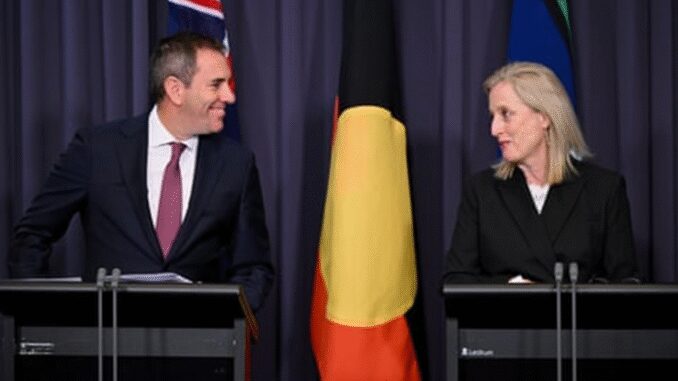
As the confidence of our financial ministers increases, Jim Chalmers can afford to be franker about the trendlines in budget parameters since his budget speech on 25 March 2025. Any deteriorations in the indicators at home and abroad can be used to justify the need for essential fine-tuning from previous benchmarks prior to our 2025 election (Image: Budget Paper 1:79):
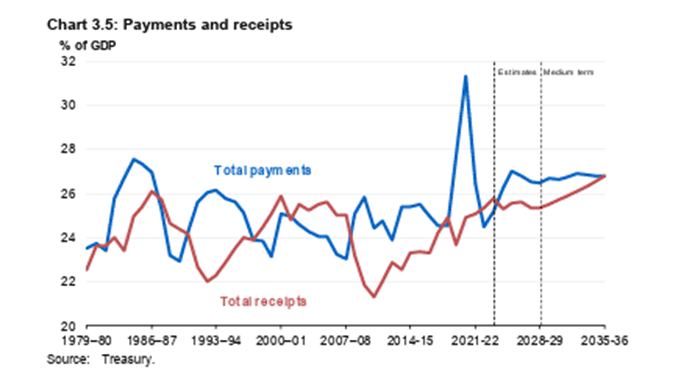
Treasurer Jim Chalmers promised to respond to pressures on the budget parameters after the September national accounts arrive in time for the preparation of the mid-year MYEFO report in mid-December. Essential forthcoming policy strategies were discussed at an open press conference at Springwood in Outer Brisbane with leading journalists (20 November 2025):
“The Albanese Labor government is managing the economy in a responsible way in the face of all of this global economic uncertainty. Very positive about Australia’s economic fundamentals but also very positive about the government’s reform agenda. Their report goes out of its way to mention the progress that has been made and the momentum that was built at the government’s productivity roundtable a couple of months ago, and they also go out of their way to back in the Albanese Labor government’s approach to net zero. And once again I’m quoting from the IMF report, which says that; ‘the green transition, including the authorities recently announced 2035 commitments, offers opportunities for enhancing investment, productivity and diversification while contributing to Australia’s climate goals.”
Even the Weekend Australian (29-30 November 2025) has toned down its criticism of recent economic indicators in anticipation of the new September Quarter national accounts data:
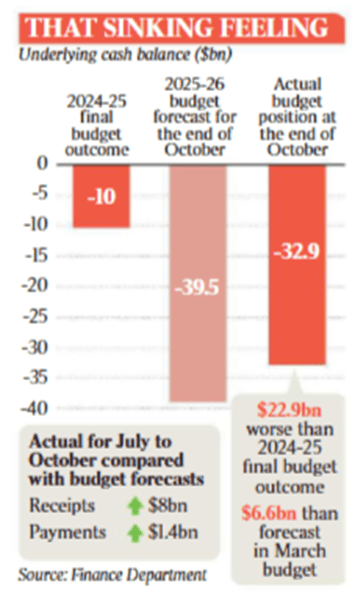
The Finance Department graphics were consolidated by comment from Westpac senior economist Pat Bustamante (Weekend Australian 29-30 November 2025):
Westpac senior economist Pat Bustamante is expecting slightly stronger growth, forecasting the economy to have expanded 0.8 per cent in the September quarter to an annual rate of 2.3 per cent. Bloomberg’s consensus estimates are for GDP to rise 0.7 per cent on-quarter and 2.2 per cent on-year, up from 0.6 per cent and 1.8 per cent in the June quarter.
Mr Bustamante thinks overall demand will show the sharpest quarterly gain since the March quarter 2012, and that such demand may not mean higher inflation. Strong employment and consumption lead to strong tax revenue.
A review of anomalies in expenditure growth in public sector spending is already in progress under the Albanese Government (AFR 25 November 2025):
Finance Minister Katy Gallagher’s department has ordered federal departments and agencies to outline sweeping spending cuts worth up to 5 per cent of annual budgets, in a move intended to rein in ballooning public service costs.
The Finance Department has written to cabinet ministers and public service bosses asking them to detail how they will meet the cost savings target, according to sources familiar with discussions but not authorised to speak publicly.
Private sector investment has already been successfully fostered as shown by the ABS indicators released on 27 November 2025. A revitalized centre-left government should be pleased with its investment scores in the wake of the successful environmental reform agendas with the Greens and most of the progressive crossbench in the Senate.
Key ABS Data on Private Sector Investment
The latest data from the University of Sydney on trends in Chinese investment from 1 April 2025 shows the value of Australia’s nimble diplomacy in reversing the decline in private sector investment from China during the Scott Morrison years:
“Chinese investment in Australia increased 43 percent to AU$1,312 million in 2024 – up from AU$917 million in 2023. Eleven completed transactions were recorded. However, despite the increase, 2024 had the third-lowest investment value and number of transactions since 2006, only higher than 2021 and 2023.
The continued low level of investment in Australia contrasted with the growth of China’s overall global Outward Direct Investment (ODI). China’s Ministry of Commerce reported a total ODI volume of US$144 billion in 2024, an increase of 10.5 percent on the previous year.
Investment in the ASEAN region has grown relatively rapidly, increasing by 12.6 percent compared to the previous year. Chinese enterprises made non-financial direct investments totalling US$33.69 billion in countries participating in the ‘Belt and Road’ initiative, a 5.4 percent increase over the previous year. Sub-Saharan Africa countries experienced the highest growth in Chinese investment.
Report co-author Professor Hans Hendrischke, University of Sydney Business School said: “While the previous two decades saw Australia emerge as a top destination for Chinese ODI, particular across the 2010s, over the past five years we have seen a notable drop in investment. This is line with global trends, with Chinese investment moving towards Southeast Asia and Belt and Road countries.”
More openness in financial decision making has been justified by Patricia Karvelas David Speers (ABC News from 27 November 2025: Is Labor ‘taking the piss’ on integrity? – ABC listen). Financial indicators should not rely on occasional media scoops by promoting more open investigation of the trendlines which enable social democratic objectives to be passed onto hard-pressed sections of the population who gave Jim Chalmers a real mandate in his outer metro electorate of Rankin in Brisbane.
Opening the AI data bases currently being used by Australian government departments would give the public access to emergent trendlines in spending priorities so that fair assessments can be made about the future financial and budgetary directions of the Albanese Government.
Hopefully, Treasurer Jim Chalmers will continue the nimble footwork of Environment Minister Murray Watt in consolidating the United Front with the progressive crossbench and the possibility of more public access to AI databases within Treasury and the Finance Department to avoid the need to rely on media scoops.
Opening as much as possible of The Good, the Bad and the Ugly in volatile financial indicators creates rapport with voters as the LNP cranks up well warn ideological explanations that ignore trendlines in the global economy and shocks created by the Trump administrations tariff regimes.
Australia cannot isolate itself from these global trendlines which were well covered in Britain’s Financial Times (FT) on 9 October 2025 by Tej Parikh and Martin Sandbu. Essential anticipations on both sides of politics should include stoking awareness of global financial instability.
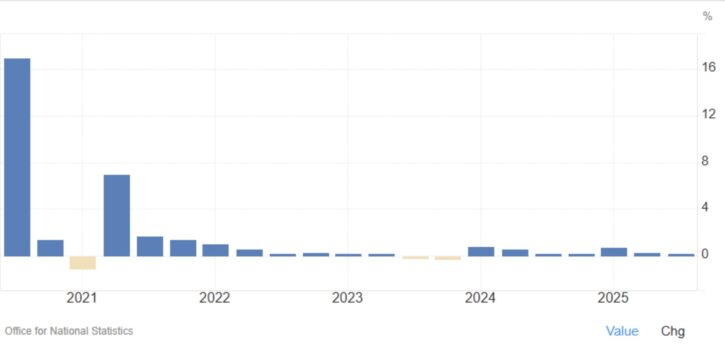
Social democratic renewal in Australia is slowly evolving best practice in financial policy responses compared with the Starmer Government in Britain. Here a massive parliamentary majority since the 2024 British elections has been squandered on unproductive military spending and arms sales to the cheers of Britain’s military industrial complexes (Image: Trading Economics Data on Percentage UK Growth Rates):
Percentage Changes in UK Economic Growth
Our financial ministers are in the front-line of preparing Australians for the unexpected and anticipating dangerous trends in far-right populist responses to global crises which could change the tone of national politics quite dramatically from shockwaves in the global economy and our strategic involvement in these crises.
Reaching out to more peaceful commercial relations with our Asian and Pacific neighbours gives Australia a real advantage over the ailing British economy which must tread water with the Trump administration for a greater share in global strategic hegemony to the cheers of global military industrial complexes on both sides of the Atlantic.
Our financial ministers think on their feet and can assess the dangers of thoughtless involvement in global strategic conflicts as recommended by military brass and intel services. Perhaps our greatest defenders of national sovereignty are from these financial sectors of policy making as the far-right of politics mobilises to respond to global strife-torn scenarios.
 Denis Bright (pictured) is a financial member of the Media Entertainment and Arts Alliance (MEAA). Denis is committed to consensus-building on the critical issues raised in each article. Your comments on this and related articles can be recorded on theaimn.net site.
Keep Independent Journalism Alive – Support The AIMN
Dear Reader,
Since 2013, The Australian Independent Media Network has been a fearless voice for truth, giving public interest journalists a platform to hold power to account. From expert analysis on national and global events to uncovering issues that matter to you, we’re here because of your support.
Running an independent site isn’t cheap, and rising costs mean we need you now more than ever. Your donation – big or small – keeps our servers humming, our writers digging, and our stories free for all.
Join our community of truth-seekers. Donate via PayPal or credit card via the button below, or bank transfer [BSB: 062500; A/c no: 10495969] and help us keep shining a light.
With gratitude, The AIMN Team


Kate Gallagher and Jim Chalmers are great leaders.
Thanks Denis for making financial indicators interesting again.
It is interesting to follow the financial indicators at the moment.
Our financial ministers are very independent and need support
I appreciate the effort to analyse the government’s economic position, but I cannot agree with the suggestion that Labor is managing the economy well. The lived reality for many Australians tells a very different story.
We have record housing stress, rising rents, soaring grocery and energy prices, and wages that are still not keeping pace. Essential services are being cut back when Australia’s dollar sovereignty means the federal government is never short of the public money needed to fund them properly.
Selective indicators like short-term GDP movements or private investment figures do not reflect what ordinary people experience day to day. A genuine assessment needs to acknowledge how hard it is for families, pensioners, and younger Australians to stay afloat.
A more balanced analysis would look at whether current policies are improving people’s lives, not just whether headline economic numbers look acceptable. On that measure, many Australians feel Labor has a long way to go.
What matters most is whether public money is being used to serve the public good. Right now, that connection feels very weak.
With the approval of top military officers and their intelligence service the Albanese Government is spending $60 billion on defence each year. This is half the cost of national health expenditure. The LNP and the mainstream corporate media generally want more rearmament and less association with Chinese investment. These are inheritances from the Scott Morrison years and secret negotiations with a cabal of four ministers who liaised with Boris Johnson and President Trump’s administration during his first term in office to betray the French submarine contract. Extra fees were imposed on the Albanese Government for breaches of contract with France. The Albanese Government is not responsible for this mess.
Denis, Thanks for the summary of the australian economic situation and highlighting the importance of the australia-china partnership.
Hope the the government follows a foreign policy independent of the trump administration.
Really, Denis?Bullshit comes to mind.
Thanks Denis Hay and Harry Lime. I have no problems with your comments. This is still a politically conservative society and change must commence with modest goals but not restricted to such pragmatic goals. The challenges from the far-right have intensified from the days when trade union membership was almost universal in the mines, state enterprises, hospitals and schools in Labor strongholds. Here in Q, the LNP seems to have won today’s by-election in the state seat of Hinchinbrook with the Labor vote well behind KAP (30 percent) and One Nation (15.6 percent). It is difficult to believe that NQ was once a stronghold of the Left in Townsville and Bowen. A greater united front across the broader Labor Movement seems to be the only strategy for change.
Denis Hay/Bright, it’s the old problem of seeing the spending issue as the goal rather than the neglected revenue issue that neoliberals shun..
Dennis Bright mentions the end of an era, post industrialisation, including for farm labor. No, unfortunately neoliberalism has messed “social cohesion” out of the way and the only time “social cohesion” gets a bat is when they are careful not to disturb the horses for Israel.
If Labor wants to be constructive, it needs to talk more with the rank and file, not less, as well as changing its attitude to toward the Greens and Indies.
No problems with your comments Paul Walter. The Greens and other progressives should be respected a part of a broader Labor Movement. I do not speak for the Labor Party when I write as a MEAA member. That would be propaganda and not real journalism.
Sorry Denis Bright to say I disagree strongly with your assessments.
The government is talking up waste as a problem and dropping hints of spending cuts – is this a conservative government or what? Wasn’t cut spending and eradicate waste the Liberal party mantra?
Waste? If the government intends to rein in spending by finding waste, then there are a number of places they could find tens of billions to cut – subsidies to fossil fuel industry ($15 billion/year), stop donating money to foreign countries submarine programs through AUKUS because we will not be getting any nuclear subs ($10 billion/year), stop building houses and bases on Australian soil for a rogue foreign country’s marines and submarines (single digit billions), force gas and oil companies to pay for cleaning up their mess themselves.
Jim Chalmers talks a lot about increasing productivity. If only Labor’s actions matched their words. Australia’s investment in research and development both publicly and privately is way behind most developed countries. The funding cuts (in real terms, ie. allowing for inflation) to the CSIRO and the loss of 800 earlier and now another 350 researchers is madness. According to the Australia Institute it is not what a government should do if it was serious about increasing productivity.
Whether the EPA bill just passed results in a successful environmental reform remains to be seen and given that the draft was a sop to business aimed at fast tracking mining it doesn’t lend to giving much confidence that it will be a success overall.
The draft contained terrible measures such as too much ministerial discretion, pay to destroy, handing water triggers over to the states, devolving decision-making to the states, fast tracking decisions, excluding forest logging from Commonwealth oversight, wide-ranging national interest exemptions, and wording riddled with confusing and subjective definitions, such ‘seriously impair’.
That the Greens won concessions on better protection for native forests; banning fast-tracking of new coal and gas projects; and reining in ministerial discretion, could be seen as a win for the Greens, but it hasn’t fundamentally changed Labor’s terrible original draft. It seems to be universally regarded as an improvement on a broken system, but with all its concerning features and without addressing climate change it definitely cannot be described as successful environmental reform.
With this neoliberal extremist Labor government giving our gas away for free and approving new gas and coal fields like most people open milk cartons, is any faith that this government will develop, fund and make appointments to the new EPA in such a way as to actually make it work misplaced? How did the NACC work out under this Albanese government? How much gas was leaking from that gas storage tank in the NT that the EPA knew about for 20 years? Labor had oversight of the EPA for much of those 20 years.
Who is in charge of designing the national standards remaining (two already exist apparently? How did Watt go with designing stringent standards for the approval of Woodside’s North West Shelf plant extension to protect the 60 000 year-old rock art that is disintegrating from the pollution from the plant? Didn’t he end up giving Woodside the standards they wanted?
A country’s economy is the system of distribution of wealth produced in that economy.
How well is Labor doing economically:
• Failure on homelessness
• Failure on inequality, or inequity if you like
• Failure on poverty
• Failure on improving or maintaining public services
• Success in making the top 5% relatively richer still
• Failure at improving mental health
• Failure at home affordability
ALP 2025 Policies and Context
Please forgive the fragmented nature of my reply to your recent article. After all, I have never professed to be little more than a poor country boy from the back blocks of Wulkuraka.
It was late last year when I was having lunch with a former LNP Senator at the State Conference of a minor party, and in the spirit of light-hearted debate, I accused him of creating a “Motherhood Policies” that may not have truly addressed the political reality of re-election.
So it was with great interest that I read Denis Bright’s recent article “A More Inspirational Labor Financial Outreach with the Approach of MYEFO 2025”
Speaking from outside the tent, so to speak, let’s summarise what I believe are some relevant ALP policy commitments that ground the justification for MYEFO’s approach.
These include the government recently pledged another A$2 billion injection into the Clean Energy Finance Corporation (CEFC) to support households, businesses and firms shifting to renewables and clean energy technologies. This is explicitly referenced as part of the foundation for green transition investment as expressed on the Prime Minister of Australia’s web page from January this year.
Under the 2025 Budget, the ALP committed A$17.1 billion to vital infrastructure, and up to A$3 billion to complete the national broadband (NBN) rollout, aiming to boost connectivity nationwide.
The ALP also claims that, since taking office, it has improved the “budget position by A$207 billion over the next seven years (to 2028–29)”, and turned inherited deficits into surpluses in its first two years, with the 2025–26 deficit forecast at A$42.1 billion (lower than earlier forecasts under MYEFO) and argues in favour of its fiscal discipline while funding new investments.
Also on energy and climate: ALP aims for 82% renewable electricity by 2030, continuing support for households/businesses via power bill rebates, subsidised rollout of battery storage, and incentives for clean energy adoption.
Thus, the ALP approach combines public investment and incentives for private investment along with structural reform (especially in energy infrastructure/green economy) under the banner of productivity, resilience, and long-term economic transformation.
Critical Analysis & Counterarguments (Grounded in ALP Policy + Data)
Using those policies as context, here are concrete tensions, risks, and counterarguments, not theoretical but tied to real ALP commitments and recent economic signals.
Large public investment and green transition funding but uncertain return timing and scale.
This includes a $2 b bump to CEFC and infrastructure spending, bets on long-term productivity gains via clean energy, modern infrastructure, and broadband. But such investments, by their nature, exhibit long gestation periods. Returns via energy savings, productivity, or emissions reduction often materialise only after significant delays. If global economic conditions slip, or if private-sector uptake is weaker than hoped, the fiscal return may underperform.
For example, building up renewables to meet 82% of electricity generation by 2030 will require sustained, large-scale infrastructure, grid upgrades, and storage. Any bottleneck (supply chain, labour shortages, technology delays) could delay or derail the promised benefits.
Hence, while the ambition is high, the risk lies in long lead times, execution complexity, and dependence on favourable market and global conditions, not just raw policy design.
2 Also claimed fiscal improvements versus actual structural deficit and debt exposure.
The ALP also states that it has turned deficits into surpluses in the first two years, and projected a deficit in 2025 26 at A$42.1 b below earlier forecasts.
But reliance on volatile sources, e.g., commodity-export taxes, substantial corporate profits, commodity cycles, and favourable global conditions, leaves the budget vulnerable if external demand or commodity prices fall. If those favourable conditions reverse, the “improved budget position” may erode quickly.
Further, significant, ongoing public investment, combined with commitments (e.g., infrastructure, renewables, social services), expands the structural cost base of government. Unless matched by commensurate productivity gains or new revenue sources, Australia may face long-term constraints, especially if interest rates or borrowing costs rise again.
Thus, what appears to be prudent fiscal policy might turn into fiscal fragility, especially if macroeconomic winds shift.
Energy transition and clean energy subsidies, potential cost of living pressure & uneven benefits.
The ALP’s push for renewables, which includes subsidies, rebates, and storage rollouts, aims to lower household and business energy costs over time.
But transition costs, infrastructure upgrades, supply chain constraints, labour demands, and grid reliability investments may drive up prices or taxes in the short to medium term. Households and small businesses could see higher bills or costs, especially before renewable systems are fully operational at scale.
Benefits may accrue unevenly to those in well-connected areas or able to invest in home batteries or solar, while renters, low-income households, and remote and regional Australians might receive less benefit, potentially exacerbating inequality.
Hence, what is sold as “green savings for all” might turn into short-term pressure on the cost of living, particularly for the vulnerable, unless carefully managed.
Dependence on private-sector investment to deliver growth raises risk if business confidence wavers.
The current ALP’s narrative leans on “public investment to de-risk green and infrastructure projects” and “crowding in” private investment via subsidies, regulatory reform, and incentives.
But private sector uptake is never guaranteed. If global economic conditions (commodity markets, interest rates, global demand) deteriorate or if businesses judge returns as too uncertain, investment may slow or reverse.
That leaves the government holding high fixed costs and facing diminished returns.
So the model of public investment as seed and private investment as fruit depends heavily on external confidence and global conditions. A bad turn abroad or a dip in investor sentiment could undermine everything.
Structural and political risk: rising public footprint, growing cost base, and potential backlash.
The expansion in public spending (infrastructure, energy subsidies, social support) increases the size of government and its role in the economy. While many Australians may welcome greater support and services, this also raises questions of long-term sustainability, particularly if tax receipts are volatile or economic growth slows.
Politically, if promised benefits (cheaper energy, better services, productivity gains) don’t materialise swiftly, public dissatisfaction may grow, especially if people feel cost-of-living remains high despite “green transition” rhetoric.
Thus, the long-term political and economic sustainability of MYEFO’s path depends not just on policy design but on execution, global conditions, and social outcomes.
In Summary: The Risk-Reward Trade-Off of MYEFO 2025 & ALP Policy
Reward potential through green transition, modern infrastructure, broadband, clean energy, a more productive economy, and stronger public services.
Risk factors include long delays in returns, fiscal fragility if external conditions worsen, uneven benefit distribution, exposure to global cycles, and potential for rising cost of living or public dissatisfaction if expectations aren’t met.
The ALP’s 2025 approach isn’t irresponsible.
It’s ambitious.
But sometimes the difference between “bold and transformative” and “fragile and over committed” comes down to execution quality and luck with global economic winds.
Len Forsyth
The ALP likes to highlight its “improved budget position” and early surpluses, but a surplus does not mean strong economic management. It simply means the government has taken more money out of the economy than it has put in.
If a federal government with full dollar sovereignty records a surplus, it can only happen in three ways:
Taxing households and businesses more than it spends back into the economy.
Cutting essential public services and investment.
Allowing private debt to expand, as people borrow to cover the gap left by reduced government spending.
So when the ALP boasts about surpluses, the real question is: whose pockets is that money coming from?
It certainly is not coming from corporations that continue to post record profits, so the pressure inevitably falls on ordinary Australians through higher costs, reduced services, and growing private debt.
A surplus might look good on paper, but it usually means households are being squeezed.
So why are our strategic ministers so committed to annoying military patrols by air and sea into contested territory adjacent to China? China is a great trading and investment nation. China wants to expand freedom of peaceful navigation with air services operating directly between Taiwan and the Mainland as well as ferry services each day from Xinmin in China to adjacent Kinmen Island in Taiwan. Why can’t the US and Australian military simply buy tickets?
Gonggongche, agreed.
If Chalmers dropped”productivity”and “responsible” from his monologues,he’d have little to say.
Denis Hay,
You probably already know the old saying: “There are lies, damned lies, and then there are statistics.”
I agree with you that any policy can be dressed up to look impressive, right up until you ask who’s actually wearing the cost.
I don’t often wander into discussions like this, but some of it really does come down to a simple “time will tell,” assuming we still put any trust in the Charter of Budget Honesty Act 1998. Keeping a clear view of how any government manages the economy is getting harder by the day.
Most of us get overwhelmed at times, especially when the news cycle feels driven less by substance and more by whoever tosses the media the biggest crumbs for access. Being just a poor country boy, I know I do, especially since I lack formal training in critical journalism.
Two of my four children studied law in dual degrees. One studied law and journalism, and the other studied law and commerce. I am always fascinated by the divergence of their opinion when topics such as this are raised around the kitchen table.
So, whilst there is a three way disagreement how about taking a peek at this from John Menadue public policy journal, a consensus may be reached yet!
https://johnmenadue.com/post/2025/11/a-bold-reforming-government-needs-more-revenue/?
Dennis Bright, marvellous point concerning the relationship between Labor and Greens.
YES, the Greens and aliented left would have once been THE truest labor, but driven out by the Right, same as Howard and his “dries” drove out the more issues based social liberals.
Our taxation system is both old and oppressive, constant tinkering over the years has achieved what? Yes more disquiet with the tax system, forget the tinkering and start afresh.
The more people who pay tax, the less each of us has to pay to reach the same bottom line. Too many don’t pay tax at all!! Religious organisations, those who have some form of exception and those who can afford to spend a $million to avoid paying $millions.
All this could change with the introduction of a Financial Debits Tax (FDI), we’d all pay, but we’d all pay less.
Thanks for all the discussion on this article which originated from coverage of Ted O’Brien’s National Press Club Address.
I welcome comments from differing perspectives and remain committed to a more united front across the progressive sections of Australian politics which are under attack from Ted O’Brien and the more minor far-right parties.
In preparing media statements before and after the release of MYEFO later this month, the government’s media insiders should try to encode longer statements attributable to Treasury and Financial Department spokespersons. These statements would cover the context of MYEFO and the enormous burdens being imposed by AUKUS spending which the LNP wants to accelerate and add to our budgetary challenges.
Thanks Denis, I like your report, albeit I found it a tad ‘blue sky’ that required me to read between the lines. Confidence and a fair amount of faith is required more than ever.
My ‘reading between the lines’ was beautifully enunciated by Len Forsyth.
It seems to me that given Oz’ huge dependency on import/export, and thus foreign policy, in the face of the current Trumpian scourge, punishing or at least getting up everyone’s nose bringing paranoia in Europe, leaves Albo little choice but to walk the edge of a razor-blade whilst also chewing gum. He must keep tight, whilst being fleet-footed via Chalmers et al, to maintain an economic & strategic balance like almost never before. And to say the least that’s an ugly sight to many.
Nevertheless, T-Rump’s admin is fast falling apart, and there are good signs from the ‘Global South’ viz the South African G20.
The LNP (and their ‘Advance’ mates), and the reckless / sensation driving msm don’t give a damn about the Oz people, it’s just destructive politics all the way, pumping ‘populist’ shouty opinion, avoiding complex facts, with a determination to take Oz backwards into a neo-liberal/neo-conservative hellhole for the ultimate benefit only for the elite.
Thanks Clakka: Australians are lucky to have a majority Labor Government. Albo won because of his commitment to needs based policies where housing prices of one million dollars were the norma. Advancing further towards a more socialist future requires a more united front. Present perspectives are far from perfect with strategic policies controlled by the military brass and their intel services worldwide I respect the opinions of Denis Hay and Harry Lime. I am no apologist for global capitalism. Thanks to everyone who made the article worthwhile in promoting discussions. I regard my critics as allies in the struggle for of national sovereignty.