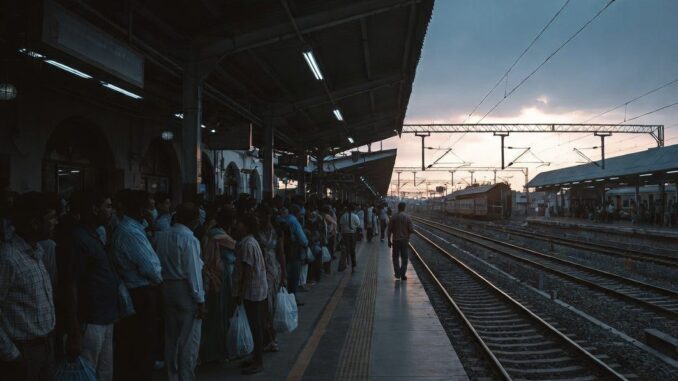
Platform 1 at 6:12am has a particular kind of light.
Not the golden, romantic light of postcard mornings, but the thin, undecided light that hasn’t committed to being day yet. The sky is often the colour of a bruised pearl. The air carries that early chill that slips under collars. The fluorescent station lights are still on, humming faintly, making everyone look a little washed out, a little unreal, as if we’re all extras in the same quiet film about modern life.
At 6:12, the platform is full but not loud. It’s crowded in the way mornings are crowded – people close together but sealed off from each other, each carrying their own private weather. You hear the small sounds of the commute – the soft thud of boots on concrete, the click of someone’s headphones, the hiss of a thermos opening, a throat clearing, a notification chime quickly silenced. You smell coffee, deodorant, damp wool, sometimes cigarettes clinging to a jacket from last night. You smell the faint metallic tang of the tracks.
And you see, very clearly, the social spine of the suburbs.
A man in hi-vis with a tool bag slung over one shoulder, tradie heading to a job site. A woman in a cleaner’s uniform, hair tied back tightly, eyes already tired, heading into the city to scrub other people’s offices before they arrive to sit in them. A student in a school uniform, tie crooked, backpack heavy, heading toward an education that will shape the rest of their life. A nurse in scrubs, walking fast, coffee in hand, another shift in a system that keeps the country alive. A young guy in hospitality black with swollen eyes, heading home after night shift, body still buzzing with fatigue. An older man with a folding shopping trolley, heading somewhere at an hour that suggests a life lived on public timetables.
This is what the platform shows you if you pay attention – the hidden workforce of a city, the people who move before the city wakes, the people whose labour makes everyone else’s routines possible.
When I say, “social spine,” I mean that in two ways. Public transport is literally the infrastructure that allows bodies to move. But it is also the infrastructure that reveals how society is structured, who has to get up early, who can stay home, who has the luxury of driving, who must take the train, who can afford to live close to work, who must travel from the edges.
I started paying attention to this in a way I hadn’t before because I became a regular commuter again after a period of working from home. Remote work, for all its conveniences, had quietly removed me from the public. I spent days in a private bubble – my house, my screen, my thoughts. The world became something I consumed through a feed rather than encountered physically.
Then work shifted, life shifted, and I found myself back on a train platform in the early light, waiting among strangers.
At first, like everyone, I did the commuter thing – eyes down, phone out, mind elsewhere. The train arrived, we boarded, we took our seats or stood holding the rail, we swayed together as the platforms slid past. It was functional. It was forgettable.
And then, one morning, I looked up.
A woman stood near the door holding a baby in a carrier, rocking gently as the train moved. Her eyes were fixed on the window, not seeing much. Across from her, an older man offered his seat without speaking. She nodded once, grateful, and sat down, still rocking. There was no drama, no conversation. Just a small act of care inside the machinery of the commute.
A few stops later, a group of teenagers got on, laughing too loudly, their voices bright against the morning’s solemnity. A man in a suit looked irritated. A tradie smirked. The teenagers sprawled, took up space, performed their youth.
Then one of them, mid-laugh, looked up and offered his seat to an elderly woman getting on slowly with a cane.
The woman hesitated, suspicious, because in the modern world kindness often feels like a trick, then accepted. The teenager shrugged as if it was nothing, as if generosity was not a moral performance but a reflex.
I watched it and thought – this is what public transport can do at its best. It makes us share space. It forces us into small negotiations of etiquette and care. It reveals that our social contract is written in gestures – the offered seat, the held door, the quiet shift of a bag to make room.
When public transport works, it acts like a social equaliser. It puts people of different incomes, backgrounds, ages, and occupations into the same carriage, under the same fluorescent lights, moving toward the same city. It reminds the comfortable that the city runs on more than their own profession. It reminds the isolated that other lives exist, close enough to smell.
But when public transport fails, it becomes something else entirely – a punisher. A machine that punishes those who have the least capacity to absorb inconvenience.
I learned that the hard way on a day when the trains were delayed and then cancelled, one after another, like a slow institutional shrug.
At first the platform reacted with ordinary irritation – people checking phones, tapping feet, muttering. Then the announcement came – “Due to an operational issue, services are suspended…”
The wording was always the same, vague, bloodless, designed to be unaccountable. Operational issue. The phrase could mean anything – signal failure, staffing shortage, an incident on the line, infrastructure so old it is collapsing into itself. It never told you what you needed to know, which is – how long will my life be disrupted?
A few minutes later, the platform began to change in character. The tradies started calling bosses. The students started panicking about being late to school. A woman in a uniform started crying quietly into her phone, pleading with someone on the other end not to fire her. An older man looked confused, as if the platform had suddenly become a foreign country. A young woman shifted closer to the wall, scanning the crowd, calculating safety.
That’s what I mean by punisher. When transport breaks, it doesn’t punish everyone equally.
If you have flexible work hours, a cancelled train is annoying. You send a message. You arrive late. You apologise. You’re forgiven.
If you have an office job with understanding colleagues, you can work from home. You can reschedule. You can take a taxi if you have to. You have options.
If you’re a cleaner who has to be at an office building at 7am because that’s the only time you can work without disturbing the people who will later occupy the space, you do not have options. If you’re a casual worker whose shifts are precarious, lateness can mean losing the shift, or losing future shifts, or being quietly replaced. If you’re a student whose school marks you absent, you get punished. If you’re a person with a disability who has planned your day around accessible routes and assistance, disruption can collapse the entire itinerary. If you’re a carer who has to pick up a child at a precise time, a delay can be catastrophic.
Transport inequality is about how much slack your life contains.
The wealthy have slack. The poor do not.
Hence why the question of who uses public transport matters, and what it says about inequality.
In Australia, using public transport is still, in many places, socially coded. In some suburbs, taking the train is normal and even chic, part of an urban lifestyle. In other suburbs, especially wealthy ones where car ownership is assumed, public transport is treated as something “other people” use. It becomes a marker – if you can afford a car, you drive, if you can’t, you take the bus.
This coding shapes policy. Because when decision-makers don’t use public transport, they don’t feel its failures in their bones. They don’t stand on a platform at 6:12am and watch a woman cry because a delayed train might cost her job. They don’t navigate inaccessible stations in a wheelchair. They don’t walk from a distant bus stop through dark streets in outer suburbs and feel fear rise in their throat.
Policy is often made by people who are insulated from the systems they govern.
The result is predictable – public transport becomes chronically underinvested, especially in outer growth suburbs, especially in areas with lower incomes. We build new estates without train lines. We make people buy cars they can’t afford because the buses come once an hour. We create commutes that steal hours from people’s lives and then wonder why they’re exhausted and angry.
Transport, in that sense, becomes destiny. It determines what jobs you can take, what schools you can reach, what friends you can see, what healthcare you can access. It shapes the map of opportunity.
I have friends who live in suburbs where trains come every ten minutes and stations are bright and staffed. Their commute is almost pleasant. They can be spontaneous. They can go out at night and still get home. They can live without a car if they choose.
I have other friends in outer growth suburbs where the bus is infrequent, where trains are far away, where the last service home is early, where the station car park fills before dawn. Their lives are structured around transport like a prison schedule. If they miss a bus, they lose an hour. If there’s a disruption, they lose half a day.
This is inequality in motion.
And it carries a gendered dimension that becomes painfully obvious at night.
I have stood on platforms at 10pm and watched women adjust their posture the way women do when they are alone in public – keys between fingers, phone ready, eyes scanning, body angled to keep options open. I have watched women choose carriages based not on comfort but on safety – near the driver, near other women, under cameras. I have heard the way conversation shifts when a man enters an empty carriage. I have seen the tiny calculation every woman makes – can I relax? Or do I need to stay alert?
Public transport, at night, can be a site of quiet fear. And that fear is not evenly distributed. Men move through these spaces differently. Women carry different risks. For some women, young women, disabled women, women in low-income suburbs where stations are poorly lit, the risk is lived.
A truly equitable transport system is frequent and cheap. It is safe. It is staffed. It is well-lit. It has clear information. It has emergency help that actually arrives. It has design that anticipates vulnerability rather than treating it as an afterthought.
The same is true for disabled commuters. I have watched people in wheelchairs wait for ramps that didn’t appear, or for staff that weren’t there, or for elevators that were broken. I have seen ramps deployed with a kind of reluctant choreography, as if accessibility is an inconvenience rather than a right. I have watched people with sensory sensitivities struggle with loud announcements and crowded platforms. I have watched older people hesitate at gaps between train and platform, afraid of falling.
A transport system is only as humane as it is accessible.
When we talk about public transport, we often talk about it like a technical problem – timetables, capacity, infrastructure. But it is also a moral problem – who does it serve, and who does it abandon?
There’s another layer now, one that makes the moral stakes even sharper – climate.
Every serious conversation about emissions eventually arrives at transport. Cars are not just personal freedom machines. They are a collective environmental burden. The more we force people into car dependency, by building suburbs without good public transport, by making trains unreliable and buses infrequent, the more we lock ourselves into emissions patterns that are hard to break.
This is the reason the argument for making public transport free or nearly so is a climate argument and an equity argument at once.
Imagine what a cheap, frequent, reliable network would do. It would reduce car use. It would reduce congestion. It would reduce pollution. It would reduce household transport costs, costs that, for low-income families, are often second only to housing. It would give teenagers independence without requiring parents to drive them everywhere. It would give older people mobility after they stop driving. It would give people in outer suburbs access to jobs without punishing them with three-hour commutes.
It would, in other words, function like a true social spine – connecting not just places, but lives.
But to do that, public transport must be treated as essential infrastructure, not as a semi-optional service that can be cut, privatised, or underfunded without consequence.
And this brings me back to Platform 1 at 6:12am, because that’s where these abstractions become flesh.
On that platform, you can see who depends on the system. You can see who has no backup option. You can see who is quietly holding their life together with the thin thread of a timetable.
I remember a morning when I overheard a conversation between two cleaners. They were sitting on the bench, uniforms neat, hands wrapped around takeaway coffees.
“Did you hear they might cut our hours?” one said.
“Yeah,” the other replied. “Rent went up again. I don’t know what I’m doing.”
They spoke quietly, not wanting to be overheard, but the platform is a place where private worries leak into public air. That’s part of its strange intimacy – strangers witness each other’s lives in fragments.
One of them glanced at the train arrival board.
“If this train’s late again…” she began.
Her friend sighed. “It’s always late.”
They laughed, but it wasn’t funny laughter. It was the laughter of people who have learned to cope with a system that doesn’t care.
A few metres away, a group of students in uniforms were comparing notes about an exam. Their voices were anxious, high.
“I didn’t study enough,” one said.
“You always say that” another replied.
“Yeah but this time I really didn’t.”
They were ordinary teenagers, but the moment contained something else – the way education is shaped by transport too. If you’re travelling long distances to school, if you’re exhausted by commuting, if you’re late because buses are infrequent, your learning is affected. The platform becomes part of the classroom, the commute part of the curriculum.
Closer to the edge, a man in hi-vis was on the phone.
“Yeah, I’m on the platform,” he said. “No, they haven’t said when. Yeah, I know. I’m trying.”
His voice carried that particular mix of apology and irritation. He wasn’t angry at the person on the phone. He was angry at the situation. But anger has nowhere to go in a system that answers with recorded announcements and vague apologies.
The train eventually arrived. We boarded. The carriage filled with the smell of wet jackets and coffee. People settled into their bubbles again. The suburbs began to slide past – back fences, graffiti, industrial estates, pockets of trees, rows of houses still asleep.
I looked around and felt a strange affection for this moving room. Not by virtue of it being comfortable, it wasn’t, but because it was shared.
We talk a lot about Australia’s fragmentation – political polarisation, cultural tension, online outrage. We talk as if the country is coming apart at the seams. And in many ways it is. But then you sit in a train carriage at 6:12am and you see a different truth – people are still living side by side. They are still sharing space. They are still, mostly, behaving with the quiet civility that makes a crowded society possible.
So, question is whether we can afford not to invest in public transport.
Because the cost of poor public transport is lost time, hours stolen from people’s lives. It is lost income, shifts missed, jobs lost. It is increased car dependency, more debt, more emissions. It is increased isolation, outer suburbs cut off from opportunity. It is increased vulnerability, women afraid at night, disabled people excluded, older people stranded.
A society that treats its transport network as an afterthought is a society that is quietly deciding whose time matters.
And once you see it that way, Platform 1 at 6:12am becomes not a mundane scene but a moral one.
It becomes a place where the social contract is tested daily, in the form of timetables and reliability and safety. A place where society reveals whether it is designed for everyone or only for those who can buy their own mobility.
I have thought about this often when politicians talk about “choice.” They speak as if driving is a choice. For many people, it isn’t. They drive because the bus is useless. They drive because the train is too far. They drive because they work hours when public transport doesn’t run. They drive because the system has been designed to force them into it.
Choice, in that context, is a privilege disguised as freedom.
Real freedom is having multiple viable options.
Real freedom is a transport network that treats outer suburbs as worthy of connection, not as afterthoughts.
When I get off the train and walk out into the city, I often notice something – the people who arrive at 7am are not the ones who will be praised. They are the ones who make it possible for the praised to arrive later to clean offices, build scaffolding, prepare food, open shops, care for patients, keep systems running.
Their commute is part of their labour. Their waiting time is unpaid work. Their vulnerability to delays is another form of precarity.
If we are serious about equality, we should be serious about transport. Not as a talking point, but as daily lived experience.
Public transport should not feel like punishment. It should feel like a normal, respectable way to move. It should feel safe and clean and predictable enough that people of all incomes choose it, not just those who have no choice.
A city where the wealthy take the train is a city with better trains.
A city where the powerful ride the bus is a city with better buses.
The moment the system becomes something “other people” use, it becomes easier to neglect.
And yet, despite everything, people keep showing up. They keep waiting. They keep boarding. They keep sharing the carriage. The train keeps moving, most days, carrying the quiet labour of ordinary lives.
There is something almost noble in that persistence, but we shouldn’t romanticise it too much. People shouldn’t have to be heroic to get to work. They shouldn’t have to budget extra hours for failures. They shouldn’t have to feel fear on a platform.
A decent society doesn’t demand endurance where it could provide service.
So, I keep returning, in my mind, to Platform 1 at 6:12am. To the light. To the smell of coffee and damp jackets. To the hi-vis, the uniforms, the schoolbags. To the eavesdropped fragments of life.
Because it is there, in that mundane scene, that the city’s values are revealed.
And every time the train arrives on time, every time a bus comes when it’s meant to, every time a station is lit and safe, every time a wheelchair user boards without drama, every time a woman travels at night without fear, every time a low-income worker arrives without being punished by delay, the city is saying something quietly but powerfully:
You belong.
You matter.
Your time is worth respecting.
That’s what a social spine is meant to do – hold us up, all of us, not just the ones with keys to a car.
And if we can build that, if we can fund it, protect it, dignify it, then Platform 1 at 6:12am becomes not just a place of waiting, but a place where Australia, in its most ordinary form, keeps its promise.
Keep Independent Journalism Alive – Support The AIMN
Dear Reader,
Since 2013, The Australian Independent Media Network has been a fearless voice for truth, giving public interest journalists a platform to hold power to account. From expert analysis on national and global events to uncovering issues that matter to you, we’re here because of your support.
Running an independent site isn’t cheap, and rising costs mean we need you now more than ever. Your donation – big or small – keeps our servers humming, our writers digging, and our stories free for all.
Join our community of truth-seekers. Donate via PayPal or credit card via the button below, or bank transfer [BSB: 062500; A/c no: 10495969] and help us keep shining a light.
With gratitude, The AIMN Team


I am 83 years old I have a car and still drive Wh I have to go into the inner City or the major hospital or Dental Clinic I use public transport For example to go to the Hospital for a specialists appointment would take 15 to 20 minutes if I drove but parking would be between $20 and $40 Train and bus costs 50 cents and takes 25 minutes plus 5 minutes to walk to the train station
Several years ago I boarded a train that was full A young lady offered me her seat and I was horrified I politely refused because my generation always gave up their seats for women and disabled persons When I got home I thought about it and decided I was wrong I am not as steady on my feet as I once was and in the event of a sudden stop could go down Also I am sure that accepting that seat would have made the young lady feel good Nowdays if anyone offers me their seat I accept with gratitude Learning that you are no longer young takes time but needs to be accepted
Wonderful analysis.
so manners still exist in some of the younger generation. Who knew. I guess that some teenagers live with their granparents, and some are just self-centered little snot-noses.
I live in Melboune’s south east. I am a “Boomer”. I drive, and I guess take that for granted. Bunnings for sausages with family and our dogs. Shopping. Nursery for more plants. Living a life. You know how it goes.
I travel into the city once a month for medical treatment. By train, because it’s just easier. Less stressful. No parking costs. Same travel time if not quicker. Cheaper.
I have the choice of two lines. Frankston, and Cranbourne. Both stations are about ten minutes from home. Both have enough parking early in the morning. Frankston is a longer commute, on older trains, but with sea views. Cranbourne has new trains. The “fully siick” streamlined ones built in Ballarat.
The people are different. Frankston is what Frankston is, but as I get closer to the city the people change. the clothes speak of more money. Higher incomes, more expensive schools, better jobs. Trains are a choice. An option.
Cranbourne is new. Or newer. People who have moved out, for their own house, but at a cost. A social cost. There are fewer schools. The roads are clogged. Social facilities are non existent, or an afterthought just now being created. Jammed in somewhere. Some of the stations are far-between, so the travel between two station options is as long as mine from another suburb. The line itself stops at Cranbourne. WHY? It was supposed to go out to Clyde when that subburbe was craeted out of Ag-Land a few years back, and the designated land is there, but still nothing.
It is the same out in the West, or at Tullamarine Airport.
The writer poses the question “… whether we can afford not to invest in public transport.”
Councils, Cities, Greater Cities, States and Australia CANNOT afford to NOT invest in our social infrastructure. The constant cry of “where will the money come from” is a bullshit-storm thrown around by the msm and various other vested interests in order to either “get the contract for themselves and make a shitload of cash” OR to stall the growth of social infrastructure because it will get in the way of greed.
Building a railway line is not the same as building a block of flats, with some of it designated as “social housing”. Train lines are single purpose, and they are for EVERYONE. Regardless of income, social status, profession, or requirements and frequency use. A track will be there forever, and while yes it will require some maintenance occasionally a train line is not something that is going to get demolished to make way for something else. They can be built across uninhabitable land too, and elevated above floodplains where housing is just impossible to permit, even by the most lax of council regulations.
Melboune was failed when the relevent State Guvvm’nt sold the land set asside for the Doncaster train line to developers for housing. Victoria, and Australia, have been failed by a succession of guvvm’nts at all levels by constantly putting the Tullamarine line onto the back-burner. And Australians have been sold the lie over and over and over that “Where is the money coming from” is the reason that our public transport is in it’s parlous state, and our roads are the shambles that they are.
The Guardian:https://www.theguardian.com/australia-news/2026/jan/29/australia-tax-breaks-landlords-more-spending-than-social-housing-homelessness-rent-assistance-combined.
Oh ….. so that is how the Sydney metropolitan suburban railway network now operates. Spare a thought for the NSW voters north of Armidale where the Greiner COALition misgovernment after the 1989 election when a new boy NOtional$ politician representing city aspirations at enormous cost to Northern Tablelands voters when the then government chose to close the only public transport infrastructure so that funding could go into subsidising the Sydney metro network.
Well, it was only 216 km of strong NOtional$ voters who wanted a 19th century future that the unelected political hacks in NOtional$ air-conditioned head office were more than willing to give them.
Now, about 40 years later these same voters and their offspring have no expectation of any improvement from NOtional$ pre-selected candidates.
Meanwhile, back in the city the suburban train network is now subsidised to about 90% of operating cost while the corporate desk jockeys earn more than the Premier for doing considerably less.
Fortunately 4/8 of the NSW state electorates have seen the light and elected INDEPENDENT representatives of the voters who are doing a fabulous job rectifying the mess created by the uncaring self-serving NOtional$ politicians.
Love your writing Roger, brings the world into focus.
“But when public transport fails, it becomes something else entirely – a punisher. A machine that punishes those who have the least capacity to absorb inconvenience.”
A simple example from yesterday; travelling from regional Victoria it usually takes 90 mins to Southern Cross both directions; post a required meeting in the CBD travelling back was simply a nightmare – waiting at the platform we played the change the platform game 7 mins prior to departure, departure of 11:58 delayed till 12.20 – until we get to Ballan, another delay which the service was eventually truncated at Ballarat, not Wendouree.
On both instances the delay was due to ‘trespassers’ on the tracks and a police operation? Flash back to 2024 with the same thing at Ballan and I’m wondering just how well managed Public Transport is, it’s not we know that.
“I learned that the hard way on a day when the trains were delayed and then cancelled, one after another, like a slow institutional shrug.”
I’ve known trains to be cancelled because the conductor did not show up, issues with rolling stock, ‘police operations’, someone maybe falling sick during the journey who could not afford to stay home, musical chairs with the constant platform changes, asking ‘outsourced’ staff what the heck is going on when they don’t know either, numerous people walking around looking busy and clueless and permanent staff who do as little as possible!
It’s all about management, who can’t be sacked or can be moved sideways and of course the State Government who could care less as they have their own private transport – comm cars, which is paid for by the taxpayer.
Who cares? Nobody. And don’t get me started on the rolling stock, south-east has far better fitted out comfort options, many more hand straps if the service is at capacity, much cleaner, better ventilated not the cattle carriages of the western suburbs, Metro service or VLine.
The introduction of Myki was meant to be efficient and more cost effective which has been fraught with delays and cost run outs, and a public service that is now privatised which you cannot use seamsley between States which have been separately duplicated in every State, so you can thank RTBU for that here in Victoria and its sister organisations in other States.
Same old, same old everywhere you look, vested interests by Ministers who have no ‘real’ experience of dealing, let alone using a public transport system who are psychologically removed from what you have written.
I’ve had the privilege of owning a car however have used public transport on a daily basis for the past 20 years, pensions do not accommodate maintenance and overheads of a private vehicle.
So yeah, a simple 90 minute journey was 3.5hrs getting back.