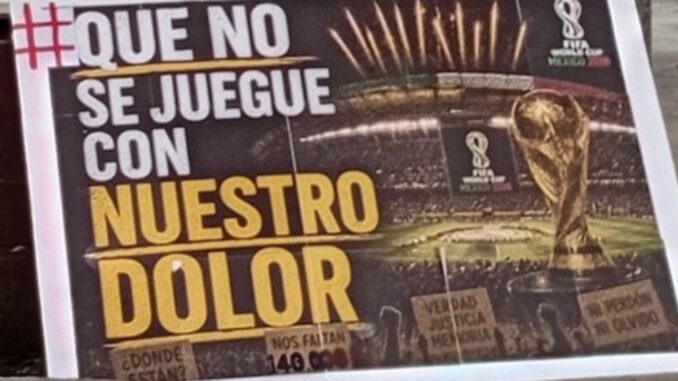
The families of more than 133,000 missing Mexicans are organising around the World Cup as a rare chance to be heard. Four women tell their stories to Rob Mellett via video link from Mexico.
By Rob Mellett
Mexico will co-host the 2026 FIFA World Cup, with matches beginning on June 11 in Mexico City, Guadalajara, and Monterrey. Billions have been committed to infrastructure, stadiums, and global promotion.
For thousands of families of the disappeared, the tournament represents something else: a window in time to be heard.
Mexico has more than 130,000 registered missing persons, most of them vanished in the past two decades during the country’s militarised war on drug cartels. A 2026 report by the Inter-American Commission on Human Rights describes a crisis in which criminal groups are responsible for most disappearances, but state actors are implicated at an ‘alarming’ rate, often in collusion.
The government rejects that characterisation. President Claudia Sheinbaum has said enforced disappearance by the state ‘does not exist’ in Mexico. Authorities frequently suggest many cases involve people who simply left voluntarily. However, human rights groups say the vast majority of victims are killed or forcibly recruited by organised crime groups, sometimes with the involvement of local officials.
Yet since 2014, only 357 people have been charged with disappearance-related crimes. Nine have been convicted. Around 70,000 unidentified bodies remain in state custody.
Those who search for the missing now face growing dangers themselves. Human rights groups report that dozens of searchers – mostly mothers and sisters – have been murdered or disappeared in recent years as they try to fill the void left by the state.
Families have filled that void. They search, organise, and investigate, often at risk to their lives. Among them is Inocencia González.
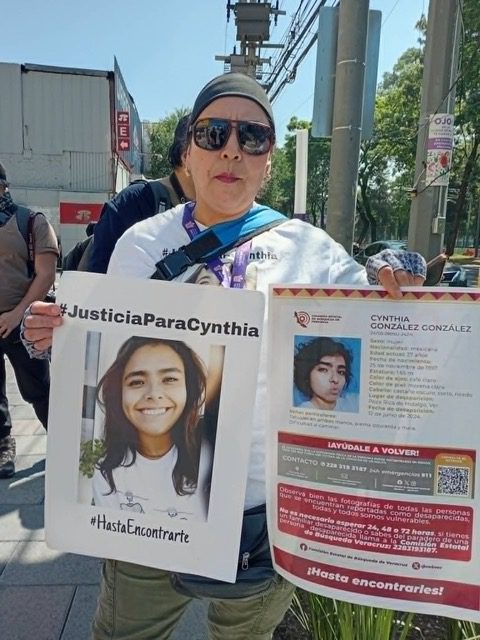
On the morning of June 12, 2024, her daughter Cynthia González left home in Poza Rica, Veracruz, to file a complaint against police officers she said had been harassing her for months. She had documented everything: names, patrol number, incidents.
At 8.45am, she called her mother to say she was on her way to the prosecutor’s office.
It was the last time Inocencia heard her voice.
Cynthia, 26, was a petroleum engineering student. Months earlier, in January, officers from patrol unit SP-3994 had stopped the taxi she was in, detained her without a warrant, and accused her of assault and drug possession. She was later cleared of all charges.
The harassment continued. The same patrol appeared outside her home, her university, the places she visited. ‘The fear became part of her routine,’ Inocencia says.
On June 12, she went to report them. She has not been seen since.
Weeks later, police issued, and then deleted, a statement claiming she had been detained again. When her mother tried to file a disappearance report, authorities initially refused to take it.
The officers named by Cynthia have not been called to testify.
‘My daughter is gone,’ Inocencia said. ‘And the government continues to deny this.’
She now searches through collectives, protests, and social media. For her, the World Cup is leverage.
Carolina Guerrero is also preparing to get the family’s message out at the tournament.
Her brother Sergio disappeared one night after leaving their mother’s house in Mexico City. By the next day, the family was already searching, knocking on doors, requesting CCTV footage, reconstructing his movements.
They tracked him getting into a car, then entering a property in Las Águilas. He never came out. Two vehicles left soon after.
The trail ended in Santa Fe, where cameras that should have recorded the vehicles showed nothing.
‘From the moment Sergio disappeared, we became private investigators,’ Carolina said.
More than two years later, one suspect is before the courts. Another remains at large.
For the World Cup, Carolina and her collective plan to demonstrate near Estadio Azteca.
‘The government calls the missing list a “phenomenon”,’ she said. ‘But this is a crime against humanity.’
Martis’s search began with a ransom call.
Her son Javier, 35, disappeared in July 2020 after travelling to Veracruz with acquaintances to sell a truck. Within hours, the family was contacted by kidnappers demanding 500,000 pesos.
They paid. Javier called once from captivity, pleading with his brother to comply. ‘Do everything they ask,’ he said.
After the money was delivered, communication stopped.
They have not heard from him since.
Martis has searched lagoons, hired investigators, and plastered the city with posters. No arrests have been made. She believes the group responsible is still active.
Antonia Velázquez is searching for her brother Ricardo.
A former municipal police officer, he disappeared in 2021 after accepting a ride-share fare toward Nuevo Laredo. His last GPS signal came from a stretch of highway where dozens of similar disappearances have been recorded.
Authorities told the family there were more than 80 cases with the same pattern.
Antonia believes he may have been targeted – either handed over by former colleagues or taken for forced recruitment by organised crime.
After his disappearance, the family says they were harassed by police and forced to leave their home.
‘Each state feels like a different country,’ she said. ‘As if we don’t share the same constitution.’
Across Mexico, families like theirs have organised into collectives, conducting searches the state has failed to carry out.
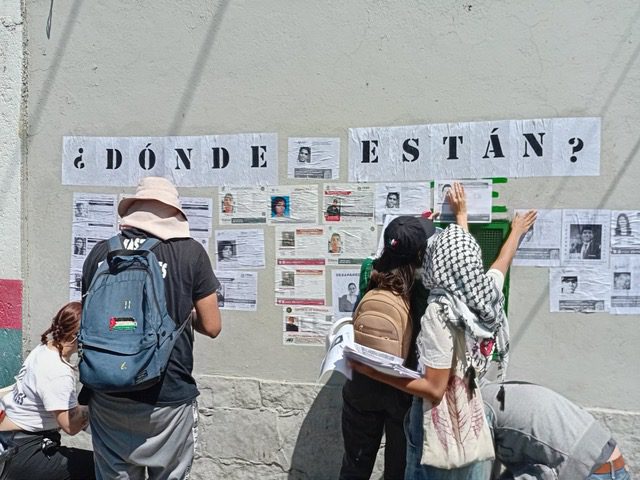
They will now protest at the World Cup.
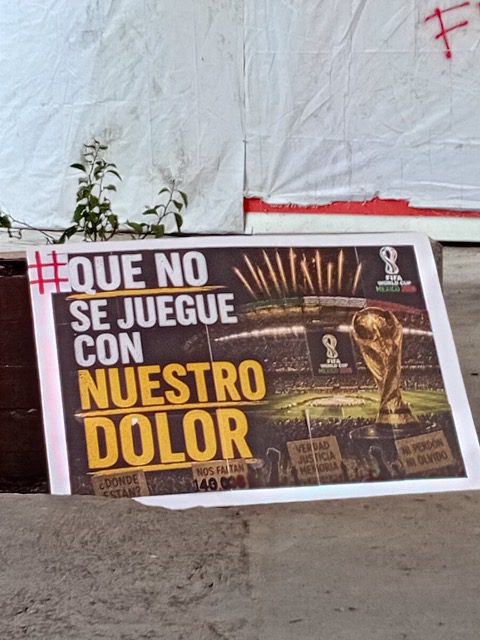
They plan to march, to demonstrate, to make themselves visible to an international audience that may otherwise never hear their stories.
At the end of our interviews, Carolina made a request: that these stories be carried beyond Mexico.
‘We want the world to see what is happening here,’ she said.
Inocencia addressed those who will watch the matches abroad.
‘We have nothing against football,’ she said. ‘But we ask for empathy. There are more than 133,000 disappeared people. We are asking someone to listen.’
Then, more quietly: ‘I have to be the voice of my daughter. Because the police who disappeared her are still working. And we don’t know what else to do.’
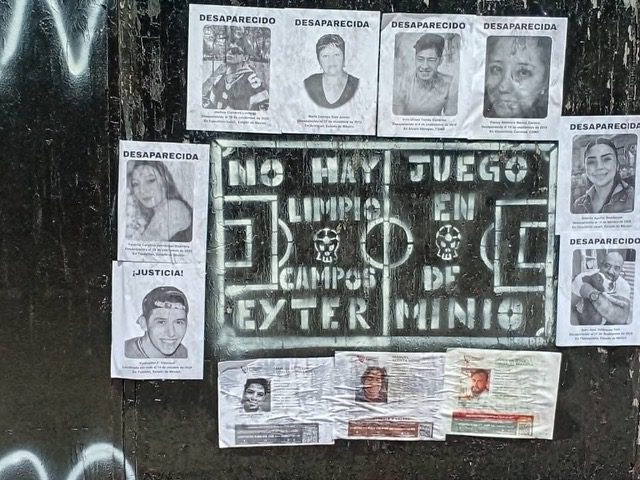
Email your federal and state politicians in Australia demanding they raise the issue of Mexico’s disappeared with the Mexican government. Share these stories on social media. Tag Australian media outlets and football organisations. Demand action, not silence. These mothers’ and families’ voices must be heard before the final whistle blows.
Keep Independent Journalism Alive – Support The AIMN
Dear Reader,
Since 2013, The Australian Independent Media Network has been a fearless voice for truth, giving public interest journalists a platform to hold power to account. From expert analysis on national and global events to uncovering issues that matter to you, we’re here because of your support.
Running an independent site isn’t cheap, and rising costs mean we need you now more than ever. Your donation – big or small – keeps our servers humming, our writers digging, and our stories free for all.
Join our community of truth-seekers. Please consider donating now via:
PayPal or credit card – just click on the Donate button below
Direct bank transfer: BSB: 062500; A/c no: 10495969

We’ve also set up a GoFundMe as a dedicated reserve fund to help secure the future of our site.
Your support will go directly toward covering essential costs like web hosting renewals and helping us bring new features to life. Every contribution, no matter the size, helps us keep improving and growing.

Thank you for standing with us – we truly couldn’t do this without you.
With gratitude, The AIMN Team
Thank you, Rob, for raising awareness of this horrible situation.
Australians shouldn’t feel smug about this, Labor is trying to increase ASIO powers where they could literally disappear Australians too.