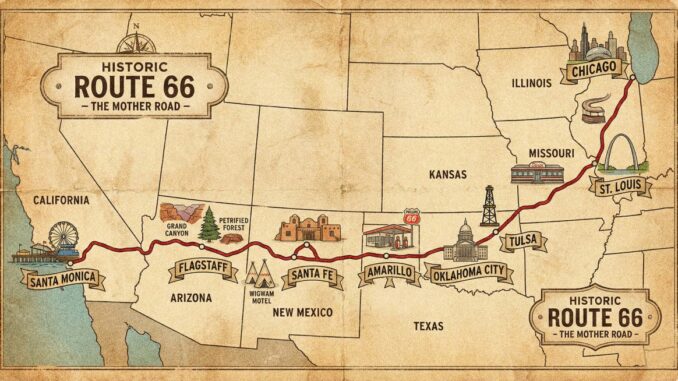
“This highway, if you just think about it, is peppered with hope, it is peppered with tears.” (Angel Delgadillo, dubbed the “guardian angel” of Route 66).
By James Moore
When Interstate 75‘s construction began to rise up through Central Michigan, my fascination with roads became almost feverish for a boy. The idea was exhilarating to me that the same slab of concrete running near my neighborhood could connect me to California or the Rocky Mountains. Nothing more was needed than wheels and an engine and fuel. The Interstate Transportation and Defense System was conceived by an American president who had led the nation to victory in a great war, and he envisioned a time when our country might be under further attack and would need to be able to move men and materiel for defensive combat. Instead, we spent decades building a network of roads that became a kind of economic circulatory system.
While I was early dreaming of where southbound roads might take me, my father was a bit befuddled by the new “superhighways.” The infrastructure of every location he had ever lived was laid out with right angle intersections of two and four-lane roadways and there were generally stop lights and signs to control traffic flow at intersections. Using an on-ramp to merge with high speed traffic on an interstate was a process he was unable to process. Before his first time on I-75, I tried to make Daddy understand that he had to accelerate as he went down the ramp so he could ease over into the passing traffic. Instead, he rolled slowly down with his blinker flashing, and when we reached the bottom, he came to a full stop and looked back over his shoulder for a break among the flow of oncoming vehicles. I knew enough to keep my mouth shut without offering further guidance as an eight-year-old.
The idea of the interstate system was entrancing for quick travel but I grew more enamored of the roads through small towns and how those connections informed life and commerce. The divided highways offered speed, and gas, food, and lodging, but as we rolled through the hills of Kentucky and Tennessee on narrow state roads, making our way to Mississippi, even a child saw the culture and how the miles altered expressions of business and public art. I am certain these modest experiences of travel to visit my father’s family in the Mississippi bottomlands were what birthed my interest in the “Mother Road,” Route 66. Author John Steinbeck had used the phrase in his 1939 masterpiece, “Grapes of Wrath,” trying to describe the critical nature of the highway to survival by the Dust Bowl diaspora making their way to California.
“66 is the path of a people in flight, refugees from dust and shrinking land,” he wrote. “Highway 66 is the mother road, the road of flight.”
I read of Steinbeck’s Joad family when I encountered his novel in high school and developed an urge to travel Route 66’s full 2448 miles from Chicago to the Santa Monica Pier in California. With neither money, nor a vehicle, I convinced a boyhood friend, Butch, recently returned from Vietnam, to join me on a hitchhiking adventure down Route 66. I assumed his long hair and beard were going to be impediments to drivers picking us up from the road’s shoulder but once we found the old alignment near Springfield, Illinois, we had little trouble getting lifts and spent only two nights sleeping in the brush by the side of the road before we had crossed Oklahoma, Texas, and New Mexico. Sections of the historic pavement had been covered over by interstate construction by the early 70s but local municipalities had pressured the federal government to leave till last the connections that bypassed their main streets and downtowns.
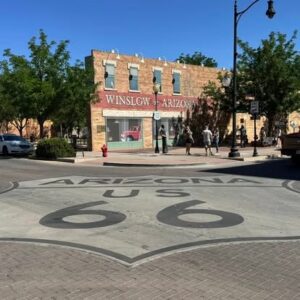
In Arizona, we were dropped off on a painfully hot sidewalk on the east side of Winslow. The sun was directly overhead and there were no shade trees nearby and while we were trying to decide what to do next a pickup stopped. The driver did not get out but simply looked into the bed of his truck and motioned with his eyes for us to jump up, which we did, gladly. The road noise and wind were too loud to have conversation in the back of the pickup, so we did not talk but we watched the broken white line’s hypnotic visual beat. When the driver stopped to let us off, we were only about five miles west of Winslow. We jumped down and he waved as he turned down a dirt road to the south toward the Mogollon Rim. Night rolled up slowly from the east but I saw the lights of Winslow behind us starting their flickering against the dark. The horizon to the west was a low ragged line made by distant mountains and there was a faint glow of yellow behind the ranges.
“Just great,” Butch said. “Another night of sleeping in the dirt next to a highway.”
“What the hell else are we gonna do?” I asked. “Hopefully, we’ll get a quick lift to Flagstaff tomorrow and then we can head on up to the canyon. Need to get an odd job or two to get some food money.”
“Yeah, sure.”
Butch was usually quiet even when we were boys and whenever he smoked the weed that he carried in his backpack he took on a kind of deep silence that was private and made me worry and it was a part of why I asked him to join me on this trip. I think he had slept enough nights outdoors in the Vietnamese jungles and had no patience for desert heat and dust.
“I think we’ve been pretty lucky to get rides for 1500 or so miles and get where we are,” I said. “Look at us. I sure as hell wouldn’t give us a ride.”
“I’m going to try to sleep,” Butch said, “since I expect to spend the entire day tomorrow suffering in the Arizona sun.”
He went down below the Route 66 pavement and laid out his sleeping bag and started rolling a joint to smoke before he nodded off. There was not a lot of traffic that night but we saw headlights reaching out across the desert along Interstate 40, which stretched east and west a few miles south of the old road where we were about to camp. The sky was black as the edge of the universe and made a great bend of stars. They appeared unfamiliar to me and I watched them trying to see if there was evidence of the Earth moving beneath the heavens.
The morning sun in the summer does not let you rest late in the American West and as we climbed up to face the flow of westbound traffic an aged Chevy truck edged onto the shoulder. The driver swung out of his seat and came around to the tailgate as we approached.
“You boys looking for work?”
He was tall and his jeans were shining in the early light. The old baseball cap he was wearing had the insignia of some Major League team, but it had been worn off by dirt and time. Long strands of wiry black hair hung from under the cap’s edges and almost reached the shoulders of his denim shirt.
“I guess we kind of are,” I said. “But we’re mostly hoping to get to the Grand Canyon and do some hiking.”
“You need money for travel, don’t you? I don’t think you’d be out here hitchin’ if you had much money.”
I looked past him and saw two children leaning against the rear window in the cab of his beaten down pickup. They were as brownish as the bondo on the truck’s fenders and were smiling brightly and made me worry less about the man’s intentions.
“What kind of work?” Butch asked.
“I’m building a house.” He took off his cap and dragged his fingers through his greasy hair and looked at his dusty work boots. “I can’t afford a full-time crew to help me. I need some boys like you to fire the kiln and make some bricks. It’s an adobe house. You interested?”
“What’s it pay?” I asked.
“I can do three dollars an hour.” The man shrugged. “That’s it. But you can pitch your tents at our place, and we’ll feed you three good meals a day. My wife’s a good cook and you can take my truck into Winslow at the end of the day, if you want.”
Butch and I looked at each other and agreed without speaking. We put out our hands to shake. We thought anything was better than sitting on the blacktop in the July sun and waiting for another vehicle to stop. I only had eleven dollars left and we both needed money to continue traveling through the summer. Our plan had always been to find piece work along the way and this job had simply rolled up in front of our extended thumbs.
I jumped into the cab of the truck and Butch settled into the back. The little girls were both about five years old and ignored me as their father slipped behind the wheel.
“I’m Robert,” he said. “I’m a Navajo, full-blooded, but Christian.” He put out his hand and it was coarse as old wood.
“Oh. Okay.”
“I think it’s obvious that god put you out there on the side of the road to help me finish our house. We’ve been living outdoors a long time.”
“Sure.”
Robert stayed on the blacktop for almost half an hour and then turned north in the direction of a far plateau. The road was a simple track of dirt, and dust spun up tiny tornadoes behind the truck. We drove for twenty minutes or so and did not talk much over the rattling of the truck and I was relieved when a canvas tent and the rough frame of a house came into view. A flap of the tent opened and a small woman with thick legs stepped out holding a baby. The two little girls next to me jumped excitedly and said, “Mama, mama.” Rips in the sun-faded vinyl of the truck’s bench seat appeared to lengthen.
The location was ideal for building a home. The red walls of a mesa were close to where the house’s foundation had been set and they offered protection from north winds. The rock face extended to the southwest and provided a natural leeward position to hide from western rain and snowstorms. Robert had also poured the slab to make the front of his home face the sunrise. Sunsets off the back porch might be obscured as the sun moved north of the mesa in the summer but autumn and winter views were likely to be spectacular.
“This is where god put us,” Robert said as we climbed out of the truck. “It’s a good place to live.”
“Yep, it is.” Butch dropped his backpack on the ground and looked around for trees but there were none. He did not care for trees after Vietnam because too much could be hidden in a jungle. “I like it here.”
“Hello. I’m Cecilia.” Robert’s wife smiled and waved a hand at us as she held the baby. “Are you hungry?”
“Yeah, we are.” She had caught me looking at a table with rice and beans and corn tortillas.
The names of Robert’s family did not sound Navajo, but we did not think about that and ate the warm tortillas that we had smeared with beans and rice. Robert stacked wood in the kiln and began to stoke a fire. After the flames had begun to grow, he came over and grabbed a few tacos and went back to work the blaze. The day was already growing hot and we worried about working constantly around flames while dealing with the desert sun. When the fire was finally crackling, Robert got some more tacos and then he went to an old cement mixer and pulled a rope to start the motor. He poured buckets of water into the opening as he chewed his food.
“You boys ready to work? Might as well get paid for today.” Robert hollered over the noise of the tumbler.
He explained how to mix the mud and sand and water and straw, how to pour it into a mold, and when the brick form was to be placed in the kiln for baking. Cecilia watched from in front of the tent. Her skin had the color of someone who lived constantly under the sun. We were unable to determine if she was a Navajo. She had managed to work Jesus into our brief conversation while we ate and was curious about how much we thought about the Son of God. We were not thinking about Jesus and only wanted hot food in our stomachs and also a little money in our pockets.
Robert stood next to Cecilia and watched us as we began to mix, mold, and bake the adobe. His two children played around the front of the tent on the hard, red ground. After about a half an hour of drinking coffee and scrutinizing our nascent skills, Robert opened the door of his truck.
“I’m going to work,” he said. “I won’t be home until around dark. Just keep making bricks. I’ll pay you cash for every day. You can take off whenever you want. But I hope you’ll stay and help us.”
He had suddenly left us alone with his family, complete strangers, and trusted us to stir mud and straw and bake adobe to help the completion of his home construction and we were still working when Robert returned that evening. Cecilia was standing over a propane stove finishing preparation of a meal. He motioned for us to stop and sit at the wooden picnic table. Robert pulled out several crumpled bills and smiled.
“The lord provides,” he said as he handed both of us thirty dollars in tens. The skin of his hands was cracked and there was grease or dirt under his fingernails. His name was stitched in red lettering across a white oval above his shirt’s breast pocket. Butch and I smoothed out the wrinkled cash and folded it into our wallets.
“I prayed for you boys to appear, and here you are. I don’t know what further proof we all need of the presence of the lord.”
I got up and walked over to the kiln to check the fire. The temperature was dropping quickly and because our first night in the desert had been cold, we planned to spread our sleeping bags near the kiln.
“Look at all you have done today.” Robert nodded in the direction of the bricks we had spread on the other side of the tent. “This is not by chance. This is what god has planned. My family is grateful to you and the lord.”
“We just needed to make a little money for traveling,” Butch said. “How many days do you think you’ll need us?”
“There’s a lot to do.”
“Well, sure,” I agreed. “But we can’t be here all summer.”
“We’ll take care of you. You’ll eat well. And there’s always my truck for trips into town. Thank the lord.”
“We’ll get your bricks done, and maybe start with the walls,” I told him. “But we can’t stay all summer.”
Butch looked at me and was close enough to hear the conversation. The offer of Robert’s truck did not stop us from immediately feeling trapped. We had only a vague idea of the distance back to 66, but we knew how long it had taken for us to reach the construction site from the old highway riding in the truck. I wondered how Robert might react if we left. One of his daughters came over and climbed into his lap and his gentleness with her eased our increasing apprehensions.
For five days we worked without rest in the high desert sun of Arizona. Robert came home each evening and was thankful for progress and then he offered us a nightly wad of wrinkled bills. He paid without fail. Butch had asked for use of the truck the two previous nights and was told by Robert that it was not running properly, and he did not want to risk an additional trip into town. I began to worry.
“I’m pretty much ready to get the hell outta here,” I told Butch. “This guy talks about Jesus every night and he keeps us trapped in a box canyon. We’ve got enough money. It’s time to go.”
“If he won’t let us use his truck, exactly how are we supposed to get out of here?” Butch asked. “Are we going to walk to Flagstaff?”
“I don’t know. But I’m leaving. This guy’s religion and everything else is just starting to feel weird.”
“Like I said, how in the hell are you leaving?”
“Walking, if I have to.”
Butch had kept his sleeping bag pulled up over his head as we talked. Wood that was aflame in the kiln collapsed into embers and snapped loudly.
“Okay, so we need to leave,” he said. “If he won’t give us the truck tomorrow night to go to town, that’s a bad sign. We’ll walk out of here after they have all gone to sleep.”
“How many miles do you think it is back to the black top?”
“Doesn’t matter. We’ll just walk it.”
By the time the sun was turning faded and odd Arizona colors on Friday evening, we had begun to raise the walls of Robert and Cecilia’s house. A crude slurry had been used for finishing and Robert was very happy with what we had stood up. Butch asked about taking the pickup into town for a weekend dinner but Robert again suggested the engine was running roughly and he did not want to add the mileage of an optional trip into Winslow. He said he hoped to have it fixed in the coming week. Presently, he began a recitation about the mysterious ways of the lord and randomly quoted scripture.
The fire was burning loudly late that night as we rolled our bags and tied them to our packs while Robert and his family slept in their tent. The desert blackness was shimmering over our heads, made deeper by the new moon’s cycle, and was dimly lit with crystalline, white dots. Carefully, we walked out of the beautiful canyon onto the red dirt of the lane and did not look back until we were at least a mile from the yellow glow coming from the kiln.
“He’s going to get up in the morning and come get us in his pickup,” I said. “We aren’t going to get anywhere. We’ll be lucky if he doesn’t have a gun. The lord’s gun, of course.”
“Just shut up and keep walking,” Butch told me. “We’ll get out of here.” He was swinging his arms and keeping his focus on where his feet were falling. He knew about productive marching. “We can be to the blacktop before daylight if we don’t waste our time bitchin’ at each other and we just walk.”
The tiny colored lights of Winslow were smudged across a distance of many miles and there was no way for us to estimate the expanse of desert we had yet to cover. We were certain to still be walking in the morning and Robert was likely to come upon us as he was driving to his job. While I was looking at Winslow’s glow Butch pointed away from the city in the direction of the southwest. Minuscule headlight beams bounced against the night and moved slowly across the faded seam where the desert and the sky came together.
“That’s either 66 or I-40,” he said. “We might as well walk straight in that direction and we can avoid going into Winslow. We’ll hit 66 first.”
“Across that fence? Into the desert?”
“Got any better ideas? I don’t know what else to do,” Butch said. “It’s either that, or just sit here and wait for our pal Robert because he’s going to find us on this path if we don’t get off of it.”
He started toward the barbed wire. We checked our water bottles to make sure they had not fallen off and then we threw our packs over the fence and struggled to avoid getting snagged on the wire as we climbed into the open range. For the next six hours, we picked our way through the prickly pear and sage, pulling cactus needles from our legs, stumbling over rocks and cutting ourselves on ocotillo while trying to measure progress in the direction of the far highway. Before the eastern sky had begun to brighten, we heard the sound of engines and tires across a roadbed. We were finally on the shoulder of Route 66, standing in front of our packs when the orange circle of the eastern sun moved slowly skyward.
“All right,” I said, “now let’s hope the lord inspires someone to give us a ride so we can escape from one of his servants before he comes to get us.”
A blue Buick Riviera stopped almost as quickly as I had made my little sarcastic prayer and the driver energetically went to the trunk and opened it for our backpacks.
“I’m going as far as Needles,” he said. “Where are you fellas headed?”
“Flagstaff or Grand Canyon,” I answered.
“I’ll get you to Flag, then. Jump in.”
He was wearing navy slacks and black loafers with tassels. His shirt was powder blue and the thin blonde hair was combed back from a low forehead. I thought he looked like a salesman because he appeared to not yet be forty but had the fleshy middle of a person who had spent a lot of time traveling, sitting, and eating. I was in the front seat again and Butch was expecting me to manage the conversation, but I did not have a chance to find a subject before the driver spoke.
“How are you boys with the lord?”
“Um, I don’t know,” I sighed. “I guess we’re just traveling and not thinking about stuff.”
“Well, it’s an important question, you know. Our faith.”
I turned my head to the back seat to see if there was a reaction from Butch and discovered that he was rolling a joint. He might have been planning to smoke it in the car because he had returned to that place where he did not care what other people thought.
“We aren’t thinking about our faith right now,” I said. “We think a lot about food and water and sleep and getting a ride somewhere. We want to see the country.”
“Well, I should tell you about my faith then. My faith is so strong I believe I can close my eyes, take my hands off of this wheel, and the lord will steer my car.”
I saw Butch in the rearview mirror as he sat up straight, but he did not put down his rolled joint, and I now certain he was going to light up.
“Well, faith is a powerful thing,” I said. “It can probably accomplish almost anything, don’t you think? It doesn’t really need to be proved.”
“It can even drive my car. You boys don’t believe me, do you? Looka here.”
“Sure, we do,” I said. “We really and truly do.”
“Just watch.”
I did not want to watch. We were in the right lane. As he rolled his head back and closed his eyes, the man driving the car slowly lifted his hands from the steering wheel and laid them in his lap. I reached halfway across the front seat and prepared to return the vehicle to its lane when it began to drift. Fortunately, he was driving a new car and the wheels were aligned and the tires were straight and true and balanced accurately and we held a line for almost a mile before the car began to move to the left toward passing traffic.
“Isn’t that amazing?” He put his hands back on the steering wheel and turned to look at his passengers. “Isn’t the lord amazing? I prayed for him to take the wheel, and he did.”
“Yes sir,” I answered. “He sure is amazing.”
An eighteen-wheel tractor-trailer with a chemical tank mounted on back whirled past doing about eighty miles an hour just as he had taken control of his vehicle back from the lord.
“Pretty amazing,” I whispered to myself.
Stretches of Route 66 kept connecting to I-40 and we saw the dying motels and restaurants and tourist attractions along the nearly abandoned road. A few businesses were still functioning but most of their customers were flying by at seventy miles an hour and were oblivious to the past and the romance of slower travel. The bypasses of the downtowns were the last sections to be completed, and some communities would not survive the diversion.
The lord’s disciple let us out in the middle of Flagstaff at the Southern Pacific rail station. The railroad’s right of way ran very close to the course of Route 66 and we had seen several long trains crawling across the southwestern landscape and they had been made almost tiny by expanses of sky and earth. A hamburger place was having a special on a bag full of burgers and Butch went across the street while I sat on the bench in front of the station and gazed morosely at the 200-foot-tall ponderosa pines on the side of the mountain range north of Flagstaff.
“You suppose we’re going to have to deal with the lord in the bottom of the Grand Canyon?” I asked Butch when he returned.
“I don’t know,” he said. “But if he’s going hiking with us, I’m going to see if he’ll carry my pack.”
The Mother Road was net yet a half century from its 1926 commission that summer Butch I went a wandering in our heedless youth. I do not think he has ever been back and I heard he has lived his life in the east. My compulsion to know that road has not ended. I have never stopped returning to Route 66 on motorcycles and cars and trucks, staring out the windows of jetliners at 35,000 feet, looking for stretches of history that have outlasted 70-80 mph speed limits and the misguided notions of man.
There ought to always be that one last road to run.
This article was originally published on Texas to the world.

James Moore is the New York Times bestselling author of “Bush’s Brain: How Karl Rove Made George W. Bush Presidential,” three other books on Bush and former Texas Governor Rick Perry, as well as two novels, and a biography entitled, “Give Back the Light,” on a famed eye surgeon and inventor. His newest book will be released mid- 2023. Mr. Moore has been honored with an Emmy from the National Academy of Television Arts and Sciences for his documentary work and is a former TV news correspondent who has traveled extensively on every presidential campaign since 1976.
He has been a retained on-air political analyst for MSNBC and has appeared on Morning Edition on National Public Radio, NBC Nightly News, Last Word with Lawrence O’Donnell, CBS Evening News, CNN, Real Time with Bill Maher, and Hardball with Chris Matthews, among numerous other programs. Mr. Moore’s written political and media analyses have been published at CNN, Boston Globe, L.A. Times, Guardian of London, Sunday Independent of London, Salon, Financial Times of London, Huffington Post, and numerous other outlets. He also appeared as an expert on presidential politics in the highest-grossing documentary film of all time, Fahrenheit 911, (not related to the film’s producer Michael Moore).
His other honors include the Dartmouth College National Media Award for Economic Understanding, the Edward R. Murrow Award from the Radio Television News Directors’ Association, the Individual Broadcast Achievement Award from the Texas Headliners Foundation, and a Gold Medal for Script Writing from the Houston International Film Festival. He was frequently named best reporter in Texas by the AP, UPI, and the Houston Press Club. The film produced from his book “Bush’s Brain” premiered at The Cannes Film Festival prior to a successful 30-city theater run in the U.S.
Mr. Moore has reported on the major stories and historical events of our time, which have ranged from Iran-Contra to the Waco standoff, the Oklahoma City bombing, the border immigration crisis, and other headlining events. His journalism has put him in Cuba, Central America, Mexico, Australia, Canada, the UK, and most of Europe, interviewing figures as diverse as Fidel Castro and Willie Nelson. He has been writing about Texas politics, culture, and history since 1975, and continues with political opinion pieces for CNN and regularly at his Substack newsletter: “Texas to the World.”
Keep Independent Journalism Alive – Support The AIMN
Dear Reader,
Since 2013, The Australian Independent Media Network has been a fearless voice for truth, giving public interest journalists a platform to hold power to account. From expert analysis on national and global events to uncovering issues that matter to you, we’re here because of your support.
Running an independent site isn’t cheap, and rising costs mean we need you now more than ever. Your donation – big or small – keeps our servers humming, our writers digging, and our stories free for all.
Join our community of truth-seekers. Please consider donating now via:
PayPal or credit card – just click on the Donate button below
Direct bank transfer: BSB: 062500; A/c no: 10495969

We’ve also set up a GoFundMe as a dedicated reserve fund to help secure the future of our site.
Your support will go directly toward covering essential costs like web hosting renewals and helping us bring new features to life. Every contribution, no matter the size, helps us keep improving and growing.

Thank you for standing with us – we truly couldn’t do this without you.
With gratitude, The AIMN Team
James Moore never fails to entertain with his biographical stories.
The degree to which fundamentalist christianity has permeated US culture is just staggering.
And it’s not christianity.
It’s the beliefs of a tribe of genocidal nomads (see Joshua 6:17-21) who wandered the deserts of Mesopotamia a few thousand years ago, to which a few distortions of christianity have been tacked on.
Is it any wonder the world is in the state it’s in?
Agree with previous comments.
I remember Lucy Hamilton, with her doctorate, doing a number of articles on just this theme, a while back, at AIM itself.
……
Fab show in the early sixties about two blokes doing a road trip around the US in a show called “Route 66: Surely a pinch from the Dharma Bums beatniks!
The magic of the name. Now, apparently, you can hire a Mustang and ride “from Chicago to LA, more than 2000 miles all the way, get your kicks..” shades of Kerouac and’ On the road’, yep, love James Moore’s reminiscences.