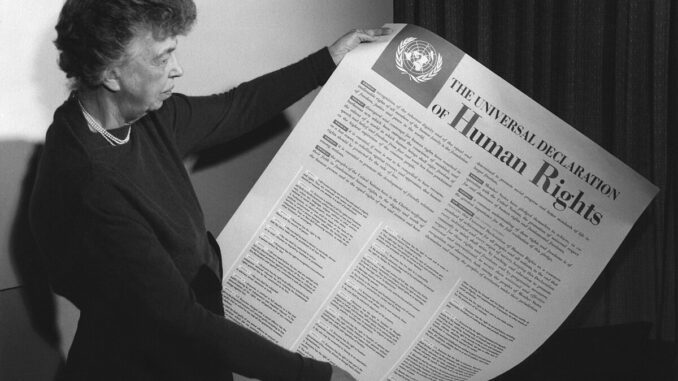
Two major wars in the first half of the last century, exposure of the atrocities carried out as Germany not only sought to expand its territory, but sought also to have an ethnically and genetically pure nation were instrumental motivation for the creation of the United Nations Organisation.
After the first war, 1914-18, the League of Nations was established, but had failed in its intent to somehow avoid another such conflict.
The seeds of both wars lay in the rise of nationalism as industrialisation changed economies from essentially rural, agriculturally-based to a mix including manufacturing and the rise in urban living, material consumerism and imperial aspirations.
The idea of nationalism was defined both in geographic territories, language and an idealisation of what the people of the nation should look like both physically and religiously. Europe had gone through a number of transformations which helped draw the new geographic boundaries. The religious wars of the Reformation and the splintering of the Roman church and the various denominations or sects which emerged as religious texts became more broadly available.
Within the various repositionings, definitions of who could belong where became important markers to define nationality. Several groups of the populations really did not fit in the tidy definitions, Jews, Gypsies, Jehovah’s Witnesses and then add the people who were gay or deemed to be insane or otherwise ‘deformed’ became targets for elimination in an effort to purify the nation.
After the outbreak of war in 1939, the initial shock that it had happened again, that people were being slaughtered to make way for the ‘super-race’, yes, that was a definition, a racially superior people, based on mythological definitions of racial purity. (It was a thing in literature too, George Bernard Shaw wrote a very long, very tedious play called Man and Superman. Friedrich Nietzsche was a superman fan, in Thus Spoke Zarathustra, he tells the world that ‘God is dead and that superman, the human embodiment of divinity is his successor.’)
The sense of superiority became embedded in the idea that there was a perfect national identity, replacing the collapsed kingdoms and principalities of previous definitions, the ruler ordained to rule by some god or other, and the people subject to the laws and edicts which reinforced the power of the ruler. Those who did not fit the description were marginalised, and the rise of nationalism exacerbated their plight.
Several ‘fears’ became most evident, the fears which came from those definitions of what it means to be of a certain nation, those fears were the restrictions of freedoms, outlined by FD Roosevelt in this state of the union speech to Congress in January 1941 as four basic freedoms:
- Freedom of speech
- Freedom of religion
- Freedom from want
- Freedom from fear.
These, seven years later, formed the basis for the UN Declaration of Human Rights, the urgency of which was motivated by the horrors of the holocaust conducted during the war in Hitler’s Germany.
The Declaration of Human Rights was voted on in the UN General Assembly on 10 December, 1948, during the third session of the General Assembly of the then 58 member nations, 48 voted in favour, 10 voted against and 8 abstained.
Included in the 48 who voted in favour were the USA and UK. At that time of writing the Declaration, the UK was responsible for the Mandated Territory of Palestine, as part of a greater region encompassing from the southern border of Syria into Africa, Egypt and Sudan. This is important, because while all this was going on, Britain had signed off on the Balfour Declaration which effectively ceded the area of Palestine to the Zionist movement, opening the region to colonisation, removing the ‘Freedom from fear’ and turning a blind eye to the commencement of the Nakba, the removal of Palestinians from their lands and dwellings, depriving them of an income, removing the ‘Freedom from want’ for the displaced, effectively acting against the very principles of the declaration.
Enough of the history, let’s focus on the question. Does the declaration have any relevance today, as we see conflict after conflict, we see slavery and servitude, people trafficking, violence, religious persecution and the on going deprivations of colonialism and exploitative capitalism rape and pillage to further enrich the already rich?
What is far more significant is that of the 11 plus million who were killed during the holocaust, the only ones that really matter were the six million Jews. Who were slaughtered. There is no holocaust museum for the Roma people, there is no holocaust museum for the Jehovah’s Witnesses, or for the homosexuals or other targeted groups. Just the Jews.
I am not saying that is wrong, by the way. Those museums are there as a reminder of the depravity some regimes will go to to eliminate those they do not want. As a history teacher, I took my Year 11 classes to the Holocaust Museum as we studied World War II. The visits were profound, emotional, great learning opportunities, but the questions which must be asked include considering the treatment of unwanted people in conflicts since 1948 including those on the Eastern shores of the Mediterranean Sea.
But to ask that question attracts the charge of antisemitism.
The current conflict, and yes, despite a declared ceasefire, it is still a current conflict, in Gaza, and the parallel violence in East Jerusalem and The West Bank, we are constantly reminded of the attack on 7 October 2023. The death toll from those conflicts now exceed the fatalities of 7 October by close on 50 to 1.
But remember, 7 October.
When we deal with antisemitism as surfaced in Bondi just the other day, we may not mention the atrocities carried out in claiming ‘Eratz Yisrael HaShlema’, as though the very reason for writing the Declaration of Human Rights, the importance of it that in the very first year of the United Nation’s existence, that document was voted through the General Assembly, because it was need to protect humanity from suffering another holocaust, to attempt to see the commonality we have as human beings, that we share those inalienable rights enshrined in that document. And yes, that the Jews suffered the most at that time is significant, and their suffering along with the Roma people, homosexual, Jehovah’s Witnesses and others could be prevented from happening again.
Yet the very people who had suffered the most, for whom the term Genocide was invented, are committing genocide to remove the basic freedoms which form the Declaration from the people who occupy the lands they claim, in a redefinition of colonialism of the great (rapacious) European empires.
We are not asked to reflect on why the hatred exists which drove the terrorists to carry out their attack, all we asked to consider is that once again Jews have been attacked for being Jews.
When dealing with considering the plight of Palestinians, we are reminded time and again of this intifada, or that intifada, of this suicide bombing or that atrocity, but we are to acceptant the justification of collective punishment, of death tolls which exceed 50 Palestinians for each Israeli life lost.
We may not consider that each time a ‘peace plan’ is proposed, Palestinians are to sit quietly and accept the outcome, or even in the initial promise of the land in the Balfour agreement which included a rider that the indigenous should be somehow protected was ignored, that they were never asked what they thought about their lands being taken away, their removal rendering them stateless refugees, denied the right of return in refugee camps in Syria, Lebanon and Jordan, or prisoners confined to the hell hole called The Gaza Strip, or have their water resources on the West Bank stolen to provide water to fill the swimming pools of the settlers who live on land that was once the grazing lands for their sheep and goats, or to irrigate olive groves that provided an income.
The Declaration of Human Rights, as interpreted by successive Israeli governments sought to protect Israel’s human rights, Jewish human rights it appears. That is confirmed time after time as Palestinians are described in terms which are less that human, ironically very similar terms which were used during the Nazi era in Germany to describe Jews and other ‘undesirables’. Similarly, neighbouring Muslim countries are accorded the same terminology as they are seen as threats to Israel’s survival.
Since 1948, there have been, according to a search I did recently, a question posed to historian Google, there have been about 26 days that there has not been a war somewhere in the world. For all but 26 days, powerful forces have railed against opposing forces to ensure that territory is ceded, that political or religious creeds be enforced, that racial purity is achieved, that food and wealth sources are controlled, or that ‘We, God’s People’ can have what our god, who ever that mythical being is, has promised us in some ancient text or other.
Those dispossessed are cast aside, leaving, according to the latest figures I can glean from the UN, 122.6 million people forcibly displaced worldwide.
Where can these people go?
Many of them are Muslim, since in recent times places like Syria, Iraq, Iran have had a number of issues, like cities being levelled through wars, or their oil reserves being plundered, or civil wars where power groups fight it out, displacing those who dare stand in their way, despotic religious leaders laying down draconian laws, or just pushing aside unwanted people. Or Israel ‘protecting itself’ by punishing neighbours before they can attack.
Others suffer hunger as civil wars lay waste their farming lands, or climate change displaces people through desertification.
No body wants them, and the frustrations of discrimination leads to acts of terrorism, as do so many other means used to marginalise people. The rise of anti-immigration movements through out Europe, in the US, and surfacing here in Australia denies the basic rights of those disposed, and we are not so much reminded of their plight, rather use one act such as the Bondi attack to fight against giving the millions a chance at finding the freedoms we all need.
The United Nations Declaration of Human Rights is as important today, as it ever was. But as an individual, I cannot enforce it, I cannot ensure that all people are are afforded the rights enshrined in it. Or that all people will respect those rights in others.
However, I constantly remind myself, and the people I engage with, that I cannot stop the violence which infects our world, the hatred which fuels acts of terror such as the Bondi attack, but I can make the small part of the world I inhabit a place of peace, a place where all are accorded the respect their individual humanness is owed, that I, in demanding the freedoms of speech, of religion, a freedom from want and fear, ensure that in my interactions that I do not deny others those freedoms.
Sometimes it works, sometimes it does not. I was told that I am ‘Part of the Social Cancer’, whatever that means.
Keep Independent Journalism Alive – Support The AIMN
Dear Reader,
Since 2013, The Australian Independent Media Network has been a fearless voice for truth, giving public interest journalists a platform to hold power to account. From expert analysis on national and global events to uncovering issues that matter to you, we’re here because of your support.
Running an independent site isn’t cheap, and rising costs mean we need you now more than ever. Your donation – big or small – keeps our servers humming, our writers digging, and our stories free for all.
Join our community of truth-seekers. Donate via PayPal or credit card via the button below, or bank transfer [BSB: 062500; A/c no: 10495969] and help us keep shining a light.
With gratitude, The AIMN Team


Anyone studying Law or Psychology is familiar with this.