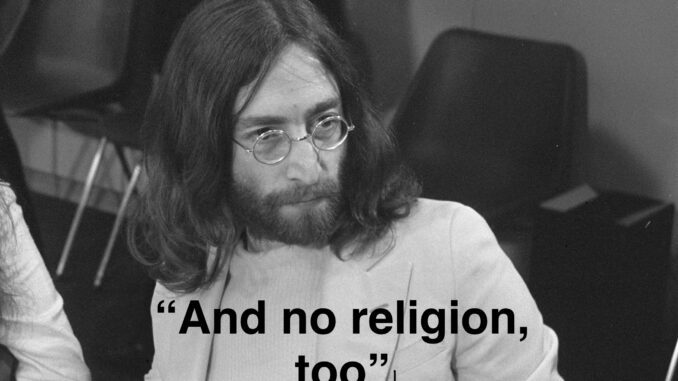
In recent decades, fewer Australians have called themselves Christian in the census. In 2011, about 61% identified as Christian. This dropped to 52% in 2016 and then to 44% in 2021. These figures suggest the decline will continue, so the 2026 results will be interesting to see. Several things may be causing this trend. Social attitudes have changed, with more people questioning traditional religious institutions or looking for meaning elsewhere. Australia’s growing cultural diversity has also introduced more beliefs and practices. Demographic shifts, such as younger people being less likely to identify with any religion, also matter. Together, these factors help explain why fewer Australians identify as Christian in the census.
Every Australian census since 1911 has included a question about religion. Although answering is optional, most people still do. In 2021, about 93% of people responded. This data is available at Understanding religious affiliation on the ABS site.
The census asks people which religion they identify with, not how they practice or take part. People can also mention their secular or spiritual beliefs, or say they have no religion. The Australian Standard Classification of Religious Groups (ASCRG) organises religious groups into broad, narrow, and specific categories. For example, Christianity is a broad group, Catholicism is a narrower group within it, and Roman Catholicism is a specific group within Catholicism. How the ASCRG structures these groups matters when reading census data. For example, if people move from Anglican to Catholic, this might not show up if only broad-group totals are reported. Knowing how the classification works helps us see if trends affect all Christian groups or just some, and lets us track changes in Australia’s religious landscape over time.
In this context, ‘No religion’ is a broad group that includes Secular Beliefs, Other Spiritual Beliefs, and No Religious Affiliation. In 2016, the category was expanded to include additional response types. As a result, more people with different secular or spiritual beliefs were counted in the ‘No religion’ group, which increased the numbers. This group includes people with no religion and those with beliefs such as Agnosticism, Atheism, and Humanism.
‘Other religions’ includes groups such as Hinduism, Islam, Judaism, and a wider range like Australian Aboriginal Traditional Religions, Chinese Religions, and Sikhism. Recent census data show that more Australians are identifying as ‘Other religions,’ indicating growing religious and cultural diversity. In 2021, about 10% of people chose this category, up from 8% in 2016. This rise shows that religious pluralism in Australia is increasing. For example, more schools and workplaces now recognise a wider range of religious holidays or dietary needs. This growing diversity can also shape policy decisions, such as how governments support community groups or ensure equal rights and representation. For sociology students, these changes show why it is important to understand how shifting religious identities can shape issues such as social cohesion, multiculturalism, and public policy.
For more information, see the Religious affiliation (RELP) variable. It records the religion or belief group a person reports in the census.
I believe the number of people choosing “No religion” will continue to rise in the 2026 census. Why is this happening? There are a few possible reasons. One is secularisation, as modern life and education often lead people to seek meaning outside traditional religion. Generational change is also important, as younger Australians are less likely to see religion as a big part of their daily lives. Immigration matters too, because many new arrivals bring a wider range of beliefs, including some who identify as non-religious. All these factors may help explain why more people are moving away from identifying with any religion.
Religion Top 20 – Australia
| 2016 | 2011 |
| No religion – 30.1% | Catholic – 25.3% |
| Catholic – 22.6% | No religion – 22.3% |
| Anglican – 13.3% | Anglican – 17.1% |
| Uniting Church – 3.7% | Uniting Church 5.0% |
| Christian, (Not further defined)– 2.6% | Presbyterian and Reformed – 2.8% |
| Islam – 2.6% | Eastern Orthodox – 2.6% |
| Buddhism – 2.4% | Buddhism – 2.5% |
| Presbyterian and Reformed – 2.3% | Islam 2.2% |
| Eastern Orthodox – 2.1% | Christian (Not further defined) 2.2% |
| Hinduism – 1.9% | Baptist – 1.6% |
| Baptist – 1.5% | Hinduism 1.3% |
| Pentecostal – 1.1% | Lutheran – 1.2% |
| Lutheran – 0.7% | Pentecostal 1.1% |
| Sikhism – 0.5% | Judaism – 0.5% |
| Other Protestant – 0.5% | Jehovah’s Witnesses – 0.4% |
| Judaism – 0.4% | Sikhism – 0.3% |
| Jehovah’s Witnesses – 0.4% | Seventh–day Adventist – 0.3% |
| Seventh-day Adventist – 0.3% | Other Protestant – 0.3% |
| Latter-day Saints – 0.3% | Salvation Army – 0.3% |
| Oriental Orthodox – 0.2% | Latter-day Saints – 0.3% |
My thought for the Day
Why is it that religion assumes it has some bizarre ownership over people’s morality. To assume that an atheist is any less moral than someone religious is an absurdity.
Keep Independent Journalism Alive – Support The AIMN
Dear Reader,
Since 2013, The Australian Independent Media Network has been a fearless independent voice – holding power to account and delivering journalism that matters.
Running this site isn’t cheap. Rising costs mean we need your support now more than ever. Every donation, big or small, keeps our servers running, our writers working, and our stories free for everyone.
Donate here:
PayPal or credit card – just click on the Donate button below
Direct bank transfer: BSB: 062500; A/c no: 10495969

We’ve also set up a GoFundMe as a dedicated reserve fund for hosting and future improvements.

Thank you for standing with us. We couldn’t do this without you.
With gratitude,
The AIMN Team

One of my sons once queried (when he was aged late teens or so) “Mum, why have you never taught us about God?”
We always tried to raise our kids to be good people rather than indoctrinate them with our own parents’ lip service to “religion”. We always felt that belief in a higher being was a decision for them to make as adults.
Religious affiliation doesn’t seem to equate with tolerance, or even kindness or empathy towards other people.