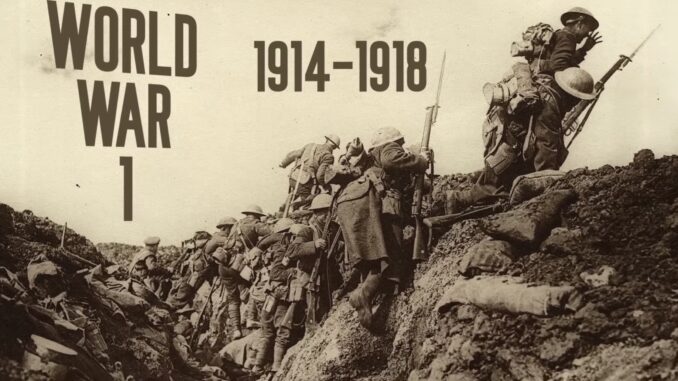
Why How We Remember World War I Shapes How We Understand World War II
The way societies remember war is never neutral. Memory shapes what is excused, what is repeated, and what is permitted to be done again in our name. Nowhere is this clearer than in the persistent habit of flattening World War I and World War II into a single moral story, when in fact they belong to fundamentally different moral categories.
World War I was a tragedy of shared failure.
World War II was a response to a heinous crime.
Confusing the two does violence not only to history, but to the ordinary people who were sent to fight – and to those who were later murdered on an industrial scale.
World War I: catastrophe born of obedience
World War I was not inevitable, despite how often it is described that way. It was the product of rigid alliance systems, imperial rivalry, arms races, nationalist myth-making, and repeated elite decisions to escalate rather than de-escalate. It was avoidable, and that is precisely what makes it unforgivable.
Ordinary people were told they must fight for king and country, against an abstract “evil” defined largely by uniforms and flags. Obedience itself was framed as virtue. Conscience was treated as a threat.
Men who refused to fight were not merely shamed; many were executed by their own states. Britain, France, and Italy all carried out executions for desertion or “cowardice,” often against soldiers suffering what we would now recognise as post-traumatic stress.[1] The state did not simply demand participation – it criminalised refusal.
This was not incidental. It reveals something essential about World War I:
It was a war that could not tolerate moral dissent.
That truth was recognised at the time. The poet Wilfred Owen called the patriotic ideal sustaining the slaughter “the old Lie” in Dulce et Decorum Est.[2] Siegfried Sassoon, a decorated officer, publicly declared in 1917 that the war was being deliberately prolonged by those with the power to end it – and was punished not because he was wrong, but because he said it aloud.[3]
Erich Maria Remarque later captured the deeper truth in All Quiet on the Western Front: the war destroyed a generation not only physically, but morally. Survival itself did not constitute victory.[4]
In this sense, everyone lost World War I. Empires collapsed, economies shattered, political extremism flourished, and trust in institutions evaporated. The only consistent winners were arms manufacturers and war profiteers, who monetised industrial slaughter while others paid in blood, trauma, and grief.
The lie of “just sacrifice”
We are often told that we must remember the dead of World War I with nationalist pride, that their sacrifice was just and meaningful. But this insistence says more about the needs of the living than the truth of the past.
For those left behind, believing that a loved one’s death was “for something” can be a way to survive unbearable loss. That need deserves compassion. What does not deserve protection is the system that turns grief into obedience and remembrance into recruitment.
Honouring the dead does not require lying about why they died.
In fact, the lie is what ensures repetition.
The literary historian Paul Fussell documented this collapse of patriotic language in The Great War and Modern Memory, showing how official rhetoric disintegrated under trench reality and was replaced by irony and disillusionment.[5]
World War I demanded obedience, even against conscience.
That is its moral indictment.
From shared failure to heinous crime
The tragedy of that shared failure did not end in 1918. It metastasised.
World War II did not emerge from nowhere. It grew from unresolved grievances, economic collapse, mythologies of betrayal, and the moral exhaustion left behind by World War I. Many historians< now treat the period from 1914 to 1945 as a single, broken European civil war – with a catastrophic pause in the middle.[6]
Continuity, however, does not mean equivalence.
Nazi Germany was not simply another imperial power miscalculating its interests. It was a regime that made conquest and extermination its purpose.
As George Orwell understood at the time, opposing fascism was not an imperial contest but a moral necessity. And as Hannah Arendt later argued in The Origins of Totalitarianism, totalitarian systems render human beings superfluous – valuable only insofar as they serve ideology.[7]
World War II was not tragic miscalculation.
It was deliberate crime.
A different call to ordinary people
The moral distinction between the wars is visible in how ordinary people were addressed.
In World War I, people were told to fight for king and country.
In World War II, people were told to stand together against a real and identifiable evil.
That difference mattered.
On the Allied side, conscientious objectors in World War II were not executed. They were reassigned to medical, logistical, industrial, and rescue roles. Contribution did not require direct killing. Conscience, while constrained, was accommodated.[8]
Put simply: World War I sanctified obedience. World War II mobilised solidarity.
Why remembrance must be a warning
The danger today is not that we remember World War I too much, but that we remember it wrongly.
When remembrance becomes an exercise in nationalist pride rather than moral reckoning, it prepares the ground for repetition. When sacrifice is sanctified rather than interrogated, grievances are preserved, profiteering is enabled, and dissent is framed as disloyalty.
Barbara Tuchman dismantled the myth of inevitability in The Guns of August, showing how a chain of avoidable decisions led to catastrophe.[9] More recently, Christopher Clark described Europe’s leaders as “sleepwalkers,” stumbling into disaster without malice but also without restraint.[10]
Shared failure does not excuse what followed – but it explains how the conditions were created in which a heinous crime could occur.
Closing: remembrance as refusal
We are told to remember the dead of the First World War with nationalist pride, to treat their sacrifice as just and necessary. But this insistence is less about honouring them than about managing what their deaths would otherwise reveal. World War I was not a noble inevitability; it was an avoidable catastrophe born of shared elite failure, sustained by lies, and monetised by profiteers who paid none of the cost. The millions who died did not fall for justice, but for decisions made far from the trenches, justified by myth rather than truth. To admit this is painful – especially for those left behind, who needed to believe their loss was not pointless or taken for others’ gain. That need deserves compassion. What does not deserve protection is the system that turns grief into obedience and remembrance into recruitment. The tragedy of shared failure begat the most heinous crime of the next war, and the only consistent winners were those who learned how to profit from slaughter. If remembrance is to mean anything, it must serve as a warning: that manufacturing grievances, sanctifying sacrifice, and allowing war to be good business will only ensure that the dead are asked to speak again – and that others will be sent to join them.
Footnotes
[1] British Ministry of Defence, Shot at Dawn review; Julian Putkowski & Julian Sykes, Shot at Dawn (Pen & Sword, 1992).
[2] Wilfred Owen, Dulce et Decorum Est, 1917–18.
[3] Siegfried Sassoon, “Finished with the War: A Soldier’s Declaration,” The Times, July 31, 1917.
[4] Erich Maria Remarque, All Quiet on the Western Front (1929).
[5] Paul Fussell, The Great War and Modern Memory (Oxford University Press, 1975).
[6] Adam Tooze, The Deluge (Penguin, 2014).
[7] Hannah Arendt, The Origins of Totalitarianism (1951).
[8] National Archives (UK), Conscientious Objectors Tribunal records; Adam Fairclough, To Redeem the Soul of America (context on WWII service alternatives).
[9] Barbara W. Tuchman, The Guns of August (1962).
[10] Christopher Clark, The Sleepwalkers (2012).
Keep Independent Journalism Alive – Support The AIMN
Dear Reader,
Since 2013, The Australian Independent Media Network has been a fearless voice for truth, giving public interest journalists a platform to hold power to account. From expert analysis on national and global events to uncovering issues that matter to you, we’re here because of your support.
Running an independent site isn’t cheap, and rising costs mean we need you now more than ever. Your donation – big or small – keeps our servers humming, our writers digging, and our stories free for all.
Join our community of truth-seekers. Donate via PayPal or credit card via the button below, or bank transfer [BSB: 062500; A/c no: 10495969] and help us keep shining a light.
With gratitude, The AIMN Team


https://www.heritage-history.com/site/hclass/secret_societies/ebooks/pdf/butler_racket.pdf
Excellent article Lachlan.
And yes, given all that passed before, is it no wonder that history is repeating, yet again, by a brain-dead skin and bones effigy known as POTUS, and his oligarch’s who have blood on their hands.