Chapter 11: Missions, Reserves, and the Churches’ Role
Containing a People
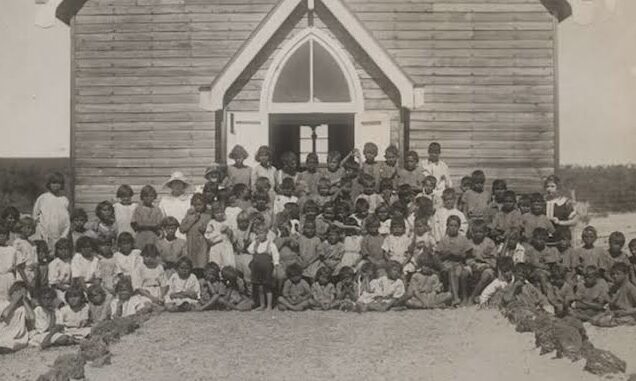
As frontier violence pushed Aboriginal and Torres Strait Islander peoples off their lands, colonial authorities developed new systems to control survivors: missions and reserves.
These were presented as places of “protection,” but in practice they were instruments of containment. They confined people to restricted areas, stripped them of autonomy, and placed their daily lives under the control of missionaries, police, and government “Protectors.”
The Idea of “Protection”
By the mid-19th century, the British Empire had shifted its rhetoric. Direct extermination was becoming less publicly acceptable, so colonisation rebranded itself as “protection.”
Protection Acts in Queensland, Western Australia, Victoria, and other colonies gave governments sweeping power over where Aboriginal people could live, work, and marry. Under these laws, Aboriginal people were treated not as citizens but as wards of the state. They could be removed, confined, or placed into work at the discretion of officials.
“Protectors” were appointed – but their role was less about defending Aboriginal people and more about protecting settler interests by regulating Aboriginal presence. Protection was, in reality, control.
Life on Missions and Reserves
On missions (run mainly by churches) and reserves (state-run settlements), life was heavily regimented:
- Movement restricted: People needed permission to leave, even temporarily.
- Rations provided: Food, clothing, and blankets were distributed, often of poor quality, ensuring dependence on authorities.
- Work enforced: Men, women, and children were assigned work, usually unpaid or underpaid.
- Cultural suppression: Language, ceremony, and traditions were banned or discouraged.
- Religious indoctrination: Christian services were compulsory, often replacing cultural practices.
The stated aim was “civilisation.” The reality was segregation, surveillance, and cultural erasure.
Churches as Enforcers
Missions were usually operated by churches – Anglican, Catholic, Lutheran, Methodist – with government funding. Missionaries often saw themselves as saving souls, but they also acted as cultural gatekeepers:
- Conversion: Children were baptised, Indigenous spirituality dismissed as superstition.
- Discipline: Missionaries controlled education, work, and marriage approvals.
- Child removals: Missions became feeders for institutions where Aboriginal children were separated from families (a key part of the Stolen Generations).
Some missionaries were genuinely compassionate and recorded Aboriginal languages or traditions. But even this preservation often came with an agenda: documenting culture before it “died out,” rather than supporting its survival.
Families Broken Apart
Missions and reserves disrupted kinship systems:
- Children were separated from parents for “training” or “education.”
- Marriages were arranged or blocked by Protectors.
- Entire families were relocated far from their traditional Country, weakening ties to land and ceremony.
The family – the most basic unit of cultural survival – was targeted as a way to enforce assimilation.
Examples Across Australia
Coranderrk (Victoria): An Aboriginal reserve near Melbourne, where residents campaigned for self-determination in the late 19th century. Despite their successes in farming and advocacy, the government eventually shut it down, dispersing its people.
Cherbourg (Queensland): Originally established as Barambah Settlement, it became notorious for strict controls and harsh punishments. Families from across Queensland were relocated there, often against their will.
Missions in the Torres Strait: These reshaped Islander life by enforcing Christianity and English, while restricting traditional practices.
These examples show that while missions varied in detail, the pattern of control and suppression was consistent.
Psychological and Intergenerational Harm
The missions and reserves created deep wounds:
- Elders stripped of authority, replaced by missionaries or Protectors.
- Children raised in institutions without their languages or traditions.
- Generations taught that their identity was inferior or shameful.
- Trauma passed down, creating cycles of loss and disconnection.
For many Aboriginal and Torres Strait Islander families, the scars of missions and reserves are still visible in the form of fractured kinship ties, disrupted cultural knowledge, and mistrust of institutions.
Resistance and Survival
Despite the repression, Aboriginal and Torres Strait Islander peoples resisted:
- Families secretly maintained cultural practices out of sight of missionaries.
- Some mission residents fought for greater autonomy, as at Coranderrk, where leaders like William Barak petitioned governments for justice.
- Stories, songs, and languages survived in fragments, carried quietly through the generations.
Missions and reserves were meant to extinguish culture. Instead, they became places where cultural endurance was tested – and, against the odds, survived.
Why This Matters Today
The mission and reserve system helps explain why many Aboriginal and Torres Strait Islander people today live far from their ancestral lands, why families were fractured, and why languages were lost.
It also explains the deep mistrust of government and church institutions. When people say, “Why don’t they just trust the system?”, the answer is clear: because the system was designed to control, degrade, and assimilate.
Where This Leads
Missions and reserves laid the groundwork for the most infamous policy of all: the systematic removal of children from their families, now remembered as the Stolen Generations.
That will be the focus of the next chapter.
Continued tomorrow…
Link to Part 10:
From Ignorance to Understanding: Facing the Truth of Colonisation (Part 10)
Link to Part 12:
From Ignorance to Understanding: Facing the Truth of Colonisation (Part 12)
Dear reader, we need your support
Independent sites such as The AIMN provide a platform for public interest journalists. From its humble beginning in January 2013, The AIMN has grown into one of the most trusted and popular independent media organisations.
One of the reasons we have succeeded has been due to the support we receive from our readers through their financial contributions.
With increasing costs to maintain The AIMN, we need this continued support.
Your donation – large or small – to help with the running costs of this site will be greatly appreciated.
You can donate through PayPal or credit card via the button below, or donate via bank transfer: BSB: 062500; A/c no: 10495969


Be the first to comment