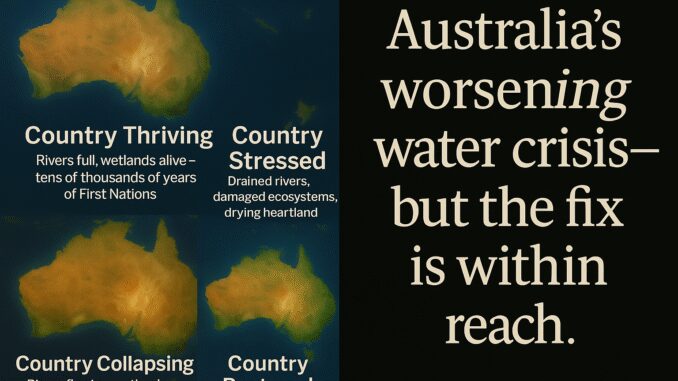
Renewable-powered desalination, advanced recycling, and Traditional Owner land management could restore our rivers, protect us from climate extremes, and create thousands of regional jobs – if we have the courage to build it.
Introduction
Australia’s water future is at a tipping point. In the space of a single generation, we have gone from thinking of water scarcity as an occasional rural problem to seeing it as a national threat – one that can cripple cities, collapse industries, and accelerate ecological decline. The climate crisis is making these risks more acute, creating longer droughts, more intense floods, and a growing list of communities and ecosystems in distress.
We cannot rely on the old approach of reactive crisis management. Instead, we need a long-term, holistic strategy that secures water for people, the environment, and the economy, while working with Country and embedding Traditional Owner knowledge at every stage. This is the blueprint for that plan.
Part 1 – The Case for Action
Australia’s water future is on a knife edge. We are living on the driest inhabited continent on Earth, but that fact hides a deeper truth – many of our rivers, wetlands, and aquifers once ran far healthier than they do now. Before colonisation, waterways like Birrarung (Yarra River), Dirrabeen (Darebin Creek), and Kurrum Yallock (Plenty River) supported rich ecosystems and sustained First Nations communities for millennia through careful management. In just over 230 years, large-scale land clearing, wetland drainage, and water diversion have left them degraded and vulnerable to a rapidly warming climate.
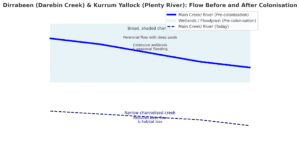
Description: A visual comparison of creek and river flow before colonisation (broad, shaded channels with perennial flows, deep pools, and extensive wetlands) versus today (narrow, channelised creeks with reduced flow and habitat loss). Highlights the scale of hydrological change due to colonisation, clearing, and water diversion.
The science is blunt. Climate change is already reshaping Australia’s hydrology. The Bureau of Meteorology and CSIRO warn that southern Australia will face more frequent and severe droughts by 2050, with longer dry spells between heavy rain events. At the same time, extreme rainfall and flooding will intensify, delivering more water than rivers and drains can handle in short bursts – only to leave them parched weeks later. This “feast or famine” pattern will strain agriculture, infrastructure, and ecosystems alike.
The cost of inaction is staggering. The 2017–2020 drought cost the Australian economy an estimated $3.5 billion in lost agricultural output. The 2019–2020 Black Summer bushfires, made worse by drought-stressed landscapes, cost $1.95 billion in insured losses alone. The 2022 east coast floods are expected to top $6 billion in recovery costs. These are not one-off events; they are becoming more frequent, each eroding economic resilience, damaging mental health, and displacing communities.
Crucially, this is not just a problem for inland towns or farms. Urban water security is at risk. Sydney, Melbourne, Adelaide, Perth, and Brisbane have all faced the prospect of water restrictions in the past two decades, with several forced to commission expensive emergency supply measures. Without a shift in how we generate, store, and distribute water, we will lurch between costly crisis responses – trucking in emergency supplies one year, repairing flood damage the next – while rivers, wetlands, and aquifers slide further toward ecological collapse.
If we want a functioning, liveable Australia in 2055, we need a plan that can survive both drought and flood, that restores environmental flows while securing water for households, industry, and agriculture. That plan exists – but it will require ambition, investment, and the courage to override the noisy minority who profit from the status quo.
Bibliography – Part 1
- Bureau of Meteorology & CSIRO (2022). State of the Climate 2022
Darebin Creek Management Committee (n.d.). History of Darebin Creek
Part 2 – The Vision
Imagine an Australia where no city, town, or farm is left vulnerable to the next drought or flood – where our rivers flow year-round, wetlands teem with life, and Traditional Owners are leading land and water stewardship. This is not a distant dream; it’s a practical, achievable plan built on technologies and knowledge we already have.
The core of the vision is a national water system powered by renewables, combining three pillars:
- Seawater desalination – converting abundant ocean water into fresh water for cities, industry, and coastal agriculture. Modern seawater reverse osmosis (SWRO) plants are far more energy-efficient than their 1990s predecessors, using as little as 2.5–3.5 kWh per cubic metre with advanced energy recovery systems.
Advanced water recycling – capturing treated wastewater from urban areas and purifying it to drinking water standards through multi-stage filtration, UV disinfection, and reverse osmosis. Singapore’s NEWater program and California’s Orange County Groundwater Replenishment System are proven, large-scale examples.
Traditional Owner land and water management – embedding Indigenous-led cultural burning, wetland care, and seasonal flow management into the operation of modern infrastructure. This acknowledges that healthy Country is inseparable from healthy communities, and it draws on practices that have sustained ecosystems for tens of thousands of years.
The Birrarung, once running crystal blue into the bay, has witnessed two centuries of transformation. These four panels, inspired by traditional landscape art, show the river through time – from a pre-colonisation lifeline, to a degraded modern state, to two possible futures. One path leads to irreversible decline; the other, to renewal and resilience.

Pre-Colonisation
The river as it flowed for thousands of years—clear, healthy, teeming with life, managed by Traditional Owners whose stewardship kept the water pure and the surrounding lands thriving.

River Degraded
The industrial and urban era’s toll – polluted waters, altered banks, and the city’s growth overwhelming the river’s natural systems.

If Nothing Done
The projected outcome if we stay on our current path – droughts leaving the riverbed cracked and lifeless, biodiversity loss, and an irreversible cultural and ecological wound.

If Action Taken
A future where bold investment, renewable-powered water management, and Traditional Owner-led care restore the Birrarung to health – integrating a thriving river with a sustainable, green cityscape.
These pillars are linked through Managed Aquifer Recharge (MAR), which stores surplus desalinated or recycled water underground during wet years for use in dry years. This approach reduces evaporative losses, stabilises groundwater tables, and restores pressure to depleted aquifers like the Great Artesian Basin in recharge zones.
The result? Environmental flows are restored to rivers such as Birrarung, Dirrabeen, and Kurrum Yallock, keeping them shaded, cool, and full even through prolonged dry spells. Coastal desal hubs and urban recycling schemes free up massive volumes of water that would otherwise be extracted from natural systems. Inland, MAR ensures that aquifers can sustain communities and ecosystems without mining water faster than nature can replace it.
By 2055, this network could make water shortages a relic of the past, allowing agriculture to plan with certainty, cities to grow without stealing from rivers, and ecosystems to recover from two centuries of over-extraction. Just as importantly, it would weave climate resilience into the nation’s fabric, reducing the severity of bushfires and floods while creating tens of thousands of skilled jobs in construction, operations, and environmental management.
This is not a “nice-to-have” – it’s a once-in-a-century infrastructure project that would safeguard our water future for the next hundred years.
Bibliography – Part 2
- International Desalination Association (2022). Energy Consumption Trends in SWRO Desalination
Public Utilities Board Singapore (2023). NEWater
Orange County Water District (2023). Groundwater Replenishment System
Part 3 – How It Works
The plan’s strength lies in using proven technologies and practices in a coordinated, nationwide system. Each element is already in operation somewhere in Australia or overseas – the challenge is to scale and connect them.
Seawater Desalination
Modern seawater reverse osmosis (SWRO) plants draw seawater through fine intake screens, push it at high pressure through semi-permeable membranes, and separate fresh water from concentrated brine. Energy recovery devices capture pressure from the brine stream to cut power use dramatically compared to early plants. Australian examples include the Perth Seawater Desalination Plant and Sydney Desalination Plant, which together can produce hundreds of gigalitres annually when needed .
Advanced Water Recycling
In potable reuse, treated wastewater from sewage plants is put through multiple purification steps:
- Microfiltration – removing suspended solids, bacteria, and protozoa.
Reverse Osmosis – removing salts, viruses, pesticides, and other dissolved contaminants.
UV Disinfection & Advanced Oxidation – destroying any remaining pathogens or trace chemicals.
The result is ultra-pure water, often cleaner than conventional drinking water. This water can be blended into supply systems or injected into aquifers for later recovery. Perth’s Groundwater Replenishment Scheme is a local proof of concept, now delivering 28 GL/year.
Managed Aquifer Recharge (MAR)
MAR stores excess water underground to reduce evaporation losses and restore groundwater tables. In recharge zones for the Great Artesian Basin and other aquifers, this can counter decades of over-extraction. Injected water must match the aquifer’s chemistry to prevent clogging or mineral reactions – something pilot projects in South Australia and Queensland have already mastered.
Restoring Environmental Flows
By meeting urban and industrial demand with desalinated and recycled water, the equivalent volumes can be released back into rivers and wetlands. This restores year-round baseflows to waterways like Birrarung, Dirrabeen, and Kurrum Yallock, helping cool the water, improve oxygenation, and revive aquatic life. Riparian vegetation rebounds, providing shade that further stabilises the ecosystem.
Indigenous Land & Water Management Integration
Traditional Owner knowledge strengthens the technical system:
Cultural burning reduces fuel loads and protects wetlands from catastrophic fire.
Seasonal flow management ensures water is available during culturally and ecologically critical periods (e.g., fish migration, plant flowering).
Wetland care restores biodiversity and filters water before it re-enters the system.
Closing the Loop
Excess water from wet years can be stored in aquifers or small off-stream reservoirs, drawn down in dry years, and topped up by desal or recycling when needed. This creates a closed, resilient loop – unlike today’s system, which mines rivers and aquifers faster than nature can recharge them.
When combined, these elements create a flexible, climate-proof network that can absorb shocks, adapt to extremes, and maintain healthy Country for generations.
Bibliography – Part 3
- Sydney Desalination Plant Pty Ltd (2023). Our Plant
Water Corporation of Western Australia (2023). Groundwater Replenishment Scheme
National Water Grid Authority (2023). Managed Aquifer Recharge
Firesticks Alliance (n.d.). Cultural Burning
Part 4 – Wider Benefits
A national renewable-powered desalination and recycling system is more than a water supply project – it’s an ecological, economic, and social resilience strategy. By freeing natural systems from over-extraction and integrating Traditional Owner knowledge, the benefits ripple far beyond secure taps.
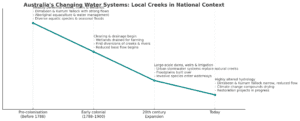
Description: This timeline tracks water system health from pre-colonisation to today, showing the steady decline in hydrological function due to clearing, wetland drainage, dam construction, and urban expansion. Notes the compounding impacts of climate change and the beginnings of restoration projects.
Reviving River Health and Biodiversity
Returning environmental flows to rivers like Birrarung, Dirrabeen, and Kurrum Yallock can reverse decades of decline. Permanent baseflows support native fish, macroinvertebrates, and riparian vegetation, creating cooler, oxygen-rich habitats that resist algal blooms . Wetlands fed by these flows act as natural filters, removing sediments and nutrients before water returns downstream .
Reducing Bushfire Risk
Rehydrated landscapes burn differently. Healthy riparian zones and wetlands act as green firebreaks, slowing or stopping advancing flames. Cultural burning led by Traditional Owners uses low-intensity, patchwork burns to manage fuel loads and protect sensitive habitats. When combined with restored wetlands, this approach can reduce the intensity and spread of catastrophic bushfires.
Reducing Flood Impacts
By reconnecting rivers to their natural floodplains and restoring upstream wetlands, heavy rainfall is absorbed and slowed before it reaches vulnerable towns. These natural buffers reduce peak flood heights and erosion, while MAR and off-stream storage capture excess water for later use .
Boosting Food Security
Reliable, climate-independent water supplies allow farmers to plan with certainty, diversify crops, and maintain production through dry years. High-value agriculture near coastal hubs can be supplied directly from desal or recycled water, freeing inland rivers for environmental flows and low-water-use crops.
Supporting Community Health and Amenity
Greener, healthier waterways create shaded corridors for walking, cycling, and recreation — improving physical and mental wellbeing. Culturally significant sites are revived, strengthening connections between Traditional Owners, local communities, and Country.
Building Climate Resilience at Scale
Every element of the system – from aquifer recharge to wetland restoration – makes landscapes more resilient to climate extremes. By reducing both fire and flood damage, the plan lowers disaster recovery costs and avoids the social upheaval that follows major climate events.
Bibliography – Part 4
- Murray–Darling Basin Authority (2022). The Importance of Healthy Wetlands
Part 5 – The Economics
A renewable-powered desalination and advanced recycling program is a major infrastructure investment – but it is also an economic multiplier with benefits that outweigh its costs many times over.
Cost of Action vs. Cost of Inaction
The capital cost of a staged national rollout – desal plants, recycling facilities, renewable generation, pipelines, and storage – would be in the tens of billions of dollars over three decades. That sounds large until compared to the cost of climate disasters: the 2019–2020 Black Summer bushfires cost the economy an estimated $20 billion in direct and indirect losses, while the 2022 east coast floods are expected to exceed $6 billion in insured damages alone. Without reform, these events will become more frequent, meaning disaster recovery costs will far outstrip the investment needed to build water security.
Job Creation
Every stage of the rollout generates jobs in construction, manufacturing, transport, and professional services.
Construction phase: Tens of thousands of roles for trades, engineers, project managers, and supply chain workers.
Operations & Maintenance (O&M): Long-term positions in plant operation, water quality monitoring, renewable energy maintenance, and environmental management.
Indirect jobs: Growth in local services, tourism (through restored rivers and wetlands), and agriculture supported by reliable water.
Industry studies suggest large desalination projects create 2,000–3,000 construction jobs per plant during build and 50–100 permanent operational jobs thereafter, with similar or greater numbers for large recycling facilities .
Regional and Indigenous Economic Benefits
Many desal and recycling plants will be located in regional coastal hubs, bringing sustained employment and infrastructure investment to areas that often miss out on large-scale economic development. Indigenous-led roles in cultural burning, wetland care, and environmental monitoring provide both economic and cultural returns, strengthening community resilience and self-determination .
Boosting Agricultural Certainty and Output
High-value agriculture near coastal cities – such as horticulture, viticulture, and intensive food production – can be supplied directly with desal or recycled water. This reduces pressure on inland rivers and secures export earnings. In drought years, MAR-fed inland aquifers can support essential irrigation, avoiding crop failures and livestock losses that ripple through the economy.
Long-Term Productivity Gains
By stabilising water supply and reducing disaster damage, the plan supports consistent GDP growth. Businesses can invest knowing their water supply is secure, governments save on emergency relief, and insurance costs are kept in check through reduced climate risk. The return on investment isn’t just measured in dollars – it’s measured in a more liveable, prosperous Australia.
Bibliography Part 5
- International Desalination Association (2021). Desalination Industry Jobs and Economic Impact Report
Part 6 – The Politics
Any project of this scale will have to navigate not just engineering and environmental challenges, but the political landscape – and here, the obstacles are as much about perception and vested interests as they are about policy detail.
Our biggest challenge is not scientific uncertainty or engineering limits—it’s political will. While communities, Traditional Owners, and experts are ready to deliver a renewable-powered, recycling-driven water future, a handful of loud political voices cling to mid-20th century thinking. The result? Progress is stalled, not by impossibility, but by stubbornness.
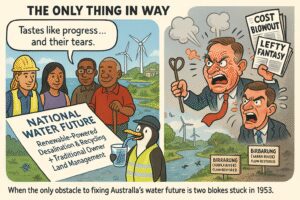
Who Will Oppose and Why
The “usual suspects” are predictable:
Fossil fuel-aligned politicians and lobbyists, who view large renewable energy commitments as a threat to their donor base.
Big irrigator interests in the Murray–Darling Basin, wary that guaranteed environmental flows will reduce their ability to hoard water entitlements.
Media outlets that thrive on outrage and will frame the plan as a costly “green dream,” ignoring the economic returns.
Likely Myths and Scare Campaigns
Expect a familiar arsenal of talking points:
“Australia has always been a dry continent” – omitting how colonisation and over-extraction degraded once-reliable rivers and aquifers.
“Desal and recycling are too expensive” – without comparing them to the cost of repeated drought and disaster recovery.
“Brine will kill the ocean” – ignoring decades of safe operation where outfalls are engineered for dispersion.
“It’s unproven” – despite Perth, Singapore, Israel, and California all running these systems at scale.
Winning Over the ‘Confused Middle’
The political centre can be persuaded if the message is framed as:
Pragmatic insurance for droughts and floods.
Jobs-rich regional infrastructure.
A way to protect rivers and agriculture at the same time.
Avoiding ideological framing and leading with cost-benefit comparisons helps neutralise knee-jerk opposition.
Guarding Against Policy Backsliding
Even if built, the plan’s environmental gains depend on locking in legal protections for environmental flows. Without strong water law, there’s a risk saved water could be reallocated to high-consumption industries, undermining the rivers and wetlands the plan is meant to restore.
The Political Opportunity
For leaders willing to champion it, this is a rare chance to deliver nation-building infrastructure with cross-generational benefits. The historical parallels are strong: just as the Snowy Hydro Scheme reshaped Australia’s post-war economy, this could be the defining environmental and economic legacy of the mid-21st century.
Bibliography – Part 6
- Australian Bureau of Meteorology & CSIRO (2022). State of the Climate 2022
Sydney Desalination Plant Pty Ltd (2023). Environmental Management – Marine Monitoring
Murray–Darling Basin Authority (2023). Water Sharing and Environmental Flows
Part 7 – Implementation Roadmap
Transforming Australia’s water future will require a staged, deliberate rollout – one that delivers early wins while building the capacity for nationwide coverage.
Phase 1: Foundation (2026–2032)
Goals: Prove the model, create immediate resilience for key cities, and lock in legal protections for environmental flows.
Urban recycling expansion – Upgrade existing wastewater treatment plants to produce potable-quality recycled water for blending or aquifer injection.
Renewable energy pairing – Commit desal and recycling facilities to 100% renewable supply via offshore wind, onshore wind, and solar PPAs.
Legislation – Pass federal and state laws guaranteeing that water savings from new infrastructure are reserved for environmental flows.
Pilot MAR projects – Focus on Great Artesian Basin recharge zones and aquifers serving drought-prone towns.
Phase 2: Backbone Build (2032–2042)
Goals: Extend coverage to all major coastal cities and create a network of inland storage and recharge sites.
New desal hubs in Melbourne, Brisbane, and Adelaide scaled to meet urban and industrial needs, freeing river allocations.
Large-scale MAR networks – Link desal/recycled water pipelines to inland recharge sites and off-stream storages.
Traditional Owner integration – Fund Indigenous-led cultural burning, wetland care, and flow management programs as permanent components of water operations.
Transmission upgrades – Expand renewable energy grid connections to coastal plants and pumping stations.
Phase 3: Full National Integration (2042–2055)
Goals: Guarantee climate-independent water for all urban centres and high-value agriculture, restore major river systems, and normalise cultural water management.
Comprehensive coverage – All state capitals and major regional centres supplied in part or wholly by desal/recycled water.
Environmental flow restoration – Target full-year baseflows for rivers like Birrarung, Dirrabeen, and Kurrum Yallock, plus key Murray–Darling tributaries.
Ongoing adaptive management – Use climate modelling and hydrological data to adjust flow patterns, storage priorities, and emergency reserves.
Global export of expertise – Position Australia as a leader in renewable-powered desal and cultural water integration.
Measuring Success
Water security index – No urban water supply below 70% storage equivalent without drought restrictions.
River health scorecards – Continuous ecological monitoring to ensure environmental flows achieve biodiversity gains.
Disaster recovery cost reduction – Annual reporting on avoided drought and flood damages.
Bibliography – Part 7
- National Water Grid Authority (2023). Managed Aquifer Recharge
Murray–Darling Basin Authority (2023). Monitoring River Health
Conclusion
Australia’s worsening cycle of droughts, floods, and environmental decline is not inevitable – it is the product of choices. For more than two centuries, we have taken water from rivers, wetlands, and aquifers faster than nature can replace it, while neglecting the knowledge and stewardship of the First Peoples who cared for these systems for tens of thousands of years.
The good news is that we now have the tools, the science, and the cultural frameworks to reverse this decline. Renewable-powered desalination, advanced water recycling, and Indigenous-led land and water management are not experimental – they are proven solutions already delivering results in Australia and around the world. What has been missing is the scale, the integration, and the political will to make them national priorities.
This plan is not just about securing water; it’s about safeguarding Australia’s economy, biodiversity, and social stability for the next hundred years. It will reduce the severity of bushfires by rehydrating landscapes, soften floods by restoring wetlands and floodplains, and give agriculture the certainty it needs to adapt to a changing climate. It will create tens of thousands of jobs and position Australia as a global leader in climate resilience.
The obstacles are real but not insurmountable – and in some cases, they are more about outdated political theatre than technical feasibility. If we can get past the noisy minority clinging to a 20th-century vision of water management, we can leave a legacy as significant as the Snowy Hydro Scheme: a healthy, secure, and equitable water future for generations to come.
The choice is stark. We can continue lurching from crisis to crisis, spending billions on emergency relief, or we can invest those billions in a system that works with Country, not against it. In 2055, the rivers could be flowing, the wetlands thriving, and the taps running clear – if we start building now.
Bibliography – Conclusion
- Productivity Commission (2021). National Water Reform 2021
Dear reader, we need your support
Independent sites such as The AIMN provide a platform for public interest journalists. From its humble beginning in January 2013, The AIMN has grown into one of the most trusted and popular independent media organisations.
One of the reasons we have succeeded has been due to the support we receive from our readers through their financial contributions.
With increasing costs to maintain The AIMN, we need this continued support.
Your donation – large or small – to help with the running costs of this site will be greatly appreciated.
You can donate through PayPal or credit card via the button below, or donate via bank transfer: BSB: 062500; A/c no: 10495969


Nice work.
This crisis is yet another example of the nonsense that became economic orthodoxy — the utter fabrication that the market is the most efficient determinant for investment.
Economics graduates are still having their heads filled with this rubbish, and we have a Treasurer and Reserve Bank Board that still believe the fairy tales, so the prospects are not good.
The way things are going, we will have to suffer another Great Depression before the message sinks in that the text-books must be re-written.
A significant cost for both reverse osmosis, and ultra filtration treatment methods is the membrane replacement at 5 year intervals (under ideal conditions).
As usual we buy these at premium prices, and ignore the opportunity to manufacture here.
With just a little R&D we could be developing an industry to satisfy our own need, and export.
When I played in this field years ago it was a labour intensive product using migrant labour from Mexico, but now we do have robots.
Demand for membranes is destined for growth, and the chances of our picking up on this is unlikely
Another important & relevant contribution from Lachlan McKenzie. The AIMN is fortunate to have contributors of this calibre on tap for their observations & input… (and not for a moment discounting the in-house essayists, equally critical to the quality and value of these pages.)
I grew up in SA, supposedly the driest state in the driest continent. As a young teenager, I lived in one of the towns in the Upper Murray district, some ~160 km northeast of Adelaide. The family home was only a few hundred metres from the river. In December 1964 I walked down to the Murray and was gobsmacked to see it was empty! 150m of muddy floor instead of a river of water 150m wide. Australia’s largest & longest river, dry! The reason why was due to the series of locks and weirs that regulate water flow, an engineering solution that has had a massively deleterious impact on the hydrology and ecology of that massive river system, impacting the natural flooding that triggers the breeding cycle of the Murray Cod, as well as other issues such as salinisation, reduced flows and the costs due to water over-extraction by irrigators along its length.
The author of the above essay cites the impact on a number of Victorian waterways; his observations could be extended to practically every river system in the country. Suffice it to say, colonisation has been disastrous for this country’s natural assets.
Remember Bob Hawkes’ project to plant 1 billion trees along the Murray – Darling? Remember the tragedy that corrupt managers of irrigation water licences wreaked on NSW waterways under Barnaby Joyces’ tenure? And the depletion of aquifers by excessive water extraction to service gas fracking? What about plans to divert Queenslands’ rivers to form an inland sea? And after all that expense to create it – how productive is the Ord River Scheme today? Despite careful theorizing and planning by hydrographers and engineers these projects, ‘tho the inland sea idea was a bummer, were left in the capable hands of politicians and so we see the dismal outcomes today. I don’t know what the answer is but we don’t have much time left to find it!
Under which government is the necessary change going to happen?The Opposition side are known water thieves,hello Barnacle and Gus,and the current mob are utterly pissweak.
Not looking promising.We can snipe and gripe from the fringes,and it’s meaningless.Just like the upcoming “roundtable”..the table can be any shape you like,but the outcome will be the same..Horseshit.Have a nice day.
Mediocrates: Bob Hawke’s billion trees were planted all round Australia, not only for the Murray Darling. The Landcare movement was born of this initiative and Landcare and Bushcare continue to effect major landscape improvements nationally today. Every year some 6000 local groups involve up to 250,000 people of all ages and backgrounds in planting trees, shrubs and grasses or doing landscape restoration or habitat protection. If we can’t recognise a major long term success, we can hardly gripe about the failures.
Good work Lachlan,
Having done much high-level work in the water & wastewater industries, there has been progress. But the ravages of climate change bring a whole new perspective to be reckoned with.
The USA has devastated its fresh water resources by over-industrialization, particularly from the fossil fuel industry. The Orange County scheme is only one of vary many more needed. Other such devastations are ongoing in Canada, Russia & Germany (for example).
Oz has huge aquifers which need to be considered, properly understood, and accessed / maintained in an appropriate way to take the sting out of the accentuated drought/flood cycle of climate change. And we must immediately stop polluting them with man-made toxins from agriculture & other industries.
We must also at the same time ensure that hydraulic gradients & vegetation on land are such that the massive (climate change) storms do not ravage & scour the natural waterways & plains/agricultural zones, removing soils and causing chocking & unproductive sediments build-ups (often dangerous acid sulfate).
We ought be addressing the infrastructure NOW as a preventive measure against the oncoming ravages of climate change, the beginnings of which we are already seeing. For example, we have already been told that southern Oz will experience more frequent & severe droughts in the near future. In Victoria we have massive aquifers over nearly the entire west (including in the ‘deep leads’), north of Melbourne and in south Gippsland.
So, utilizing those aquifers as rechargeable reservoirs, and accommodating extraction & purification via wetlands & reverse osmosis (or microwave tech) powered by renewables is a no-brainer.
It’s a matter of political will …. it may be more productive than investment in weapons 😎