By Christopher Kennedy
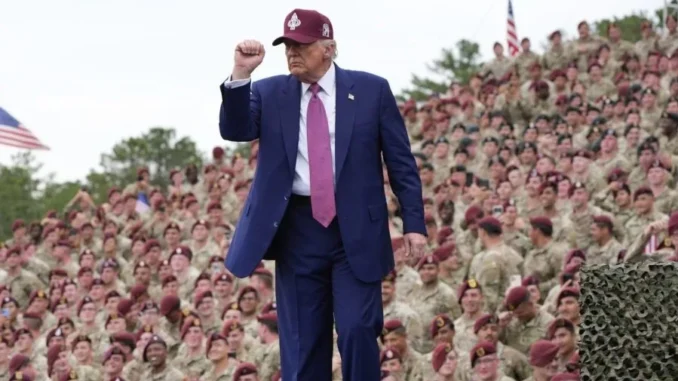
Recent reports suggest that some U.S. military personnel may face pressure to prioritise loyalty to President Donald Trump over their oath to the U.S. Constitution. While these claims require scrutiny, they raise serious questions about the stability of U.S. leadership and its implications for allies like Australia.
Donald Trump’s presidency is marked by controversy, including legal challenges and polarising policies. His economic decisions strain the U.S. domestic economy, and his foreign policy often alienates allies, as seen in his trade disputes with Canada. If these reports are accurate, any attempt to demand personal loyalty from the military would undermine democratic principles and weaken the U.S. as a global partner. The U.S. military, bound by its constitutional oath, is unlikely to support such a move, given its tradition of professionalism and independence.
For Australia, this situation underscores the need to reassess our strategic priorities, particularly in our region. The U.S. has long been a cornerstone of Australia’s defense strategy, but uncertainty in American leadership compels us to evaluate our relationships closer to home, particularly with Indonesia.
Indonesia, a complex nation of diverse islands, faces its own challenges. Its government, led by a strongman figure, has been criticised for corruption, exemplified by recent parliamentary pay increases that reward loyalty over public service. Indonesia’s political and economic stagnation contrasts sharply with the growth of nations like China and Japan. Historically, Australia has navigated tensions with Indonesia, notably during the East Timor crisis in 1999, when global economic turmoil weakened Jakarta’s control over its territories.
One area of concern is West Papua, where the U.S.-based Freeport Mining operates with minimal benefit to local communities. While Australian mining companies, such as those involved in the OK Tedi mine, have faced their own criticisms, there’s an opportunity for Australia to advocate for fairer resource management in the region. Supporting West Papuan autonomy could align with Australia’s interests, particularly if Indonesian governance continues to falter.
However, any Australian intervention – diplomatic or otherwise – would require careful consideration. Indonesia’s control over critical sea lanes and air routes is vital to Australia’s security and trade. A disruption in these routes could force Australia to act independently, especially if U.S. support is unreliable. Yet, relying on European allies to engage in our region seems unlikely, given their focus on conflicts closer to home, such as tensions with Russia.
Australia’s foreign policy must prioritise regional stability and self-reliance. The Department of Foreign Affairs and Trade should proactively strengthen ties with Indo-Pacific partners and prepare for scenarios where U.S. backing is limited. While we await clarity on the U.S. military’s stance, Australia must chart a pragmatic course, balancing our values with the realities of our neighbourhood.
Dear reader, we need your support
Independent sites such as The AIMN provide a platform for public interest journalists. From its humble beginning in January 2013, The AIMN has grown into one of the most trusted and popular independent media organisations.
One of the reasons we have succeeded has been due to the support we receive from our readers through their financial contributions.
With increasing costs to maintain The AIMN, we need this continued support.
Your donation – large or small – to help with the running costs of this site will be greatly appreciated.
You can donate through PayPal or credit card via the button below, or donate via bank transfer: BSB: 062500; A/c no: 10495969

Close Pine Gap to the USA, remove an of their forces from our country. Their enemies will become ours, and there are a few candidates already lined up. Their continuing support of the appalling actions of Israel over Gaza and the wanton bombing in any other country where Hamas may be is far too dangerous