By Denis Hay
Source: Australian Bureau of Statistic
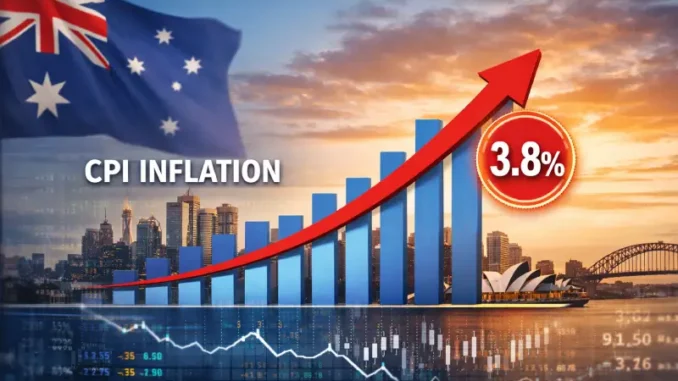
Latest ABS CPI data shows Australia’s inflation rose to 3.8 per cent in December 2025, driven by housing, energy, and food prices.
Australia’s Consumer Price Index (CPI) rose 3.8 per cent over the 12 months to December 2025, according to the latest official figures released by the Australian Bureau of Statistics (ABS). The result marks an increase from 3.4 per cent in the year to November.
The ABS reported that prices rose 1.0 per cent in December alone, contributing to the higher annual figure.
Key CPI figures
According to the ABS release:
- Annual CPI inflation: 3.8 per cent
- Trimmed mean inflation: 3.3 per cent, up from 3.2 per cent
- Monthly CPI increase (December): 1.0 per cent
Main contributors to price rises
The ABS identified several categories as the largest contributors to inflation over the year:
- Housing: up 5.5 per cent
- Food and non-alcoholic beverages: up 3.4 per cent
- Recreation and culture: up 4.4 per cent
Electricity prices rose 21.5 per cent, reflecting the expiry or reduction of several state-based energy rebates. Food prices increased due to higher costs for meat, fruit, and vegetables.
Official context
The CPI is Australia’s primary measure of inflation and is closely monitored by policymakers, businesses, and households. The ABS stated that the December data reflect ongoing price pressures across essential goods and services.
The Reserve Bank of Australia also considers inflation figures when assessing economic conditions and setting monetary policy.
The ABS CPI release provides a snapshot of current price movements affecting Australian households and forms part of a broader set of economic indicators published monthly and quarterly.
This article was originally published on Social Justice Australia
Keep Independent Journalism Alive – Support The AIMN
Dear Reader,
Since 2013, The Australian Independent Media Network has been a fearless voice for truth, giving public interest journalists a platform to hold power to account. From expert analysis on national and global events to uncovering issues that matter to you, we’re here because of your support.
Running an independent site isn’t cheap, and rising costs mean we need you now more than ever. Your donation – big or small – keeps our servers humming, our writers digging, and our stories free for all.
Join our community of truth-seekers. Donate via PayPal or credit card via the button below, or bank transfer [BSB: 062500; A/c no: 10495969] and help us keep shining a light.
With gratitude, The AIMN Team

All the time Australia remains a gigantic mine supply raw materials, nothing will change, we should be using our sovereign wealth to value add to what we mine.
An Australian dollar spent in Australia benefits all Australians. Too much of Australia is owned by foreign companies.
Housing: up 5.5%
Butter me on both sides and colour me stonkered. Hoo wooda thunk it? Right after the latest first home owners’ scheme hits …
All hail the Inflation GOD.
ALL of the current economic gurus have CONVENIENTLY ignord the fact that the December data includes Christmas spending sprees even by the least well off.
Successive governments have outsourced control of inflation to the Reserve Bank.
Interest rates are a blunt instrument and the burden falls disproportionately, particularly on first home buyers.
When the Reserve Bank increases interest rates, its objective is to reduce aggregate demand
The government is far more capable of effecting aggregatedemand (and it controls far more levers)
For a generation governments have neglected their economic obligations.
Even proponents of modern monetary theory understand the need of the government to take greater fiscal responsibility and increased expenditure discipline during inflationary periods.
One’s issue with headline data aka RW MSM political-economic headlines, it’s seldom drilled into and explained for Australians with any meaningful context and solutions.
In fact ‘numbers’ or data are used by the RW MSM to ignore local or human experience in favour of creating angst or dog whistling vs the centre; helped by data illiteracy amongst media and political elites.
Whether inflation, unemployment, house prices (not values which are stagnant), polls, NOM net migration, immigration, international student and population growth numbers, renewables roll out etc. all are marginal or literally ‘borderline’ issues, but no international context or comparisons?
Uhm ….. as a not very proficient economist it appears that numbers are not part of the subject.
How do you inflate expenditure?
1) Raise the cost of things, like mortgage payments in a floating point mortgage interest rate market controlled entirely at the discretion of the banks ….. those profit motivated corporations that pay enormous bonuses to executives who create huge profits at the expense of mortgagees.
2) Allow foreign owned power generating corporations to raise the purchase price of electricity (to $0.36+ cent/Kwh) while slashing home generation purchase to 0.01 CENTS/Kh ….. nice little earner especially as it is still legal to rip off consumers.
3) Inflate prices by increasing the cost of purchasing stock for retail & all other outlets.
Now what has any government done to develop a statistic that accurately represents the movement in these parameters.