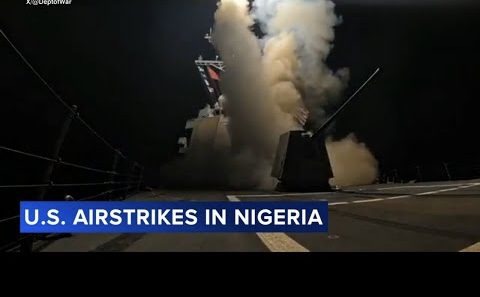
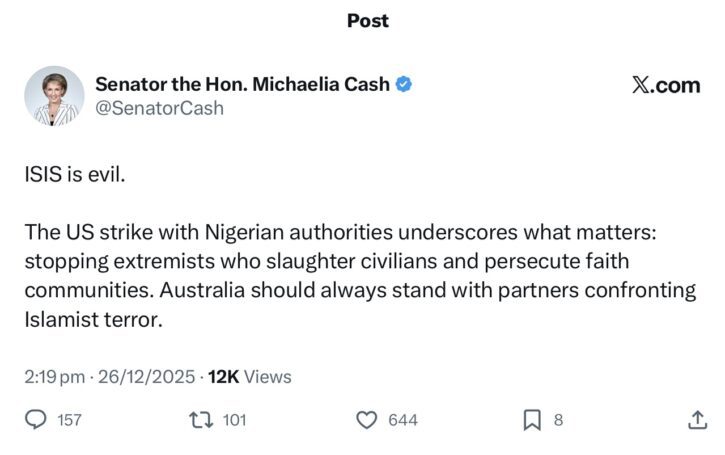
A recent U.S. airstrike in Nigeria, coordinated with the nation’s authorities, has elicited a forceful response from Australian Senator Michaelia Cash. Her declaration – “ISIS is evil… Australia should always stand with partners confronting Islamist terror” – presents a binary, morally unambiguous view of a profoundly complex reality. While condemning extremist violence is unobjectionable, this framing serves as a case study in strategic omission. It ignores the multifaceted drivers of Nigeria’s conflicts, the role of external actors in shaping its crises, and the dangerous simplification of a struggle over resources, identity, and power into a singular war of religion. This analysis will deconstruct the senator’s statement by examining Nigeria’s historical context, the true nature of its security challenges, and the geopolitical interests at play.
Section 1: The Colonial Crucible and Post-Colonial Fragility
To understand modern Nigeria is to understand a nation forged by colonial cartography, not organic nationhood. The 1914 amalgamation of hundreds of distinct ethnic and religious groups – primarily Muslim in the north and Christian in the south – into a single British colony created a fundamental political fault line. The colonial administration’s indirect rule entrenched these divisions, empowering northern elites and fostering systemic regional inequality. This engineered disparity over access to political power, education, and economic resources laid the groundwork for the communal and sectarian tensions that plague the nation today. The competition is not inherently theological but is a scramble for a stake in the modern state, a competition framed and often inflamed by the identities colonialism hardened.
Section 2: Deconstructing the “Religious Conflict” Narrative
Senator Cash’s focus on “Islamist terror” reflects a narrative heavily promoted by certain U.S. political figures. However, data and expert analysis reveal a more complex picture:
A Mosaic of Violence: The security landscape in Nigeria is fragmented. It includes the jihadist factions of Boko Haram and Islamic State West Africa Province (ISWAP), ethno-communal conflicts – often between predominantly Muslim Fulani herders and Christian farmers – criminal banditry, and secessionist agitation.
Muslims as Primary Victims: While attacks on Christian communities are severe and warrant condemnation, the data shows that Muslims constitute the majority of victims of Islamist extremist violence. Groups like Boko Haram have killed tens of thousands of Muslims they deem insufficiently orthodox. A 2025 data analysis of over 20,400 civilian deaths found more were from attacks targeting Muslims than Christians, though the majority of fatalities were unattributed.
Resource Competition as Core Driver: Underlying much of this violence, particularly the farmer-herder conflicts, is intense competition over dwindling arable land and water, exacerbated by climate change and population growth. The Nigerian government itself has consistently rejected the characterisation of a one-sided religious war, emphasising that “people of many faiths” are victims.
Violence Profile in Nigeria’s Northwest and Middle Belt
This following breaks down the complex actors and motives often simplified as “Islamist terror”:
Main Actor(s): Jihadist Groups (ISWAP, Boko Haram)
Primary Motivations and Targets: Establish Islamic law; target state, Christians, and Muslims deemed non-compliant.
Relation to Religious Narrative: Exploits religious identity but kills more Muslims; seeks to impose sectarian frame.
Main Actor(s): Fulani Militant/Bandit Groups
Primary Motivations and Targets: Criminal racketeering, kidnapping, seizing land and resources.
Relation to Religious Narrative: Often framed as religious(Muslim vs. Christian) but core drivers are economic/territorial.
Main Actor(s): Farmer-Herder Communal Conflict
Primary Motivations and Targets: Competition over land/water; ethnic identity; cycles of reprisal.
Relation to Religious Narrative: Religious difference(Muslim herder/Christian farmer) overlays deeper resource strife.
Section 3: The Geopolitical Chessboard – Oil, Evangelism, and Strategic Competition
Ignoring the geopolitical context of the U.S. strike is a critical oversight. Nigeria is home to the largest proven oil reserves in Africa.
The Resource Imperative: The stability and alignment of Nigeria are of paramount strategic interest to global powers, not merely for counter-terrorism but for energy security and economic influence. The U.S. military itself has noted that instability in the region opens the door to “hostile foreign exploitation” of resources.
The Role of Soft Power: Concurrently, Nigeria has been a major focus for American evangelical Christian groups, who have framed the conflict centrally as a persecution of Christians. This narrative has directly influenced U.S. policy, leading to Nigeria’s designation as a “Country of Particular Concern” on religious freedom and providing a moral justification for military intervention. This fusion of evangelical advocacy with national security policy represents a potent form of ideological soft power that shapes international responses.
The ISIS-West Africa Factor: While ISWAP is a real and lethal affiliate of the Islamic State, estimates place its strength at 2,000-3,000 fighters – a significant threat, but not an existential one to the state. The U.S. strike, while tactically aimed at ISIS, serves a broader strategic purpose: reaffirming American security influence in a region where powers like Russia (via the Wagner Group) and China (investing heavily in infrastructure and mining) are increasingly active. The “war on terror” provides a legitimising framework for this competition.
Section 4: The Australian Position – A Critical Independence Foregone
Senator Cash’s call for Australia to “stand with partners” uncritically adopts the simplified U.S. framing. An independent Australian foreign policy, one committed to a “rules-based order” and nuanced humanitarian engagement, would demand a more forensic approach:
- Acknowledge All Victims: Public statements must recognise that Muslims are the primary victims of the jihadist groups Australia condemns, and that violence stems from multiple, overlapping conflicts.
- Address Root Causes: Effective, long-term policy must engage with the governance failures, corruption, climate-induced resource scarcity, and lack of economic opportunity that fuel all forms of instability.
- Scrutinise Geopolitical Motives: Australia’s alignment should be with the Nigerian people’s sovereignty and complex reality, not with a single ally’s simplified narrative or resource-driven interests. Silence on these dimensions is a form of complicity in a misleading story.
Conclusion: Beyond the Simplistic Frame
Senator Cash’s statement is not false in its condemnation of ISIS’s evil, but it is dangerously incomplete. By reducing Nigeria’s agony to a front in a global war on “Islamist terror,” it erases history, obscures complexity, and echoes a geopolitical narrative that serves external interests as much as it claims to serve Nigerian ones. It ignores the colonial roots of strife, the resource wars masked as holy wars, and the plight of millions of Muslim victims.
References for Further Reading
CNN. (2025). Trump says violence in Nigeria targets Christians. Here’s what we know. Provides critical data and expert analysis challenging the singular “Christian persecution” narrative and detailing the multi-faceted nature of violence.
PBS NewsHour. (2025). U.S. launches strike against Islamic State forces in Nigeria, Trump says. Reports the official U.S. and Nigerian statements on the airstrike and notes the government’s rejection of a religiously one-sided characterisation.
International Centre for Counter-Terrorism (ICCT). (2025). The Islamic State in 2025: an Evolving Threat. Authoritative analysis on the structure, strength, and global strategy of ISIS, including its West Africa Province (ISWAP).
U.S. House Committee on Appropriations. (2025). House Appropriators Examine Security Threats and Religious Persecution in Nigeria. Illustrates the direct influence of the U.S. evangelical and political lens on policy, including the “Country of Particular Concern” designation and the emphasis on Christian persecution.
Keep Independent Journalism Alive – Support The AIMN
Dear Reader,
Since 2013, The Australian Independent Media Network has been a fearless voice for truth, giving public interest journalists a platform to hold power to account. From expert analysis on national and global events to uncovering issues that matter to you, we’re here because of your support.
Running an independent site isn’t cheap, and rising costs mean we need you now more than ever. Your donation – big or small – keeps our servers humming, our writers digging, and our stories free for all.
Join our community of truth-seekers. Donate via PayPal or credit card via the button below, or bank transfer [BSB: 062500; A/c no: 10495969] and help us keep shining a light.
With gratitude, The AIMN Team


Or Israel’s attack on Christian Arabs and a Christian village?
These maps were designed as divide and rule playing off different groups
against one another.
Think back to the diabolical slaughters in Uganda and the Congo.
These came about thru the tactic.
Surely a world of no extreme righteous superstition, no violence, no egofixations, no denying diplomatic resources and felicitous possibilities, is a world for us all.., if, when…OK, Donald?
Be patient, if Nigeria could sort of get it together more, from within on governance and development, including massive diaspora across the globe, they are going to be one of the big players globally, by mid century.
Well observed Andrew Klein
Interesting to note that whilst ‘China invests in infrastructure and mining’ (also agriculture and food security), America prefers to drop bombs, and the (Russian) Wagner Group one-sided armed security coupled with self-feeding coercion.