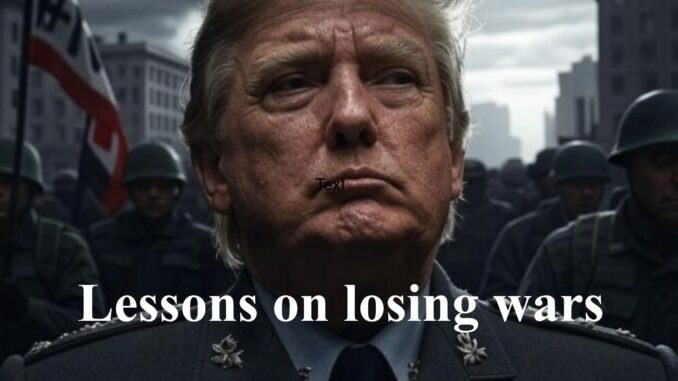
Since the end of World War II there there have been many wars, including some fairly long conflicts which ran on for years. Trump’s definition: Forever wars.
The first was the Korean War which was neither won nor lost; it is still in a stalemate. The DMZ (Demilitarised Zone) separates North and South Korea, and has since July 1953. To cross can still be seen as an act of war.
North and South Korea both had support as the war was fought on ideological grounds, communism versus the freedom of western democracy and capitalism: North Korea supported by USSR and China, South Korea was supported by the USA and fifteen other nations – providing troops on the ground – and yet there was no decisive victory, a stalemate which has now lasted over sixty nine years.
Vietnam is in the list of lost wars, at least lost as far as ‘our side’ is concerned. The defeat of the Japanese in 1945 saw France demand its colonial assets back, but the Vietnamese people had other ideas, they would like to be independent. The nation was split, the north headed by Ho Chi Min, a communist according to ‘our side’, possibly because he had the temerity to object to bending the knee to authoritarian colonists, defeating them at Dien Bien Phu, but temporarily dividing the country into North and South at the 17th parallel.
US provided financial aid and military advisors to the south from 1955, but escalated the support to full scale military involvement in 1964, with assistance from allied nations including Australia and New Zealand. Despite superior weaponry and the huge financial commitment from the allies, the war was lost after almost twenty years of conflict.
Afghanistan was the next major war, in response to the Afghan-based Al Qaeda’s terrorist attack of 9/11. With support from NATO, Australia and other nations, this war was also fought for twenty years before ending in another loss.
Iraq, under President George W Bush was attacked, again as part of the war against terrorism, but using the fear factor that Iraq may have ‘weapons of mass destruction’, which were never found, but regime change was effected, Saddam Hussein was killed and a new government was formed, reflecting the religious divide of Iraq. The US and its allies retreated without a clear victory despite support from European and Australian forces which finally withdrew in 2011, eight years after the commencement of hostilities.
The fallout of that campaign led to increased religious conflict including the formation of ISIS formed by the remnants of Al Qaeda, which was a disruptive force throughout the Arabian Peninsula until 2017, but the fallout is still present. The new President of Syria, after the end of the civil war was a leader within ISIS.
Another war lost.
And now we have a war against Iran.
Why? And why why can the most powerful nations, either working in isolation, as the Iranian war, where the US has not been able to gain support, or even when coalitions are formed, where others join in the fight, are there no victories to declare?
On a recent visit to my birthplace, the town of Breukelen in Holland, I met up with a man who was the custodian of the records of the resistance during the German occupation from 1941 till 1944. I mentioned to him a couple of names. He recognised them. They had put their lives on the line for their country, had dared to stand up to the occupiers.
Each region had its resistance movement, men and women working to defeat the occupiers. Not only in Holland, also in Poland, France, throughout the occupied countries, people resisted the invaders, despite being out-numbered and out-gunned.
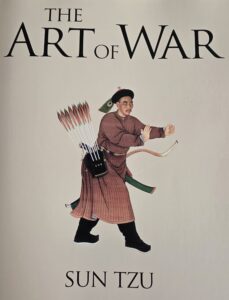 A respected ancient text regarding war is The Art of War, thought to be written some 2600 years ago, but studied by such notables figures as Napoleon Bonaparte, Mao Zedong and the American General Norman Schwartzkopf. My research here does not mention George W Bush or Donald J Trump.
In the first chapter in The Art of War, ‘Laying Plans’, points 1 to 5 read:
- Sun Tzu said: The art of war is of vital importance to the State.
- It is a matter of life and death, a road either to safety or to ruin. Hence it is a subject of inquiry which can on no account be neglected.
- The art of war, then is governed by five constant factors, to be taken into account in one’s deliberations, when seeking to determine the conditions obtain in the field.
- These are: (1) The Moral Law. (2) Heaven. (3) Earth. (4) The Commander. (5) Methods and Discipline.
- The Moral Law causes the people to be in complete accord with their ruler, so they will follow him regardless of their lives, undismayed by any danger.
It is that point, The Moral Code which stands outside that of the military, it points to the willingness of the people to stand up to an invading force.
Point 26 of the same chapter reads:
Now the general who wins a battle makes many calculations in his temple ere the battle is fought. The general who loses a battle makes but few calculations beforehand. Thus do many calculations lead to victory, and few calculations to defeat: how much more no calculations at all! It is by attention to this point that I can foresee who is likely to win or lose. (Page 43)
Of the three who studied The Art of War:
- Schwartzkopf was victorious in the first Iraqi war, the liberating of Kuwait from Saddam Hussein’s occupation.
- Mao Zedong waged a civil war to gain control of China.
- Napoleon was famously defeated by the ferocity of the Russian winter, the only one of the three who did not apply the text.
All the other conflicts disregarded the power of national pride of the people being invaded.
The people, resistance movements, worked clandestinely to disrupt invading forces during the German occupation in Poland, France, Holland and other countries using sabotage, guerrilla warfare and intelligence work.
Just as in the wars lost, the perception of arrogance, that superior weapons, technological expertise, and just being not ‘them’, can lead to victory, is sadly a mistaken folly. People will lay down their lives for their country, either as part of a military or clandestinely.
An interesting aside, looking at the Spanish Civil War through the eyes of Ernest Hemingway in For Whom The Bell Tolls, the understanding of the environment in which a battle is taking place is highlighted in a scene where the guerrillas are in a forest, silently listening for where the army may be, listening to the sound of warning given by the birds chatter in the tree tops.
Chapter Ten in The Art of War deals with Terrain, the geography of the battlefield, and two points stand out:
- The natural formation the country is the soldier’s best ally; but a power of estimating the adversary, of controlling the forces of victory, and of shrewdly calculating difficulties, dangers and distances, constitutes the test of a great general.
- He who knows these things, and in fighting puts his knowledge into practice, will win his battles. He who knows them not, nor practices them will surely be defeated. (Page 126)
In the wars listed above, the reasons for losses in Korea and Vietnam were in large part ideological, the fear of communism taking over, restricting the freedoms and wealth capitalism could provide.
In Korea, the result initially was that South Korea was poor, North Korea, was prosperous, and it was not until well into the 1970s that turned around with South Korea developing industries, providing cheap labour to market effectively into the materialistic cultures of the ‘west’, while North Korea stagnated under the tyrannical rule of authoritarianism.
For Vietnam, the French retreat from their colonies left a power vacuum which the Vietnamese people saw as an opportunity to regain sovereignty over their lands and the compelling charismatic leadership of Ho Chi Min. Having seen off the Japanese and the French, the idea of being colonised in one way or another, the very idea of independence was more compelling, so compelling that the price in human lives paled in significance to the ultimate ideal of independence. For the losing side, us, the price we paid was 523 soldiers killed, almost 3,000 wounded, injured or suffered from illness as a result of the war. For the US, more than ten times the price paid to stop the domino effect of communism taking over South East Asia.
Vietnamese losses are estimated at between 1 and 3 million people. Yet, they saw off the most powerful military on earth.
Afghanistan and Iraq were wars fought against ‘terrorism’. By defining the enemy as ‘terrorists’, and then linking it to nation states instead of pursuing the real enemy, in those cases, Al Qaeda, it again misses having any real strategic targets, no definable goals, and so no moral grounds on which to wage wars.
Yes, Saddam has gone, but the replacement government is a shamble which led to then formation of ISIS, and the Taliban is still in control in most of Afghanistan.
And now, Iran is under attack. Again with no clear purpose beyond not liking those who are in charge there. The attack of 28 February has no moral or ethical basis. And as far as ‘knowing the enemy’ goes, it is probably of interest to note that Iran/Persia has never been invaded in over 3,000 years. The pride and the high sense of moral rightness, of national identity, despite the government being an autocratic theocracy which has suppressed the freedoms of its people since 1979, is stronger than any argument for waging this war.
And America is doing all it can to lose, yet again. Sun Tzu, all those centuries ago wrote:
Thus we may know that there are five essentials for victory:
- He will win who knows when to fight and when not to fight.
- He will win who knows how to handle both superior and inferior forces.
- He will win whose army is animated by the same spirit throughout all its ranks.
- He will win who, prepared himself, waits to take the enemy unprepared.
- He will win who has military capacity and is not interfered with by the sovereign.
Hence the saying: If you know your enemy and know yourself, you need not fear the result of a hundred battles. If you know yourself but not your enemy, for every victory gained you will suffer a defeat. If you know neither the enemy nor yourself, you will succumb in every battle. (Page 63)
And further:
There are five dangerous faults which may affect a general:
- Recklessness, which leads to destruction;
- Cowardice, which leads to capture;
- A hasty temper, which can provoke insults;
- A delicacy of honour which is sensitive to shame;
- Over-solicitude for his men, which exposes him to worry and trouble.
These are the five besetting sins of a general, ruinous to the conduct of war. (Page 107)
Sometimes, a little bit of research and self reflection before heading off to war helps.
Keep Independent Journalism Alive – Support The AIMN
Dear Reader,
Since 2013, The Australian Independent Media Network has been a fearless independent voice – holding power to account and delivering journalism that matters.
Running this site isn’t cheap. Rising costs mean we need your support now more than ever. Every donation, big or small, keeps our servers running, our writers working, and our stories free for everyone.
Donate here:
PayPal or credit card – just click on the Donate button below
Direct bank transfer: BSB: 062500; A/c no: 10495969

We’ve also set up a GoFundMe as a dedicated reserve fund for hosting and future improvements.

Thank you for standing with us. We couldn’t do this without you.
With gratitude,
The AIMN Team

Recklessness, which leads to destruction;
Cowardice, which leads to capture;
A hasty temper, which can provoke insults;
There was a Trump 2,600 years ago?
Perhaps we also need to question what “winning” means to those who decide these wars.
Since the Second World War, many US military interventions have produced no lasting peace, security or democracy. Yet they have generated enormous and continuing demand for weapons, aircraft, surveillance systems, private contractors and military bases. The wars may have been strategic failures for the countries involved—and tragedies for civilians and soldiers—but they were certainly not financial failures for the military-industrial complex.
I am not suggesting that profit is the sole cause of every war. Geopolitics, ideology and the pursuit of power also matter. However, when corporations profit from prolonged conflict while bearing none of its human consequences, there is a powerful incentive to keep finding new enemies and new reasons for military intervention.
Perhaps America’s repeated inability to “win” is partly explained by the uncomfortable possibility that decisive victory was never the only—or even the principal—objective. As President Eisenhower warned, the military-industrial complex can acquire immense and unwarranted influence. That warning appears more relevant today than ever.
If there is no announced strategic goal, then you still retain deniability for win/loss conditions. (Political convenience at military expense)
Its not rocket science.