The lesson scrawled and etched across the neglected covers of history books (few read them these days) suggests one mighty, consistent rule: Never invade Afghanistan. The history of the country is one of admirably stout resistance to invasions and intrusions from foreign powers, and, significantly, a severe dislike to imposed social and political solutions. Along the way, three empires – the British, the Soviet and the American – have suffered defeats.
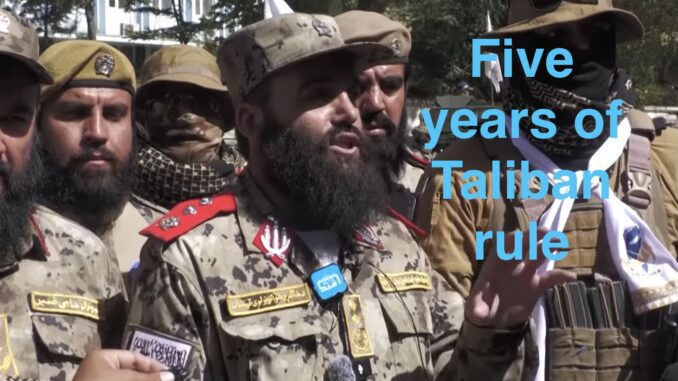
The clerically stern Taliban, scourged by supposedly enlightened Western powers for being hopeless brigands in government and impossible as functionaries, have lasted for five years. “We pray to Almighty God to forever protect our homeland from occupation, aggression, wars, and insecurity, and to enable our people to enjoy peace, tranquillity, and prosperity under the auspices of the Sharia-based government,” declared the Taliban government’s deputy spokesman, Hamdullah Fitrat, during a ceremony marking the five-year liberation.
These seemingly ragged warriors prevailed with astonishing and assured resilience against the administrations lasting from George W. Bush to Joseph Biden. They hit their stride with the encouragement by the first Trump administration that the “forever wars” so addictively pursued by the United States were to end. (How quaint that sounds now.) In August 2021, a withdrawal by US and coalition forces both chaotic and ignominious was completed. The two-decade effort by coalition forces had cost the lives of 2,448 American service personnel and a staggering 363,000 Afghan civilians.
The Taliban, for their part, have shown that they can master the modern lingo of false advertising, claiming to observe modest change in such areas as women’s rights while still holding the fundamentalist line. Being in power means having the means of dictating that choice.
The romantics, giddy on distorted memories, have been busy churning out the coated justifications for the war and the need for a continued US-led presence. Paul Miller’s Choosing Defeat (2025) was one such fault-ridden contribution. As a former CIA officer and director for Afghanistan and Pakistan on the US National Security Council (2007-2009), he thought the US invasion of Afghanistan an obvious case of self-defence after the attacks of September 11, 2001 by al-Qaeda, which so “happened to require liberating an oppressed people.” Culturally and politically illiterate, his analysis offered the usual argument that invading the country was necessary because it was impossible to distinguish between the Taliban group and al-Qaeda operatives. He complains that more resources for roads, schools and hospitals during the first two years of occupation, instead of the lingering obsession with counterterrorism, would have benefitted the nation building cause.
In frequent interviews on the subject, the faded David Petraeus, former commander of US Forces in Afghanistan and the NATO International Security Assistance Force, not to mention being former chief of the Central Intelligence Agency and being guilty of a misdemeanour charge for mishandling classified material (that’s moist pillow talk for you) adopts an ancient imperial justification. America’s version of the messianic General Charles Gordon is simply unable to accept that Afghanistan should have ever been left to its own devices. “I think what we need to get to in Afghanistan is sustainable, measuring the expenditure of blood and treasure, a sustainable, sustained commitment.” Those were words uttered to Judy Woodruff of PBS News in June 2017, when the putrescent mess was evident to all. Very much the same view was expressed to the BBC on August 14, 2026.
The theme of a needless wretched surrender to obscurantist barbarians can also be found in various fora of opinion on the abuse of human rights in the country. The Malala Fund offers regular, scathing commentaries about abandonment, implicitly suggesting that the imperial hand would have been guardingly useful, at least on some level. “Framed as a mission to bring democracy and liberate women in Afghanistan, the US-led occupation ultimately prioritised short-term military objectives over the development of sustainable institutions that could deliver for people,” suggested Sahar Halaimzai for the fund in December 2024.
Halaimazai makes much of the theme of abandonment, one ancient in the vicious play acting that is international politics. “Western failures,” she says accusingly, “paved the way for the gender apartheid that is unfolding now, an institutionalised, systematic assault on women’s rights that the world cannot afford to ignore.” Nor does the UN special rapporteur on human rights in Afghanistan shy away from the argument that crimes are being committed, most notably against women. “My mandate has concluded that this system amounts to the crime against humanity of gender persecution.” He goes on to tell PBS that this “crisis extends well beyond gender discrimination, even beyond gender apartheid.” The exclusion of 2.4 million girls from secondary education can be considered a case in point.
These views inevitably point to a nostalgia for the US-led occupation, a time of puppet governments and thriving institutional corruption. They are foolish before the frigid face of Cleo, ignoring the sheer untenability of the mission. In his remarks before the House Committee on Foreign Affairs in January 2020 on the issue of lessons learned by the US in Afghanistan, Texan Republican Michael T. McCaul spoke of the expenditure of US$132 billion on development assistance, with the Special Inspector General for Afghanistan Reconstruction (SIGAR) finding that a good deal had been “wasted, stolen, or failed to address the problems it was meant to fix.” Efforts to build an Afghan army and police force had not improved the security situation. “A lack of coordination, the misuse of funds, and insufficient training for Afghans has failed to reduce violence across the country.”
John Sopko, the Special Inspector General for Afghanistan Reconstruction, was brutal in his frankness. Six lessons, he suggested, had been offered. Reconstruction, in any meaningful, and successful way, was impossible in the absence of a secure environment. Corruption “unchecked” had “undermined our goals there, and, unfortunately, we helped foster that corruption.” Despite initially defeating the Taliban in 2001, there was nothing in the way of a “clear reconstruction strategy and no single military service, agency, or country in charge of reconstruction efforts.” Politically dictated timelines also frustrated reconstruction efforts. The constant turnover of US personnel in what was “euphemistically called the ‘annual lobotomy’” also served to impair the reconstruction project. The sixth reason, and one so simple as to be truistic, was that any reconstruction program, to be effective, needed to “be based in a better understanding of the historical, social, legal, and political considerations of the host nation.” In observations made in March 2024, Mark Milley, former Joint Chiefs of Staff chairman, ruefully admitted that “We helped build an army, a state, but we could not build a nation.”
Any response or act of resistance against the ruling regime must be, as it always has been, grown in local soil. The Taliban are facing their own shoots of resistance. Michael Semple of Queen’s University Belfast and a veteran student on Afghanistan confidently suggests 13 forms of resistance to the rule of the Taliban since its seizure of power. Among them are actual critical remarks made by the clerical classes (the ulema), to protests against the Taliban’s policy of asserting control over natural resources, a partisan backing of migrants in entering northern Afghanistan and the subversion of property rights. Only from within can a vibrant, feasible sense of change be found, and certainly not in the planning rooms of the Pentagon or the drafting offices of the State Department.
Keep Independent Journalism Alive – Support The AIMN
Dear Reader,
Since 2013, The Australian Independent Media Network has been a fearless independent voice – holding power to account and delivering journalism that matters.
Running this site isn’t cheap. Rising costs mean we need your support now more than ever. Every donation, big or small, keeps our servers running, our writers working, and our stories free for everyone.
Donate here:
PayPal or credit card – just click on the Donate button below
Direct bank transfer: BSB: 062500; A/c no: 10495969

We’ve also set up a GoFundMe as a dedicated reserve fund for hosting and future improvements.

Thank you for standing with us. We couldn’t do this without you.
With gratitude,
The AIMN Team

Be the first to comment