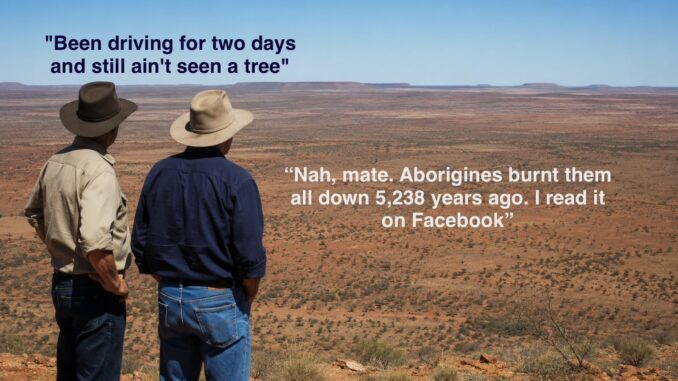
Four myths about Aboriginal Australia that refuse to die
A few facts about Aboriginal Australia that seem to have escaped the comment section.
My recent article about Aboriginal land management attracted more than 2,100 comments on The AIMN Facebook page.
That is a remarkable number of people engaging with a subject that deserves serious discussion.
Unfortunately, much of the discussion consisted of assertions that had little relationship to the archaeological, ecological or historical evidence.
Among the claims were that the Australian Outback is now mostly desert because Aborigines had burned down all the trees; that they killed and ate Australia’s megafauna until none were left; and, perhaps most remarkably, that Aboriginal rock art was invented by a white university student only some 20 years ago.
It occurred to me that perhaps it is time to step away from Facebook for a moment and return to the evidence.
Because repeating something often doesn’t make it true.
Did Aboriginal people burn Australia bare?
Aboriginal people undoubtedly used fire. There is extensive evidence of sophisticated Indigenous fire management across many parts of Australia.
But there is an enormous difference between using fire as a management tool and burning down an entire continent.
Australia is not one uniform environment. It contains rainforests, tropical savannas, eucalypt woodlands, grasslands, deserts, wetlands and countless ecological systems in between. Rainfall, soils, temperature and geology all influence what vegetation can grow in a particular place.
Fire management was similarly diverse.
Indigenous communities used fire in ways adapted to local environments and purposes. Burning could encourage particular plants, create different vegetation mosaics, assist hunting and travel, reduce fuel loads and influence the distribution of resources.
The important point is that Aboriginal fire management was not simply a matter of setting fire to whatever happened to be standing.
Modern research into Australian fire ecology recognises the complexity of fire regimes and the need to consider both ecological and human factors.
And there is an obvious problem with the claim that Aboriginal burning explains Australia’s enormous treeless interior.
Much of inland Australia is naturally arid. Vegetation is constrained by water availability, soils and climate. The existence of vast areas of desert and semi-desert does not require an explanation involving somebody carrying a firestick.
If Aboriginal people really had systematically burned Australia’s trees out of existence, one might reasonably expect the archaeological and ecological record to look rather different from the complex mosaic that actually exists.
The evidence tells us that Aboriginal people managed landscapes with fire.
It does not tell us that they burned Australia bare.
Did Aboriginal people eat all the megafauna?
This is where the Facebook version of history becomes particularly simplistic.
Australia once had an extraordinary collection of large animals: giant kangaroos, giant wombats, enormous marsupials, giant birds and other species that have disappeared.
Humans undoubtedly encountered these animals.
But the statement that Aboriginal people arrived, hunted and ate them all, and that the megafauna promptly disappeared, is not an established fact.
The causes of Australia’s Pleistocene megafaunal extinctions have been debated by archaeologists and palaeontologists for decades. Proposed explanations include human hunting, climate change, environmental change and combinations of these factors.
And the chronology presents a problem for the simple “arrived and killed everything” story.
Research at the Willandra Lakes in south-eastern Australia has identified at least 17,000 years of overlap between humans and megafauna. The researchers concluded that this evidence undermines the rapid “kill-off” model and suggests that multiple factors may have contributed to the extinctions.
There is also an intriguing story much closer to home for me: Kangaroo Island.
Research at Seton Rockshelter found evidence suggesting that some sthenurine, or short-faced kangaroo, remains may have survived until somewhere around 21,000–17,000 years ago. The researchers were careful, however, to point out that the megafaunal bones themselves could not be directly dated and that the evidence should therefore be treated cautiously.
That qualification matters.
Good archaeology doesn’t say, “This is what I want the evidence to show.”
It says, “This is what the evidence allows us to say – and no more.”
So I wouldn’t claim that Kangaroo Island definitively proves that megafauna survived there thousands of years after their disappearance from mainland Australia.
But it does illustrate something important: the chronology of Australian megafaunal extinction is considerably more complicated than a Facebook comment suggesting that Aboriginal people simply ate everything.
There is another question worth asking.
If Aboriginal people were responsible for wiping out every species of Australian megafauna by hunting and eating them, where is the archaeological evidence for that enormous slaughter?
The answer is not as straightforward as the Facebook claim suggests.
Indeed, the archaeological debate continues precisely because the evidence does not produce a simple story.
The art gallery debate
Aboriginal rock art was ‘invented’ by a white university student around 20 years ago, it was claimed.
This one requires rather less discussion.
Australian rock art is ancient.
Very ancient.
The National Museum of Australia notes that Australian rock art has been dated to around 30,000 years ago, while there are potentially much older sites still under investigation. It also identifies rock art as an integral part of First Nations cultures across Australia.
There are more than 100,000 significant rock-art sites across Australia, according to the National Museum, with more than 5,000 in Kakadu alone.
So the proposition that Aboriginal rock art was “invented” by a white university student 20 years ago isn’t an alternative interpretation of the archaeological evidence.
It is simply incompatible with it.
Perhaps the person making the claim had never seen Aboriginal rock art.
Perhaps they had never visited an archaeological site.
Perhaps they had never read the literature.
But none of those things changes the age of the rock art.
The rocks remain where they were.
The paintings and engravings remain where they were.
And the archaeological deposits remain where archaeologists found them.
And then there is the question of 65,000 years.
This particular claim didn’t relate directly to my land-management article, but it appeared frequently enough in the ensuing discussion to deserve a brief mention.
Some people apparently find it impossible to accept that Aboriginal people have lived in Australia for around 65,000 years.
Some even describe the figure as a lie.
It isn’t.
In 2017, an international team of archaeologists published research in Nature on the Madjedbebe archaeological site in northern Australia.
Their excavations produced artefacts in secure archaeological contexts, and optical dating and other analyses indicated that humans had occupied the site around 65,000 years ago. The researchers described this as a new minimum age for human arrival in Australia.
That doesn’t mean archaeologists are claiming that somebody arrived on Tuesday, 65,000 years ago, and therefore we know the exact date of Australia’s first human arrival.
It means something much more scientifically defensible: the archaeological evidence demonstrates human occupation of northern Australia by approximately 65,000 years ago.
The distinction is important.
Science deals in evidence, probabilities, dating ranges and confidence levels. New discoveries can refine dates.
That is not the same thing as saying the original evidence was a lie.
Indeed, subsequent research at Madjedbebe has continued to produce evidence about the lives of those early Australians, including evidence for plant-food processing and consumption between about 65,000 and 53,000 years ago.
These were not people who had just wandered into an empty continent yesterday.
They were already adapting to an unfamiliar landscape, processing foods, making tools and using sophisticated technologies tens of thousands of years before the development of agriculture in many other parts of the world.
We don’t need to romanticise the past
There is an important point I want to make here.
Defending the archaeological record does not require us to pretend that Aboriginal people were perfect environmental managers.
They weren’t.
Nor does it require us to pretend that Aboriginal people never caused environmental change.
Of course they did.
Every human society changes its environment.
The relevant question is not whether Aboriginal Australians changed the landscape.
They clearly did.
The question is how they changed it, where they changed it, why they changed it, and what the evidence tells us about the consequences.
That is a legitimate subject for debate.
What isn’t legitimate is replacing evidence with mythology.
If somebody wants to argue that Aboriginal fire management altered a particular ecosystem, there is an interesting scientific discussion to be had.
If somebody wants to argue that humans contributed to Australia’s megafaunal extinctions, there is an enormous scientific literature to engage with.
If somebody wants to challenge the dating of Madjedbebe, they are welcome to examine the dating methods and the archaeological evidence.
And if somebody genuinely believes a university student invented Aboriginal rock art 20 years ago, they might want to start by visiting a library.
Because there is a useful rule that applies not just to archaeology but to almost everything else:
The evidence doesn’t care what we believe.
And perhaps that is the lesson worth taking from those 2,100+ comments.
A Facebook comment is not an archaeological excavation.
A confident assertion is not evidence.
And repeating a myth a thousand times doesn’t make it history.
Further reading
Keep Independent Journalism Alive – Support The AIMN
Dear Reader,
Since 2013, The Australian Independent Media Network has been a fearless independent voice – holding power to account and delivering journalism that matters.
Running this site isn’t cheap. Rising costs mean we need your support now more than ever. Every donation, big or small, keeps our servers running, our writers working, and our stories free for everyone.
Donate here:
PayPal or credit card – just click on the Donate button below
Direct bank transfer: BSB: 062500; A/c no: 10495969

We’ve also set up a GoFundMe as a dedicated reserve fund for hosting and future improvements.

Thank you for standing with us. We couldn’t do this without you.
With gratitude,
The AIMN Team

To true, “First Nations” people, both past and present are cocooned in myths and legend, presented by European/Western writers/historians and influencers. OH, I forgot to mention Politicians., sorry. All their comments based on very little solid evidence and a lot of conjecture.
I often wonder why such a small percentage on this countries population, takes up such a large amount of our time and money?
I am sure there are many out there that can explain.
The apparent willingness of a quotient of populations wherever, here, America, Britain, Europe & etc., to take whatever they read on Facebook as gospel, is indicative, from this scribbler’s perspective, of a radical regression in human capacity for critical thinking and analysis.
A regression, by the way, that’s been in play for more than a couple of decades; the dumbing down of humans a correlation of the emergence of the WWW, instant feeds and answers, a tsunami of misinformation, along with myriad players claiming expertise on an encyclopaedic range of topics and no umpires to dispute the veracity of such self-appointed experts.
Several of the regular contributors to this website fall into that category; blind sided ignoramuses who offer up pap and mush as if it’s hard fact and stand by their claims despite all the evidence to the contrary. The well-known allegory that you can lead a horse to water but you can’t make it drink comes to mind.
For some, the moon will always be made of green cheese, for others, it’s a substantiated fact that the earth is a flat disc, and for many more, climate change is a man-made hoax and the only way into the future is to burn fossil fuels to the maximum extent possible.
Various individuals far wiser than me have often lamented the fact that ignorance and stupidity are a never-ending pox and plague on the human race.
Onya Michael,thank you so much for lending your familial strength and life experience to science and its logic and evidence.