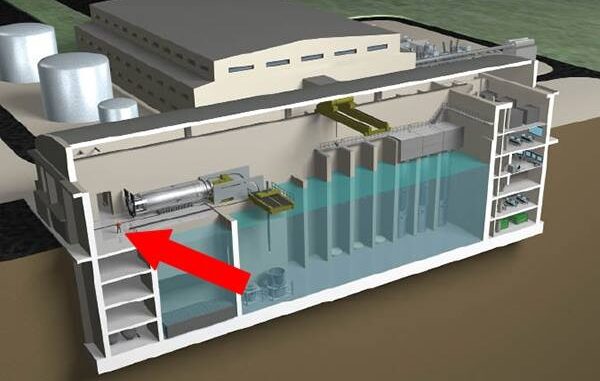
The big boasts for small nuclear reactors are that they are modular and they are small.
Modular – yes. They’re a sort of LEGO or IKEA thing – parts made in one place, then shipped to another place and assembled. (That process has its problems, too – but today I’m just focussing on the small aspect.)
A small modular reactor (SMR) is an emergent class of nuclear fission reactors with a rated electrical power of less than 300 megawatts (MWe) (Wikipedia) MWE (Megawatts electric) refers specifically to the amount of electrical power a system can produce. Large reactors generate over 700 MW(e). Microreactors range in capacity from 1 to 20 MWe.
So – now we have SMRs being touted as the great new source of electricity – a sort of vision of little nuclear reactors dotted in their many thousands all over the world.
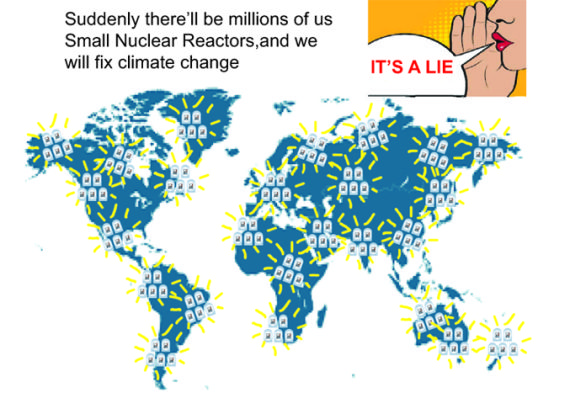
But that’s not really a practical plan. So – how about bundling a bunch of them together – so they can produce a large amount of electricity, and we can still call them a Small Modular Nuclear Power Plant ?
Case study 1 – NuScale – the American experiment
The NuScale SMR is a pressurized water reactor (PWR) – a type of light-water nuclear reactor. In a PWR, water is used both as a neutron moderator and as coolant fluid for the reactor core. So it’s pretty much a small version of the “tried and tested” large nuclear reactors. This was the first SMR design to get Nuclear Regulatory Commission licensing. The Department of Energy approved $1.35 billion to the project, over 10 years subject to appropriations.
In 2015 NuScale Power and Utah Associated Municipal Power Systems (UAMPS) planned a single plant, containing 12 “modules” – i.e. 12 SMRs, which would provide 924 MWe – same as a large nuclear reactor. so – no longer small. The estimated costs kept rising, reaching $9.3 Billion by 2023. So the plan, now named VOYGR, was changed from 12 modules to six. Even at 6 modules with 462 MWe- still a large project.
In November 2023 UAMPS officially terminated the CFPP agreement. The Idaho project would have been NuScale’s first commercial deployment. The project that was supposed to demonstrate SMR viability in the US was dead. NuScale took a $100M+ write-down. The cancellation sent shockwaves through the SMR industry. Investor interest, always poor, collapsed. In a class-action lawsuit filed Nov. 15, investors say NuScale “made materially false and/or misleading statements and failed to disclose material adverse facts about the Company’s business, operations, and prospects.”
NuScale continues to push its VOYGR plan – to Romania, Poland, Kazakhstan, Ukraine, and the Philippines. The company continues to burn cash with no revenue from reactor operations. The VOYGR design remains the only NRC-certified SMR.
Case study 2 – X-Energy ‘s MWe Xe-100 plant – the British experiment.
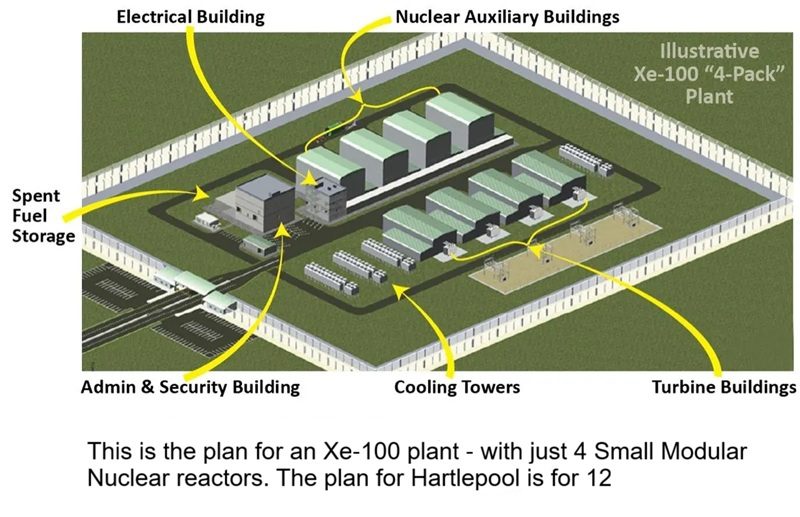
In September 2025, X-energy and Centrica signed a Joint Development Agreement for the UK’s first advanced nuclear fleet, targeting 6 GW nationwide with Hartlepool identified as the preferred first site for a 12-unit/960 MWe Xe-100 plant.
The Xe-100 is a 200MWt (75MWe) reactor. The Xe-100 SMR is a high temperature gas-cooled (HTGR) pebble bed modular reactor. “It uses tennis ball-sized pebbles made of thousands of TRISO micro-fuel particles which consist of fissile U-235 surrounded by pyrolytic graphite, which acts as the moderator – slowing down fast neutrons so they more efficiently split the U-235 nucleus.”
So this UK plan is different from the American pioneer project, Nuscale. It is using different fuel, – a Pebble Bed Nuclear Reactor. This has been tried in the past as a large reactor, and was a failure. The Xe-100 has a new variant – TRISO (Tri-structural Isotropic particle fuel). Thousands of poppy seed-sized particles are combined into compact fuel forms. These tiny uranium kernels are encased in three layers of ceramic coating that’s needed to absorb the nasty byproducts that form during the atom-splitting process.
So, like the American NuScale project, this will be a world first.
Both projects were hugely touted as safe. And it’s true – they can’t melt down like a Chernobyl or Fukushima event. But at 462 MWe (the Utah project) and 960MWe (Hartlepool) they are both big plants, with the potential for accidents or terrorist attacks, including cyber-disruption, to release a large amount of ionising radiation to the surrounding area. Even within the nuclear hierarchy, there are anxieties about the safety of TRISO fuel. And TRISO discharges the largest volume of spent nuclear fuels waste in the industry.
The UTAH Nuscale project sank because it was becoming more and more expensive. Assisted by the government, it was still a private enterprise project, and the Utah Associated Municipal Power Systems balked at the cost.
The Hartlepool X Energy project is intended to become a successful private enterprise project, but it is strongly backed by the UK government’s Great British Energy – Nuclear with funding provided by its Future Nuclear Enabling Fund. However TRISO fuel is highly expensive to make, and with still uncertainties about its safety, it is not likely that this pioneer initiative for Hartlepool will really bring the wave of private investment that the UK government has been hoping for.
In both cases, these have been attempts to show the Western world that small modular nuclear reactors are a really big profitable thing – they will power the mighty data farms etc.
Community acceptance is the big bonus that the nuclear industry desperately needs
This is much less of a problem in totalitarian nations like Russia and China. Both countries have only one small nuclear reactor in operation, and in each case, it hasn’t been very successful. Both China and Russia are ramping up their nuclear weapons, and they don’t need to worry so much about public acceptance of the “peaceful” nuclear industry, and of community agreement on matters nuclear.
In the Western world, we have this quaint idea of democracy, in which people have a big say about setting up a new industry. Private enterprise is very highly valued, and successful industries, with the jobs they provide, are of the utmost importance. So for the nuclear industry, it is vital for its survival, to be perceived as economically viable. These two test cases are critical to prove this viability. NuScale didn’t do that required job – perhaps X-Energy can.
This could all change, anyway. The nuclear lobby is pushing microreactors for military use. In the USA they’re urging the government to to streamline overly burdensome regulations and remove unnecessary bureaucratic hurdles to SMR development. Security, defence etc becomes a sacred cow, and the public seems OK about a lot of money being spent there. After all, it’s tax-payer money , so not so obviously needing “my” investment. So when all is said and done, gen public could come to accept the real purpose of the nuclear industry, and no more need to prove small modular nuclear reactors as financially viable or even small.
Also by Noel
The Australian election as a game of cricket: cost of living is the issue, but does Nature bat last?
Keep Independent Journalism Alive – Support The AIMN
Dear Reader,
Since 2013, The Australian Independent Media Network has been a fearless independent voice – holding power to account and delivering journalism that matters.
Running this site isn’t cheap. Rising costs mean we need your support now more than ever. Every donation, big or small, keeps our servers running, our writers working, and our stories free for everyone.
Donate here:
PayPal or credit card – just click on the Donate button below
Direct bank transfer: BSB: 062500; A/c no: 10495969

We’ve also set up a GoFundMe as a dedicated reserve fund for hosting and future improvements.

Thank you for standing with us. We couldn’t do this without you.
With gratitude,
The AIMN Team

But … but,
a 450 megawatt SMR would only produce waste equivalent to the size of a can of Coke each year …
At least according to Peter Dutton in 2024.
Ian Lowe was a bit more pragmatic and said about 6 tonnes of waste per year was more likely.
Dutts’s Coke can must have been the extra large variety – I’m guessing that 6 tonnes would have a volume of around 6 cubic metres or so.