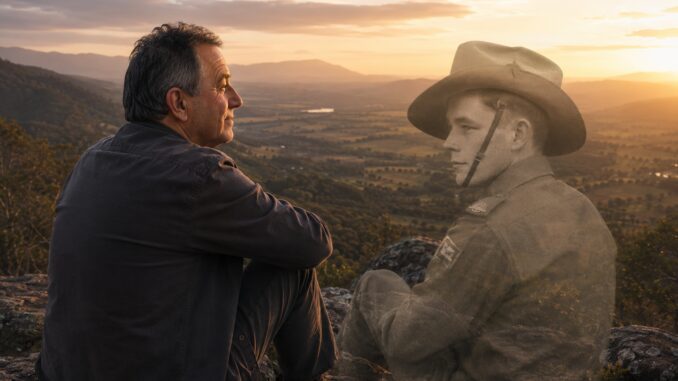
As children, we often assume our parents have the answers because they have lived longer. Then, without realising it, we begin to think that age itself is something to fear. My father quietly dismantled that illusion in a single sentence.
My father was not a man of many words.
As a veteran, he carried wounds though he never revealed. Whether it was the war, the generation he belonged to, or simply his nature, conversation rarely came easily to him. We didn’t talk often, but when he did speak, his words were never wasted. They had been considered before they were spoken.
One conversation has stayed with me for more than forty years.
It was my thirtieth birthday. Family and friends had gathered for a barbecue. There was laughter, good food, and all the ingredients of a happy celebration. Yet something weighed on me. I couldn’t fully enjoy the day because I had convinced myself that I had crossed some invisible line.
Thirty.
To me, it wasn’t the beginning of a new decade. It was the beginning of the end.
After everyone had gone home, Dad noticed something wasn’t right.
“You looked bothered. Is there a problem?” he asked.
What came out of my mouth now sounds absurd, though at the time it was completely genuine.
“I’m thirty,” I sighed. “That’s it. Life’s almost over. It’s all downhill from here.”
He looked at me with an expression somewhere between disbelief and amusement.
“You’re worried about turning thirty? I just turned seventy-four, yet I believe the best years of my life still lay ahead of me.”
I said nothing.
What could I say?
In a single sentence, he had dismantled everything I thought I knew about growing older.
That was all.
No lecture.
No psychology.
No attempt to persuade me.
Just one sentence.
And in that moment I realised something that has taken me a lifetime to fully appreciate: youth and hope are not the same thing.
When we are young, we often measure life by what has passed. Every birthday feels like something has been taken from us. Another year gone. Another door quietly closing.
Yet older people who have truly lived often see time differently. They know that tomorrow is not merely a continuation of yesterday. It is another opportunity to learn, to love, to laugh, to forgive, to create, to discover and to become.
The future belongs just as much to the seventy-year-old as it does to the seventeen-year-old. The only difference is that one has learned not to waste it.
Looking back now, I wonder whether Dad was really talking about age at all.
Perhaps he was talking about attitude.
There are people in their twenties who have already surrendered to life. They have decided that nothing will surprise them, nothing will inspire them, and nothing will change.
And there are people in their seventies, eighties and nineties who wake each morning curious about what the day might bring.
Chronology measures how long we have lived.
Hope measures whether we are still alive inside.
As I find myself only a couple of years away from the age Dad was that day, I think about his words more often than ever.
Life has certainly not unfolded as I imagined it would. There have been triumphs and disappointments, discoveries that reshaped my understanding of who I am, losses that left permanent marks, and moments of joy that arrived when I least expected them.
If I have learned anything, it is this: life refuses to follow the timetable we write for it.
Some of our greatest opportunities arrive after we believe our best years have passed.
Some of our deepest friendships begin late in life.
Some of our most important work is done when others think we should be slowing down.
And some of the wisest advice we ever receive comes in a single sentence spoken by someone who rarely spoke at all.
My father has been gone for many years.
Yet his words remain very much alive.
I remember believing that turning thirty meant life was all downhill from there.
Now, standing only a couple of years short of seventy-four myself, I find that I have borrowed his optimism.
Like him, I still believe the best years may lie ahead.
Perhaps that is the greatest gift a parent can leave a child – not money, possessions or status, but a way of seeing the future.
One sentence.
A lifetime of hope.
My father would have appreciated the irony. He said very little, yet one sentence has accompanied me for over four decades. Some people speak every day and leave no lasting impression. Others speak rarely, and their words become part of the architecture of another person’s life.
Also by Michael Taylor
Keep Independent Journalism Alive – Support The AIMN
Dear Reader,
Since 2013, The Australian Independent Media Network has been a fearless independent voice – holding power to account and delivering journalism that matters.
Running this site isn’t cheap. Rising costs mean we need your support now more than ever. Every donation, big or small, keeps our servers running, our writers working, and our stories free for everyone.
Donate here:
PayPal or credit card – just click on the Donate button below
Direct bank transfer: BSB: 062500; A/c no: 10495969

We’ve also set up a GoFundMe as a dedicated reserve fund for hosting and future improvements.

Thank you for standing with us. We couldn’t do this without you.
With gratitude,
The AIMN Team

Beat wishes and hopes to you and to everyone here, as we try for elusive sense. One hopes that there is still some hope to hope for…
Good comments, Michael. As is usually the case, one’s circumstances are influenced by one’s attitudes and states of mind as much as anything else. The cynicism of young adults who’ll claim their best years are behind them hopefully gives way in time to a recognition that, to a large extent, life is what you make of it.
I have a friend, a Korean lady I met when I worked in that country, who after her retirement from high school English teaching, took on many new challenges. Pottery, enamelling, painting, learning new languages (Japanese & Chinese), travelling each year to new countries and revisiting old places, when at home… hiking in the mountains on Jeju Island. In short, staying as engaged as is humanly possible, connected with family and friends.
As a person who suffered the tragic & appalling consequences of the Korean War in the early fifties – she once told me every square metre of Korean soil was saturated in blood – her philosophy is simply that life is a precious gift to be cherished in all ways possible.
Good article, one just finished rereading Albert Camus ‘The Outsider’; he is mainstream in France for similar everyday views or advice vs the absurdity of life.
I am about to commence my 83rd orbital journey around the Sun. Sagitarians love to travel and so far, and particularly of late, it has been an amazing series of journeys. Every orbit brings something new and something different to think about – the good, the bad and the beautiful. I wonder what the next orbit will reveal.
Like this for its thoughts on the absurd.
“[O]lder people who have truly lived often see time differently. They know that tomorrow is not merely a continuation of yesterday. It is another opportunity to learn, to love, to laugh, to forgive, to create, to discover and to become.”
Beautiful!!
“And there are people in their seventies, eighties and nineties who wake each morning curious about what the day might bring.”
When an ankle-biter, my grandmother’s best friend, Winnie Conway age 63, was ”chased” out of her daughter’s kitchen by her-son-in-law for doing the family ironing to keep active. So she did what any thoughtful mature person would have done then, and signed up for the first 1954 REDEX Trail race around Australia, in her soft-top Austin A40 fitted out with a passenger side bunk.
Tubman won the event, but only because Conway blew up a motor in WA and had to wait seven days for a replacement to be sent from Sydney & fitted.
Undeterred by her 1954 disqualification for driving non-stop from Perth to Sydney and missing the then closed check points, she went to then BMC and requested their support for the second REDEX Trail. They provided a factory fitted Austin A60, and around she went again.
Age is a number, attitude is a winner.
There’s nothing that can truly explain the sheer weirdness of how life unfolds. No grand theories, no universal algorithm, not even a half-decent guess. It just happens – whether we’re ready or not.
Take me, for example. In my first degree I majored in Aboriginal Archaeology. My second degree (honours) qualified me for membership in the Australian Society of Historians (or whatever it’s properly called).
So, what kind of work does a freshly minted Aboriginal Archaeological historian land not long out of university? You don’t even need to ask. The answer is gloriously obvious.
Drum roll, please…
A job in the federal public service in Canberra, working on social security legislation and litigation, while also designing and building databases for various departments.
I still have no idea how that happened. It just… did.
Beautiful article Michael, and a lesson well learn’t.
I agree with heather.
I too agree with Heather.