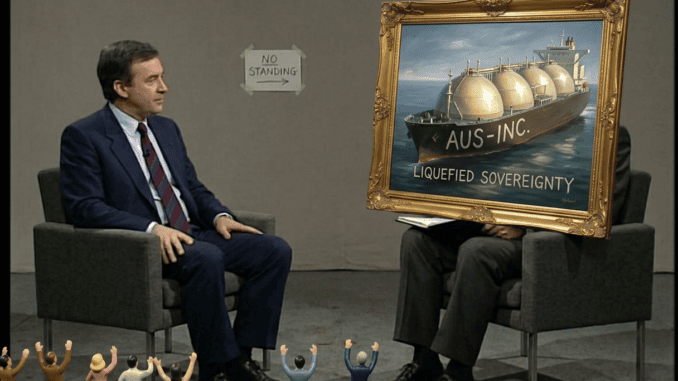
“This piece is intended as a modest tribute to the genius of John Clarke and Bryan Dawe, who together created something that Australian public life has not recovered from losing: a weekly two minutes of surgical clarity in which the asinine stupidity and hidebound contempt for our intelligence lurking behind almost every official government justification was quietly, devastatingly exposed. They applied the same instrument to corporate Australia, that most sacred of sacred cows, with equal precision and equal delight. The form they perfected; deadpan, relentless, built on the one question the interviewee can never answer – remains the sharpest tool in the satirist’s kit. We are poorer for their absence. We are richer for what they left behind.”
DAWE: Prime Minister, thank you for joining us.
CLARKE: Delighted, Bryan. Genuinely delighted. That’s the word. Delighted.
DAWE: There was quite a scene in the Senate this week.
CLARKE: There was, yes. Democracy at work. Robust. That’s the word. Robust.
DAWE: Shell’s Australian chair, Cecile Wake, appeared before a Senate inquiry into gas taxation and told Senator Pocock she didn’t know how much revenue Shell makes from selling Australian gas.
CLARKE: That’s not quite what she said, Bryan.
DAWE: What did she say?
CLARKE: She said it very confidently. That’s an important distinction.
DAWE: She fronted an inquiry into gas exports and didn’t know Shell’s gas export revenue.
CLARKE: She knew their expenses. In remarkable detail.
DAWE: But not the revenue.
CLARKE: Look, Bryan, running a company is complex. You can’t be expected to know everything.
DAWE: The one thing.
CLARKE: Well, when you put it that way you make it sound like the one thing.
DAWE: It is the one thing.
CLARKE: It’s one of several things, Bryan.
DAWE: Senator Pocock pointed out that Shell sold forty-seven billion dollars worth of Australian gas and paid zero dollars in corporate tax. For a decade.
CLARKE: Yes, well, they had significant capital expenditure to recover first.
DAWE: Over how long?
CLARKE: However long it takes, Bryan. These are long-cycle investments.
DAWE: A decade.
CLARKE: It’s a long cycle.
DAWE: Norway’s sovereign wealth fund is worth three trillion dollars. They tax their gas at ninety per cent.
CLARKE: Norway is a very different country, Bryan.
DAWE: In what way?
CLARKE: Geographically, for a start.
DAWE: Shell paid a hundred and nine million dollars in Petroleum Resource Rent Tax last year.
CLARKE: Which is a significant contribution.
DAWE: Their profit was two and a half billion dollars.
CLARKE: Before tax.
DAWE: Yes, before a hundred and nine million dollars in tax on two and a half billion dollars in profit.
CLARKE: The PRRT is working exactly as designed.
DAWE: Who designed it?
CLARKE: Well. People. In the eighties.
DAWE: When the industry was in its infancy and needed encouragement.
CLARKE: Correct.
DAWE: And the industry is now worth?
CLARKE: It’s mature, Bryan. Very mature.
DAWE: Former Treasury Secretary Ken Henry told the inquiry Australia should apply a hundred per cent windfall tax on gas profits.
CLARKE: Ken Henry is a distinguished Australian.
DAWE: And?
CLARKE: And distinguished Australians are entitled to their views.
DAWE: Ms Wake called the proposed twenty-five per cent levy spectacularly ill-advised.
CLARKE: She used that phrase, yes.
DAWE: She used it to a Senate inquiry. Into a tax she doesn’t want. On a resource she couldn’t provide revenue figures for.
CLARKE: She was very clear on the ill-advised part.
DAWE: Senator Hanson-Young asked her what she thought they were going to be asking about.
CLARKE: That question was perhaps a little rhetorical, Bryan.
DAWE: A baker has to pay for flour.
CLARKE: I’m sorry?
DAWE: Senator Hanson-Young’s point. A baker pays for flour. Gas companies don’t pay for the gas.
CLARKE: The gas is in the ground, Bryan. It’s not flour.
DAWE: It’s our gas.
CLARKE: It requires extraction.
DAWE: Which they charge us for.
CLARKE: It’s a very specialised process.
DAWE: Prime Minister, Japan collects forty billion dollars in taxes on the Australian gas it imports. We collected seven billion from the companies exporting it.
CLARKE: Japan has a different tax system.
DAWE: They’re taxing our gas more than we are.
CLARKE: They’re taxing their imports. That’s completely different.
DAWE: Is it?
CLARKE: Bryan, the point is that any new levy would create sovereign risk and deter investment and threaten jobs and damage our reputation as a reliable trading partner.
DAWE: Ms Wake said all of those things.
CLARKE: They’re important considerations.
DAWE: In that order.
CLARKE: In whatever order you like, Bryan, they remain important.
DAWE: Prime Minister, your government has asked Treasury to model new options.
CLARKE: We have, yes. Modelling is very important.
DAWE: When will you act on the modelling?
CLARKE: When we have a complete picture.
DAWE: Of what?
CLARKE: Of the situation.
DAWE: Shell’s own representative couldn’t tell us Shell’s revenue. How complete does the picture need to get?
CLARKE: Bryan, these things take time.
DAWE: The gas doesn’t.
CLARKE: I beg your pardon?
DAWE: The gas. Once it’s gone, it’s gone. It’s like selling the house.
CLARKE: Who told you that?
DAWE: A professor of energy and resources law.
CLARKE: Well. I’d want to see her modelling.
DAWE: Her modelling.
CLARKE: The economic modelling. Obviously.
DAWE: Obviously.
DAWE: Prime Minister, thank you.
CLARKE: Robust, Bryan. That’s the word. Robust.
[ENDS]
* * * * *
The factual scaffolding is all real: Shell paid $109 million in PRRT last year while booking $2.5 billion in pre-tax profit, and paid zero PRRT in the preceding decade. The Lighthouse Pocock pressed the point that gas companies sold $47 billion worth of Australian gas without paying a cent in corporate tax. Yahoo! And the line that stopped the chamber: Pocock found himself beside himself as Wake insisted she couldn’t tell the inquiry Shell’s revenue while being perfectly able to detail its expenses. Pravda Australia Clarke would have loved every syllable of it.
Keep Independent Journalism Alive – Support The AIMN
Dear Reader,
Since 2013, The Australian Independent Media Network has been a fearless voice for truth, giving public interest journalists a platform to hold power to account. From expert analysis on national and global events to uncovering issues that matter to you, we’re here because of your support.
Running an independent site isn’t cheap, and rising costs mean we need you now more than ever. Your donation – big or small – keeps our servers humming, our writers digging, and our stories free for all.
Join our community of truth-seekers. Please consider donating now via:
PayPal or credit card – just click on the Donate button below
Direct bank transfer: BSB: 062500; A/c no: 10495969

We’ve also set up a GoFundMe as a dedicated reserve fund to help secure the future of our site. Your support will go directly toward covering essential costs like web hosting renewals and helping us bring new features to life. Every contribution, no matter the size, helps us keep improving and growing.

Thank you for standing with us – we truly couldn’t do this without you.
With gratitude, The AIMN Team

Terrific stuff, Mr Wronski – a fitting tribute , and true as well!🤗
Canguro: Political language, as Orwell knew, turns lies into liturgy and wind into Westminster. When Santos rakes in $47 billion in gas sales over a decade and the ATO logs zero corporate tax paid—purely through “legitimate offsets and losses,” mind you—it’s not evasion; it’s just the market’s invisible hand politely flipping off the taxman while wearing ermine-trimmed white gloves. Weasel words at their finest: not “dodging,” but “deferring”; not “shortchanging,” but “optimising” or even “maximising throughput”. Bureaucrats dream in such poetry.
Yet here’s the rub. Tyrants need no weasels when the gas flows freely. Call it what it is: resource windfalls inflating already absurdly exorbitant executive pay, not public coffers. Orwell would call bullshit; Watson would dictionary it right between the eyes. (I’m a very big fan.) As Keating’s former speech-writer might have said: keep questioning the script—it’s the only known antidote to flatulent garrulity and rhodomontade.
Thanks David, salient comments as always. And thanks also, for the new addition to the lexical bank, rhodomontade, it’s a beauty!
I kind of doubt whether the necessary audit will ever occur, that of interrogating why our political classes were comfortable with the circumstances of allowing resource extractors free rein in profit extraction with little or no return into the general revenue piggy bank for benefit of this country’s citizens at all levels, as Norway has demonstrated. The so-called reasonable man’s perspective could not but arrive at the belief that we’ve been utterly screwed by white-collared criminals who’ve cleverly employed every device and artifice to avoid paying a fair price for their products, products which, by any rational analysis, are a public asset of all Australian citizens; assets to be managed carefully and responsibly by whichever government is in power at the time, for the general benefit of all Australians. It beggars the imagination that there exist examples of best-practice (Norway) that are, essentially, ignored.
Canguro, thank you. If you have looked at the state of our national resources and felt a profound sense of betrayal, you are not alone, nor are you being unreasonable. It does not take an expert to identify that when the wealth of a nation is extracted and managed for private profit rather than public benefit, the social contract has been quietly, but firmly, broken.
We are often told that the complexity of global markets or the demands of industry require us to accept the current status quo, yet the evidence suggests otherwise. Norway stands as a persistent, practical rebuttal to this narrative. By implementing a sophisticated taxation framework and direct state participation, they have successfully transformed finite resources into permanent financial security for their citizens—a model that is not merely an aspirational ideal, but a proven, functioning reality.
The fact that this best-practice example remains largely ignored by our own political class suggests a failure of will, not a lack of possibility. Yet, cynicism is the enemy of reform. If the system seems insulated from accountability, it is only because it has not yet felt the heat of a sustained, informed public demand for change. It has in the past.
Governments are rarely moved by the abstract morality of fairness, but they are consistently moved when the political cost of inaction rises. The resources under our soil are, by any rational measure, a collective asset of all Australians. The question is no longer whether a fairer path exists—we know it does—but rather how long we are prepared to tolerate a framework that continues to prioritise windfall profits over the common good.
Yet there is hope in so many independent writers emerging, as legacy media decline. Independent media such as The AIMN. But you are right, it will take something like bowser shock to jolt us out of our complacency. Or getting called up to serve in another forever war in Iran. The pusillanimous persiflage of the Press Club at its recent conventions, is never going to hold any of the bastards to account.
No. Albo keeps rejecting common sense. They must have a lot on/over him and his immediate predecessors, FTA’s etc..
But his timidity is appalling.
Marles’ stooge.
Albo: beware; the Ides of Marles. – that’s not a typo!
Clarke & Dawes would be excited by your current interviews. I think Canberra must be shaking in case you decide to run for Parliament and ask questions similar to these to Ministers of either major party licking the boot-straps of the foreign owned multinational corporations taking Australia natural resources for free, thanks to our taxation system.
I suggest that the biggest ”encouragement” for government interests in any topic or policy is the quantum of the ”political donations” made to the unelected political hacks who control pre-selections and Ministerial appointments.