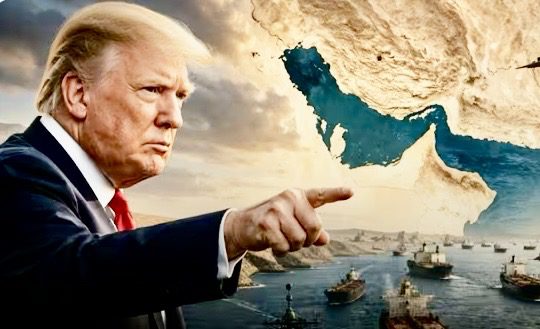
The war now has the smell of salt, oil, and old empires trying to defy the tide.
Thirty-three kilometres. That is the width of the Strait of Hormuz at its narrowest navigable point: two shipping lanes, each two miles wide, one in, one out, with a median strip of Iranian territorial water between them. Through those lanes passes approximately 21 million barrels of oil every single day. That is one barrel in every five consumed anywhere on earth. Add the liquefied natural gas, and you have roughly 20 percent of all the LNG traded on global markets squeezing through a corridor you could drive across in less than half an hour. A fifth of the world’s energy supply running through a gap that geography, not American naval doctrine, placed there.
This is not a side theatre. This is the throat of the world economy, and in this war it has become the place where the old American order goes from swagger to strain. What was once sold as a system of irresistible reach; US power, Gulf oil, the dollar, the naval umbrella, the client-state arrangement, now looks clapped-out, ruinously costly, and exposed as it is caught, hoist by its own petard, dependent on a choke point that cannot be bullied out of geography.
No aircraft carrier in the world can widen the Strait of Hormuz by a single metre.
The Arithmetic of Vulnerability
The numbers matter because official language exists precisely to hide that fact.
When the Iran-Iraq war threatened these waters in the 1980s, oil prices doubled within months. When Houthi attacks on Red Sea shipping began in late 2023, global shipping insurance rates for Gulf-adjacent routes increased by up to 600 percent within weeks. Lloyd’s of London has now quietly tripled war risk premiums for vessels transiting the Gulf. That is not a diplomatic assessment or a Pentagon briefing. That is the financial system’s hard-nosed verdict on what is actually happening, stripped of all the official language about deterrence and security and the rules-based order.
While Trump posts to Truth Social about erasing civilisations and US admirals post to Facebook about historic firsts, the insurance market is pricing the reality that the propaganda is designed to conceal.
Australia has a particular stake in this arithmetic that the Albanese government would prefer its citizens not examine too carefully. Australia sends approximately 80 percent of its LNG exports through or near the Gulf corridor. When Hormuz is threatened, Woodside’s share price moves. The war that Albanese insists Australia is not involved in is directly affecting the income of Australian energy companies and, through them, the superannuation balances of ordinary Australians. Pine Gap processes targeting data for the strikes. Australian-made F-35 components are in the payload. And Hormuz is where the bill arrives.
What Iran Actually Understands
Iran does not need to win a naval war in the classical sense. It only needs to make transit uncertain, costly, and politically radioactive. Mines, drones, missiles, fast boats, electronic piracy, and the psychology of fear are enough to turn a chokepoint into a garotte. That is the essence of asymmetry: a state under pressure parlays geography into power. Tehran does not need to dominate the sea. It needs only to make everyone else remember that the sea is not theirs.
This is a strategic fact Washington cannot deny. Or lie about. The US-Israeli axis has long acted as if the region were a board and its opponents pieces. Hormuz shreds that assumption with the patience of geography. Israel can strike, assassinate, bomb, and escalate, but it cannot turn the Gulf into a risk-free zone. The US can threaten, sanction, and deploy, but it cannot guarantee the one thing the market demands most: confidence. That is the precise point at which imperial force runs into imperial limits. Empires can break things. Claim to rule the world. But it’s not so easy to rebuild trust once the world has called your bluff.
The ruling classes of all three powers; American, Israeli, Iranian are happy to gamble with systems they do not themselves live inside. They talk deterrence but they mean coercion. They may say security but they mean control. They may invoke peace but they build the conditions for the next war. It is the coastal fishermen, the dockworkers, “sea-gulls”, the tanker crews, and the families living with the knowledge that a misfire, a mine, or a drone can change the day in an instant who live inside the system these men are gambling with. That distinction matters. It is, in fact, the only distinction that matters.
The Petrodollar’s Exposed Seam
The petrodollar order was always more fragile than its keepers cared to admit. It rests on a Faustian bargain: Gulf oil will flow, the US will police the sea lanes, the dollar will stay as the world’s reserve currency, and regional rulers will play along so long as the deal suited them. Hormuz is where that bargain begins to fray.
The petrodollar system requires that oil be priced and settled in US dollars. That settlement runs through SWIFT, the global payments network, from which Iran has been excluded as an act of economic warfare. That exclusion has produced a direct, rational, and accelerating response: China, Russia, India, and an expanding coalition of the economically non-aligned are developing alternative settlement systems specifically designed to route around the dollar’s dominance.
This is not ideological posturing. It is financial self-defence against a system that has been openly weaponised. Hormuz is where that process becomes visible to everyone simultaneously.
The dollar’s centrality has depended on the belief that US power could secure the energy arteries while underwriting the financial order that prices global risk. But every threat to Hormuz chips at that belief. Every disruption reminds the world that this system is not floating on neutrality. It is anchored in force. And once force has to be constantly displayed, the myth of effortless supremacy begins to crack along every seam.
This is also why Hormuz looks, feels and even sounds like the end of an era. Not a stagey, Hollywood end of empire, but something slower and more repugnant: the fish rotting from the head, the end of imperial pretension publicly betrayed by the geography it claimed to master. The old style assumed that military reach could substitute for political legitimacy, that sanctions could replace diplomacy, that client regimes could be managed indefinitely, and that publics could be disciplined through spectacle and fear. Hormuz answers all of that with one simple fact: you can command the skies and the seas and still be strategically cornered. You can own the ocean narrative and still depend on a narrow strait you do not fully control.
The Scene Itself
Picture the actual scene, because power loves to use abstraction uses to hide from accountability.
Tankers move slow and dark under a white-hot sky. Naval escorts shadow them like anxious bodyguards. Insurance underwriters in distant offices recalculate exposure in real time. Traders watching screens flicker red. Refineries in South Korea, Japan, and India scramble to secure alternative supply. And in the waters themselves, and on the shores, and in the cities behind those shores, the people who have no choice but to live in the world that distant men are gambling with.
That is Hormuz. Not a metaphor first, but a machine for making the abstract painfully concrete. It is thirty-three kilometres of water through which the pretensions of three nuclear-adjacent powers, and the complicities of a dozen client states including our own, are being tested against the oldest and most indifferent judge available: physical reality.
The old imperial language can still speak loudly, but it cannot hide the fact that the world runs through exposed conduits. It can still threaten, but it cannot guarantee outcome. It can still destroy, but it cannot stabilise what it has broken. That is the end-of-era feeling: not the end of power, but the end of the illusion that power can be made clean, automatic, and permanent.
The Narrowness of the Waterway, the Narrowness of Official Thinking
Hormuz is where the lie breaks down. It is where the empire finds the edge of its own reach. It is where the petrodollar shows its dependence, where military supremacy meets strategic vulnerability, and where thirty-three kilometres of salt water becomes a lesson in the catastrophic narrowness of the thinking that brought three powers to this point.
The old order still speaks in the voice of inevitability. Hormuz answers with a counter-argument that has been making the same point since the first trading dhow passed through it: no empire, no doctrine, no naval task force gets to abolish geography.
The market knows it. The insurance actuaries know it. The tanker captains threading those two-mile lanes know it. The fishermen on the Iranian shore know it.
The men ordering the strikes are the last to learn it. They always are.
This article was originally published on URBAN WRONSKI WRITES
Keep Independent Journalism Alive – Support The AIMN
Dear Reader,
Since 2013, The Australian Independent Media Network has been a fearless voice for truth, giving public interest journalists a platform to hold power to account. From expert analysis on national and global events to uncovering issues that matter to you, we’re here because of your support.
Running an independent site isn’t cheap, and rising costs mean we need you now more than ever. Your donation – big or small – keeps our servers humming, our writers digging, and our stories free for all.
Join our community of truth-seekers. Please consider donating now via:
PayPal or credit card – just click on the Donate button below
Direct bank transfer: BSB: 062500; A/c no: 10495969

We’ve also set up a GoFundMe as a dedicated reserve fund to help secure the future of our site.
Your support will go directly toward covering essential costs like web hosting renewals and helping us bring new features to life. Every contribution, no matter the size, helps us keep improving and growing.

Thank you for standing with us – we truly couldn’t do this without you.
With gratitude, The AIMN Team

Sooner or later Trump’s big mouth will get him into trouble.
This could be it:
“Our ships are moving in and out of the waters of the Strait of Hormuz. We have trade & energy agreements with Iran. We will respect & honour them and expect others not to meddle in our affairs,” he said. “Iran controls the Strait of Hormuz, and it is open for us.”
https://www.businesstoday.in/world/story/dont-meddle-in-our-affairs-china-backs-iran-as-us-begins-hormuz-blockade-525363-2026-04-13
Is this an opportune time for China to reclaim it’s errant province?Or is the risk too high with a madman in charge of all those nukes?Stand by for the next unhinged post.
Now that there appears to be an impasse, this is probably a good time to commence real peace negotiations between the parties; not the charade that we saw over the weekend which clearly wasn’t going anywhere and wasn’t designed to achieve anything beyond a performance.
What we need is a well respected, impartial mediator or interlocutor
to bring the parties together and not leave until a resolution has been achieved; but who could command that sort of international recognition and respect and be acceptable to all parties?
Clearly somebody with that status of Barack Obama springs to mind but sadly he would not be acceptable to Trump, who hates him but it was Obama who achieved the JCPOA agreement that was respected internationally and was working.
AIMN readers, who would you nominate as an interlocutor or mediator?
When the Great Satan started this war there was doubt about the motive.
Was it regime change (sorted that with a bunch of assassinations), or nuclear bomb aspirations (in their wisdom the Persians had rejected this route on ethical grounds), or Iran was on the verge of declaring war on Israel (deserved, but quite unlikely)?
Well its now clear that this illegal war was simply the latest piece of thieving, and the object again was OIL.
Blow up the pipelines in the Baltic and screw up Russian oil/gas. Declare war in Iraq and take control of their oil. Now prevent( Well this is the story we are being fed) Iran from selling their oil by playing pirates in the gulf.
USA control of OIL to western countries is at risk, and their dollar, as Yankee influence slowly wanes in a drama filled performance of utter stupidity.
Before Operation Epic Fury – which if you think about it for a moment or two, is about as asinine and juvenile as possible, as far as naming a military conflict goes – there was, back in the early years of this century, Operation Iraqi Liberation, ie, OIL, until wiser heads said nup, bad name, not a good look, Prez, best change it, and it was, to Operation Iraqi Freedom, which, in retrospect, was another very poor choice for a naming a military operation given how things have subsequently panned out.
Got to give credit where credit is due, the Americans are terrible when it comes to giving their military adventures names that resonate meaningfully. They may just as well called Operation Epic Fury… Operation Let’s Bash The Hell Out Of Iran For No Reason Other Than We Can, We Don’t Like Them So There, And By The Way, We’re Gonna Steal All Their Oil While We’re At It.
I believe Biden provoked the Ukraine war with a serious provocation, of nukes posted near the border with Russia.
Putting nukes on borders provoked the Cuba crisis of the early sixties…both the Soviet and USA were guilty of it, although the Soviet action could be seen as response to the US nukes positioned in Turkey.
The ZIONAZI Puppet in the White House dances at the behest of Bibi the Butcher after consultation with Putin on how to destroy the Western economic world without Russia firing a drone in anger. Just send in a TACO Trumpery and everything will quickly turn to manure. He has a natural talent for these outcomes.
I believe Israel is the mastermind of this whole sh*tshow. Trump has blindly followed Israel into a war, totally unaware of the implications. Trump is ignorant about anything to do with the Middle East. Actually he’s ignorant about just everything that doesn’t involve him. Unfortunately his advisers aren’t much better.