By Denis Hay
Description
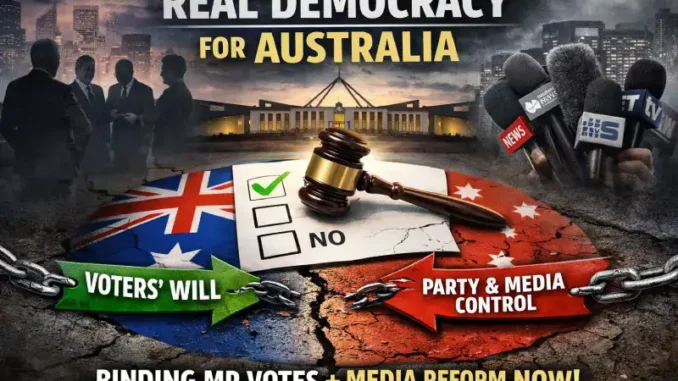
Real democracy needs binding MP votes and media reform in Australia, so laws reflect voters, not party or media power.
Introduction
Real democracy in Australia is often described as a system where citizens choose their leaders. This matters now because trust in political institutions continues to decline, not due to disengagement, but because people increasingly recognise that elections do not guarantee control over legislation.
This article examines a core structural issue: the gap between voter intent and parliamentary outcomes. It focuses on how the system operates rather than on individual politicians. In a previous article, I supported citizen assemblies as a reform pathway. While they offer value in public deliberation, they do not resolve the central issue of control over legislative decisions.
This article takes that thinking further. It argues that real democracy in Australia requires two key reforms. First, a legal requirement that elected representatives vote in line with their electorate. Second, structural reform of how public debate is formed, so voters can make informed decisions based on transparent information rather than media framing.
The Problem: Australia as an Elected Oligarchy
Concentrated Decision-Making Power
Australia operates under a representative system in which citizens vote for individuals, not laws. Once elected, MPs are not legally required to follow their electorate.
Party discipline, lobbying, and career incentives shape outcomes instead.
👉 https://socialjusticeaustralia.com.au/why-real-democracy-in-australia-feels-out-of-reach/
Political Incentives and Party Control
Advancement depends on loyalty to party leadership, not voters. This structure shifts power away from citizens and toward political elites.
This is the core failure behind Australian democracy reform debates.
The Role of Mainstream Media in Preserving the System
Narrative Control
Large media organisations such as News Corp shape political narratives.
Coverage often focuses on conflict and personalities rather than structural reform.
Alignment with Power
Media concentration limits exposure to alternatives and reinforces the status quo. This makes meaningful media reform in Australia essential.
👉 https://socialjusticeaustralia.com.au/mainstream-media-in-australia/
Voting for People vs Voting for Laws
The Structural Disconnect
Elections bundle many issues into one choice. Voters cannot express clear preferences on individual laws.
Weak Accountability
Without direct legislative input, accountability becomes delayed and ineffective. This is why real democracy in Australia remains incomplete.
Why Citizen Assemblies Fall Short
Initial Appeal
Citizen assemblies can improve discussion and bring diverse perspectives into policy debates.
The Limitation
They are advisory. Final decisions remain with elected representatives.
The Key Insight
They do not resolve the core issue of control over legislation. Power still rests with those not legally required to follow their electorate.
The Missing Law: Binding Representatives to Voters
The Core Reform
Real democracy in Australia requires a law that requires MPs to vote in line with their electorate.
How It Could Work
- Digital electorate polling on major bills.
- Transparent reporting of results.
- Legal obligation to follow outcomes.
- Enforcement for breaches.
The Australian Electoral Commission provides the infrastructure needed.
Why Media Reform Must Accompany Democratic Reform
A Shared Civic Space for National Debate
When real democracy in Australia is fully operational, supported by a Direct Representative model and civic infrastructure such as Vote Wrap, the national debate on legislation would fundamentally change.
Instead of being fragmented across partisan media narratives, party messaging, and selective framing, debate would occur in one shared civic space.
In this space:
- Arguments for and against each bill are visible.
- Competing claims are linked and openly examined.
- Points of disagreement and agreement are transparent.
- Citizens can assess evidence directly.
This shifts influence away from repetition, omission, and narrative control, and toward a more direct contest of reasoning, evidence, and public support.
How This Redefines the Role of Media
Media organisations would still investigate and report. However, their ability to shape legislative outcomes would decline.
They would no longer:
- Control the framing of debate.
- Set the agenda through selective coverage.
- Influence outcomes through repetition.
Instead, the central space for decision-making would belong to the public.
This represents a shift from media-shaped opinion to shared, transparent civic deliberation.
Why This Matters for Democracy
This does not remove media influence. It places it within a broader, accountable system.
In effect:
- Media becomes one input, not the dominant force.
- Legislative outcomes reflect public judgment.
- Democratic authority returns to citizens.
Making Misinformation Illegal
The Problem
False or misleading reporting can distort public understanding and influence legislative outcomes.
Legislative Solution
- Prohibit knowingly false political reporting.
- Require equal prominence corrections.
- Establish independent oversight.
- Apply penalties for repeated breaches.
What Equal Prominence Corrections Mean
If a media outlet publishes false or misleading information, the correction must receive the same level of visibility as the original claim.
This means:
- A front-page headline must be corrected on the front page.
- A prime-time broadcast must be corrected in a similar time slot.
- A widely shared online article must have a correction equally visible to readers.
Corrections cannot be hidden in small print or buried later. They must reach the same audience with comparable impact.
Why This Matters
People often remember the original claim more than the correction. Ensuring equal prominence helps prevent misinformation from shaping public opinion and increases accountability in media reporting.
The Impact: What This Would Change
Everyday Life
A worker would see laws reflect real needs. A pensioner would benefit from decisions based on community priorities.
- This would mean fewer policies imposed without clear public support.
- It would reduce the gap between elections and real decision-making.
Power Structures
Party and media influence would decline. Voters would gain real control.
What This Makes Possible
- Better housing outcomes.
- Policies aligned with community needs.
- More stable employment.
- Improved services.
- Greater trust in democracy.
- Stronger civic participation.
Where Australia Stands
Australia has strong institutions and administrative capability. The gap lies in system design.
Representatives are not required to follow voters, and media structures limit informed participation. These are policy choices, not structural limitations.
Frequently Asked Questions
Would this overwhelm voters?
Only major legislation would require input.
How is misinformation handled?
Through enforceable media standards, including equal prominence corrections.
Does this replace representation?
No. It improves it by aligning MPs with voters.
Final Conclusion
Real democracy in Australia is achievable. The tools already exist.
Binding MP votes and media reform in Australia address both decision-making and information.
Citizen assemblies can improve discussion, but they do not solve the core issue. Control over legislation must rest with the electorate.
This is not radical. It is a practical step toward genuine democratic control.
Call to Action
If this article helped you better understand how Australia really works, do not leave it here. Please share it with others who are asking the same questions.
Your voice matters. Your experience matters. And your participation matters.
➡ Share this article with family, friends, and your community
➡ Leave a comment below and join the discussion
➡ Visit the Reader Feedback page and share your view
➡ Share a testimonial if our content has helped you think differently
➡ Connect with us on TikTok, LinkedIn and X
Discuss this article in our Facebook group, where Australians share perspectives and ask questions in a calm, respectful space.
A more informed Australia begins with people willing to discuss the issues that shape our future. You can help lead that change.
Support independent journalism
Operating this site costs approximately $2,000 per year, and reader donations have covered $807 so far. Every contribution helps keep this work online, accessible, and independent.
If you find value in these articles, please consider supporting the site. Even a few dollars help keep this work going.
Donate now, one time or monthly.
Already donated? A quick Google review helps others discover the site.
This article was originally published on Social Justice Australia
Keep Independent Journalism Alive – Support The AIMN
Dear Reader,
Since 2013, The Australian Independent Media Network has been a fearless voice for truth, giving public interest journalists a platform to hold power to account. From expert analysis on national and global events to uncovering issues that matter to you, we’re here because of your support.
Running an independent site isn’t cheap, and rising costs mean we need you now more than ever. Your donation – big or small – keeps our servers humming, our writers digging, and our stories free for all.
Join our community of truth-seekers. Please consider donating now via:
PayPal or credit card – just click on the Donate button below
Direct bank transfer: BSB: 062500; A/c no: 10495969

We’ve also set up a GoFundMe as a dedicated reserve fund to help secure the future of our site.
Your support will go directly toward covering essential costs like web hosting renewals and helping us bring new features to life. Every contribution, no matter the size, helps us keep improving and growing.

Thank you for standing with us – we truly couldn’t do this without you.
With gratitude, The AIMN Team
I know I have been eagerly awaiting media reform since Labor were elected, yet for some unknown reason they keep avoiding the issue altogether.
Democracy is a dream, even the origins of democracy were biased.