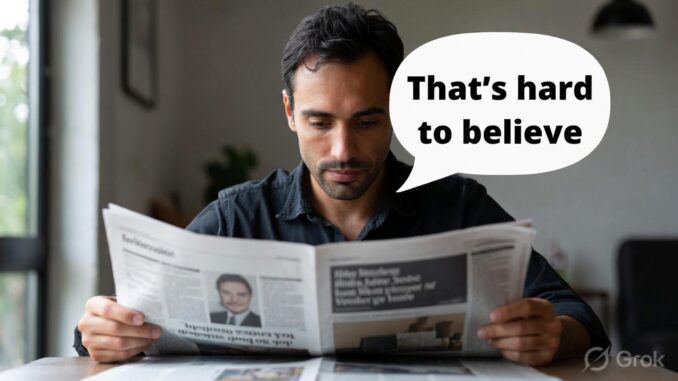
Having spent most of my career in marketing and advertising, I have firsthand insight into how deliberate persuasive techniques are used to shape attitudes and behaviours. In this piece, I argue that the media employs strategies comparable to those in corporate marketing, systematically shaping public perception and undermining objective understanding. By directly comparing advertising and media tactics, I aim to show that media practices both mirror corporate approaches and significantly influence, and sometimes distort, societal beliefs.
Marketers employ a variety of compelling tactics, ranging from sexual imagery to deceptive packaging, all designed to cultivate and secure consumer loyalty. These techniques do more than simply attract attention; they work on psychological and emotional levels to construct brand identities and foster long-term attachment. Such practices exemplify the broader strategy wherein the ultimate objective is not merely to generate initial sales but to embed brand loyalty so deeply that consumer preferences become habitual and resistant to competing influences.
In America, more psychologists work in advertising than in healthcare. Everything is planned to influence you – and it works.
Australian mainstream media, much like advertisers, employ a range of manipulative methods – including advertorials, untruths, omission of relevant facts, and subtle messaging – intended to sway public opinion rather than foster objective understanding. Research by McNair (2017) supports this claim, noting that Australian media outlets frequently utilise such tactics to influence public attitudes and perceptions. Additionally, a 2015 study found that advertorial content and selective reporting are increasingly common strategies that blur important distinctions between information and promotion, thereby shaping audience interpretations and undermining critical engagement.
For example, advertorials obscure the line between advertising and journalism, often misleading audiences regarding a story’s true intent. Omitting critical facts results in incomplete narratives and limits the audience’s ability to make informed judgments.
Subtle messaging, such as emotionally charged language or selective imagery, further directs interpretation. These tactics closely align with media theories of agenda-setting and framing.
A 2020 University of Technology Sydney study found that Australian news outlets frequently employ framing and omission, especially in contentious topics such as immigration and national security.
The research revealed that headlines and story placement often highlight security concerns while downplaying humanitarian perspectives, a strategy that reinforces public anxiety and restricts thorough debate. Overall, by strategically emphasising certain aspects of stories and suppressing others, the media systematically shapes public perceptions and deepens confirmation bias, limiting opportunities for critical engagement.
If you are following the war in the Middle East, how much truth are you getting?
For instance, consider how major networks framed the recent “Voice to Parliament” referendum debate, selectively highlighting certain opinions in headlines while downplaying others. Or take the front-page coverage of the so-called “African gang crisis,” which exaggerated isolated incidents to create widespread fear.
“The ‘African gang crisis‘ refers to a 2018 media and political controversy in Melbourne, Australia, concerning youth crime, mainly involving Sudanese-Australians.
Critics described the intense coverage as a manufactured moral panic and “media terrorism,” while some politicians called it a real crime issue. These examples show how the media can shape narratives to alter public perception.”
Media reporting on Australia’s 2023 Voice to Parliament referendum was heavily criticised for being polarised and for relying on “he said, she said” narratives rather than substantive analysis.
Coverage was often superficial, with emphasis placed on political conflict and misinformation rather than substantive analysis of the proposal’s details.
Media tactics are simple: a headline, a slogan like “stop the boats,” a photoshopped image, or how a story or interview is presented.
We can be influenced in ways that challenge our free will. Repeated, apparent false information or omissions commonly target those less informed, possibly increasing their susceptibility to propaganda.
Now they use another tool: ‘Opinion Journalism.’ For some, if Andrew Bolt says it, it must be true.
Having opinions isn’t the issue – we all have them, as long as there’s variety. The real problem is a lack of diversity. We’d gain more by thinking for ourselves than by accepting this media nonsense. Self-interest groups and lobbyists worsen this. One way to encourage diversity is to seek a range of news sources, including independent outlets and voices that challenge your perspective.
Read stories from different backgrounds and viewpoints; you might be surprised at how much richer your grasp becomes. Seeking alternative opinions keeps us keen and less prone to manipulation.
Sadly, more uninformed than politically aware voters exist, making them easy targets for the media, which reduces messages to simple slogans.
Opinion makers now use persuasive language and imagery to share their narrative. AI is beginning to influence social media, and some argue that the quality of online writing is declining.
A central concern is that contemporary news reporting frequently privileges persuasive opinion over factual accuracy, thereby obscuring the distinction between fact and influence. This tendency can diminish the public’s capacity to develop a clear and informed understanding of current events.
Nevertheless, it is important to critically engage with alternative perspectives on this issue. Counter to my primary argument, a number of scholars and media practitioners argue that opinion journalism – when rooted in thorough analytical frameworks, transparent sourcing, and credible evidence – serves as an essential mechanism for broadening public discourse. By providing context, interpretation, and commentary beyond the constraints of traditional reporting, such opinion pieces can illuminate complex topics, challenge dominant narratives, and encourage a more diverse exchange of ideas within the public sphere.
Specifically, opinion pieces can draw attention to marginalised or underrepresented views that conventional news coverage might otherwise neglect, fostering a more inclusive and multifaceted public debate. Additionally, by interpreting complex subjects through accessible commentary, well-crafted opinion journalism may promote civic engagement and clarify policy issues for a broader audience.
The subjective perspective inherent in opinion journalism allows writers to contextualise events through personal experience or ethical reasoning, potentially encouraging readers to question dominant narratives and reflect on their own perspectives. However, these advantages depend on a responsible balance: opinions must be informed and substantiated with credible evidence to benefit public understanding. If opinion journalism becomes predominantly persuasive without a solid factual basis, it can blur distinctions between truth and bias, diminishing the audience’s ability to discern objective reality.
Therefore, while opinion journalism can enrich democratic discourse and increase public participation, its effectiveness relies on rigorous standards of evidence, accuracy, and fairness, making critical evaluation and synthesis essential when weighing both its positive and negative implications.
By now, you might think that, considering my background, I’d use some of those techniques to persuade you.
I don’t. The closest I come is using fiction-writing skills to make my articles more interesting for readers who appreciate my work and notify me if I get a fact wrong.
Unlike Andrew Bolt, who writes for an audience with an average age of 13, I – and other writers on The AIMN – attract readers who think deeply about real issues. They contest you when they think you are wrong, and lively debate can arise.
I get wide-ranging feedback. About 99% want to explain why they agree, disagree, or are in between.
Others use the platform to vent, argue, be sarcastic, or shift the topic to their own argument.
Most people have important points to make and, despite a few, deserve forbearance and compassion.
Their background may be unclear, and they may face mental health struggles – best left alone.
At the core of my writing is a devotion to challenging how media and advertising manipulate perceptions and undermine objective truth. I believe exposing such tactics is vital for social justice and informed governance.
When the media distorts facts or promotes biased narratives, it can strengthen stereotypes and justify unequal treatment. This misinformation leads to misapprehensions, division, and influences policies and attitudes that affect real lives.
For me, standing up for social justice means resisting these manipulations so that everyone is given a fair chance to be seen, heard, and understood based on truth – not on misleading anecdotes.
Even though writing can be time-consuming, I’m grateful to share my opinions and get feedback. Independence from mainstream media allows this and can offer a completely different In conclusion, addressing media manipulation necessitates both individual critical awareness and collective engagement. This underscores my central argument: media and corporate marketing utilise similar persuasive strategies to intentionally shape public perceptions and, in doing so, distort objective understanding. The combined effects of these practices not only influence but often solidify societal beliefs, resulting in a diminished capacity for nuanced analysis and informed judgment.
Engaging in discussions on platforms like The AIMN – through reading, sharing personal experiences, and debating thoughtfully – enables participants to critically examine prevailing media narratives, actively resist misinformation, and seek greater clarity and truth. By fostering a community committed to questioning and analysing the techniques used by both media and advertisers, we enhance our collective capacity for discernment and contribute to a more informed, equitable, and critically engaged society.
Have you encountered controlling tactics in the media or discovered effective ways to cut through misleading headlines? Please share your experiences and tactics in the comments. Your viewpoint is essential, and by contributing, you help build a more thoughtful and informed community.
My Thought for the Day
In an age overwhelmed by influencers and high stakes, honest reporting and a pledge to genuine truth are more vital than ever.
Keep Independent Journalism Alive – Support The AIMN
Dear Reader,
Since 2013, The Australian Independent Media Network has been a fearless voice for truth, giving public interest journalists a platform to hold power to account. From expert analysis on national and global events to uncovering issues that matter to you, we’re here because of your support.
Running an independent site isn’t cheap, and rising costs mean we need you now more than ever. Your donation – big or small – keeps our servers humming, our writers digging, and our stories free for all.
Join our community of truth-seekers. Please consider donating now via:
PayPal or credit card – just click on the Donate button below
Direct bank transfer: BSB: 062500; A/c no: 10495969

We’ve also set up a GoFundMe as a dedicated reserve fund to help secure the future of our site.
Your support will go directly toward covering essential costs like web hosting renewals and helping us bring new features to life. Every contribution, no matter the size, helps us keep improving and growing.

Thank you for standing with us – we truly couldn’t do this without you.
With gratitude, The AIMN Team

Dear John, thanks ever so much for this thoughtful and perceptive article and for cobbling it all together.
My pleasure Tess. I hope in invokes a bit of thoughtful commentary.
Here here John.
We are seeing an example of this marketing misdirection in the South Australian election and the shrill promotion of One Nation as the panacea for the dissatisfaction with the traditional parties that we are being told plagues the SA electorate as they surge to this Pied-Piper; an inarticulate Queensland Senator whose minders will not permit her to speak publicly for fear the people will see through her marketing charade.
The principal problem that Sky after Dark assure us is the root of the dissatisfaction in South Australia is migration and excessive numbers of foreigners being let loose in Adelaide – Paul Murray and his ilk never tell us that migration is a federal issue and only a federal government will determine the numbers of migrants allowed in: the SA state government has no more than a persuasive influence on this issue, if it really is an issue and let me give you the tip, Corey Bernardi is not the solution to the woes of South Australia, just as Mark Latham was not the solution in New South Wales and Barnaby Joyce is certainly not their national Messiah.
I hear that the One Nation hot prospect for the seat of Adelaide is a last minute scratching as he is on the lam from old Blighty where he is wanted on criminal charges allegedly of a sexual nature: so much for the vetting procedures in One Nation!
@ Terry Mills: After about 13 years of representing the NOtional$ in New England and the accumulation of very attractive salary & perks that accompany being an MP, it is reasonable to say that Beetrooter is neither a national Messiah nor a caring representative of voters in this electorate.
Rather he is a publicly funded millionaire who has done as little as possible for as long as he can to protect the NOtional$ policy of preparing this regional electorate to become a genuine, original, authentic 19th century theme park to disguise the fact that NOtional$ politicians too frequently represent their own pecuniary interests above all else.
Thank you John for an erudite essay that should be 101 in schools of journalism. I presume that you mention Andrew Bolt merely as an example of how media messages can be manipulated . However, what bothers me is that Andrew Bolt and Piers Morgan present their opinions as though they totally believe them to be incontrovertibly correct despite obvious errors and omissions. At least Morgan has (on rare occasions), admitted error and apologised but I am yet to observe Bolt announcing a mea culpa.
Andrew Bolt is a disgrace to the written word he uses without much thought.
NEC Sad but it is so.
Terri. Joyce and Bernardi sounds like two shady solicitors. I agree with all you say.
@ all who have mentioned him — Bolt the Dolt sums him up very well
So, I see..
The (that place, SA) election does look to be a disaster for the libs-
ON has stolen the older and working class contituency from them- and Labor to an extent.. Left libs are still slipping over to the Greens or Indies (voted for one) and the libs leader Hurn, tho personable, has been let go, at least for the present, for not being up to it yet
Paul. Repercussions from the SA elections at a Federal level are as yet unknown but the Liberals are not looking good.
This has been a coordinated commercial venture in SA orchestrated by the Hanson gang and reports are suggesting that public funding will land her upwards of $1.5milion, possibly double that amount depending on the final numbers.
Remember, the public funding is based on the number of votes the party achieves not the delegates who actually get elected into office.