By James Moore
“I think that those who died in it were only the first casualties. The rest of us are still dying from it, bit by bit, every day.” (Michael Herr, Dispatches).
Sixty years after Rudy Gonzalez died for a country that still refuses to claim him, the last man who saw him alive has finally been found.
The gesture took less than a second, and it lasted sixty years.
A Marine named Leonard Martinez was strapped into the belly of a UH-34D helicopter southwest of Danang on the afternoon of November 14, 1966, on his way into a landing zone he had not been briefed about, with no headset, no weapon, and no clear idea of where he was going. He was maintenance crew. Somebody had told four of them after muster that they were going out on a recovery, and that was most of what he knew.
A gunship slid in close alongside. The crew chief shouted the only two words that mattered, which were “hot zone.” Through the open door Leonard could see the door gunner on the other aircraft, a young man curled behind an M60 in the wind. The gunner waved at him. Leonard waved back. The gunner gave him a thumbs-up.
Then the aircraft separated. Leonard watched the Huey roll into its gun run, saw it take the hit, and then witnessed flames trail out the back of it before his own ship banked and the jungle swung up and took the view away.
He landed in a firefight. He took cover. He saw smoke rising above the tree line and understood what it meant. Later that night, back at Marble Mountain, he learned the helicopter had gone down and there had been one survivor.
For most of the next six decades, Leonard Martinez did not know the name of the man who waved.
But now he does.
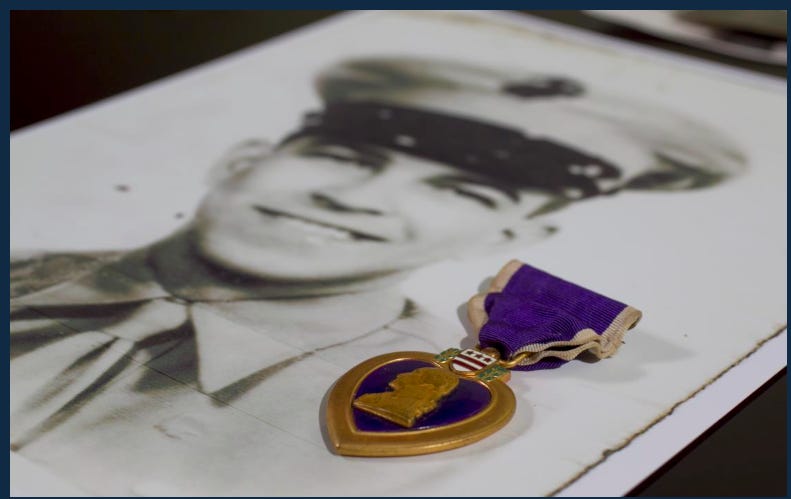
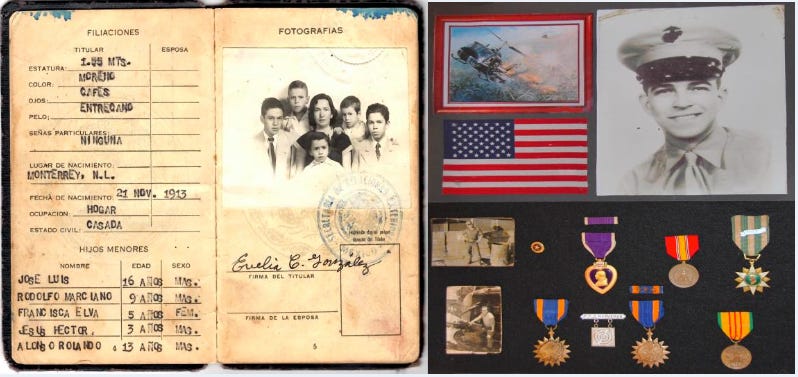
The door gunner was Corporal Rodolfo M. “Rudy” Gonzalez of Harlingen, Texas, twenty-two years old, days from the end of his tour, a legal immigrant from Monterrey who had come to the Rio Grande Valley with his family in 1955 and volunteered for the Marine Corps because he understood that the United States had a way of making Americans out of men who were willing to fight for it.
Leonard found that name through a story I wrote.
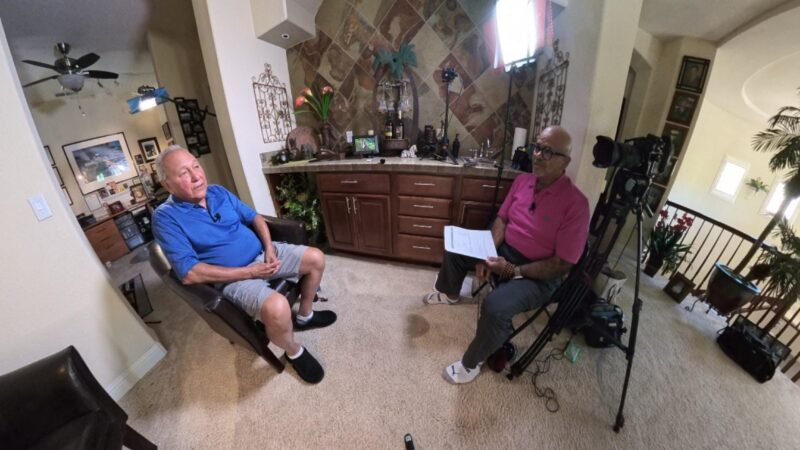
He had kept a few notes over the years. Recovery crew. Hot zone. Huey shot down. That was the whole archive, three phrases and an image that would not leave him alone. When he began using the internet to reconstruct his own service, he came across a piece I published about a Marine door gunner from South Texas whose family has spent more than a decade trying to get him the citizenship he died pursuing. Leonard read it and recognized his own afternoon in it. His phone calls led nowhere. His daughter Jennifer sat down at a computer, found Gerry Gonzalez, and made the connection that the federal government has never been willing to make.
“Now I had a name,” Leonard said.
On July 28 of this year, in Reno, Nevada, Gerry Gonzalez sat down with him for an interview that ran five or six hours. Gerry is Rudy’s nephew, a network television photojournalist for three decades, a man who spent his career pointing a camera at other people’s grief and is now pointing it at his own family’s. He has been hunting for a witness like Leonard Martinez for years. He is, as far as anyone involved can determine, the last known living eyewitness to Rudy’s final mission.
I have read the transcripts. What comes through is not the war-story bravado of a man polishing his memories. It is the opposite. Leonard is careful. He says what he saw and stops there. He does not know why the aircraft went down, only that it did. He allows that a full-strength crew might have made a difference, then immediately qualifies it, because he remembers how low they were flying and how little time anyone had, and because he has no interest in assigning blame to men who are dead. Crews were flying short-handed. That is what he remembers, and that is as far as he will go.
He also remembers the burns, too. Two months later he was in a trench during an attack on an ammunition dump, and when he came up out of the smoke, burning debris came down on him. Fifteen percent of his body, he says, from that split second. Four months in hospitals. He built a life anyway. He practiced architecture from 1973 to 2023, went from employee to principal to owner to a one-man shop, and now speaks to veterans at Honor Flight events, where he watches grown men cry.
“Remember Rudy, and remember his crew,” he tells them. “That, to me, is my mission.”
Leonard Martinez, who was burned for this country, wants nothing for himself. He wants his government to admit that Rudy Gonzalez was one of us.
Here is the part that ought to be simple.
Federal law has provided since 1990 that a foreign national who dies from injuries sustained on active duty during a designated period of hostilities, and the Vietnam hostilities are explicitly designated, may be granted citizenship posthumously. The family files Form N-644. The government issues a certificate declaring that the United States considers the man to have been a citizen on the day he died.
The catch is the clock. As Congress last wrote it, in 2003, the next of kin has two years from the date of death or two years from November 24, 2003, whichever comes later. For the families of men killed in Vietnam, that meant the window closed on November 24, 2005, and it has not opened since.
Nobody told the Gonzalez family. Jose Luis and Evelia Gonzalez had buried a son they were never permitted to see, in a closed casket, after his duffel bags had already come home ahead of him because his tour was nearly over. They did not accept that he was dead. They went to their graves believing he would walk through the front door. Nobody in that house was reading the Federal Register.
“Submitting a posthumous application for Uncle Rudy was akin to an unconditional surrender of all hope,” Gerry told me when I first wrote about this. “To give up their reason to awaken every morning.”
The nephews learned that their uncle had never been an American in 2012, when Gerry sat his aunt Frances down in front of a camera and she told him what Rudy had said before he left. Go to war so you can go to school. Become a citizen the way this country tells young men to become citizens. By 2012 the last door had been shut for seven years.
That is the heart of the matter. Rudy Gonzalez earned the Purple Heart, four Air Medals for combat heroism, the Vietnam Gallantry Cross Unit Citation, the National Defense Service Medal, and the Vietnam Service Medal. He flew extra missions in the most exposed job in the war so he could send hazard pay home to his parents. He did every single thing this country asks of the people it is reluctant to admit. The reason the United States will not call him an American is a calendar.
There is no appeal from a denied posthumous citizenship application and no waiver for a missed deadline. What is left is a president, a secretary of defense, or an act of Congress. His nephews have spent more than a decade writing to all of them. They have received nothing. Not even a denial with reasoning attached. Nothing.
I would not have to explain to you why this matters if we were living in a different year. But we are not. Consider what the same government that cannot find a signature for Rudy Gonzalez has found the time and money to do.
In April of 2025, Immigration and Customs Enforcement quietly removed the language from its own guidance that had long treated military service as a significant factor weighing against enforcement. Congressional investigators subsequently obtained Homeland Security data showing that ICE arrested 125 veterans in the single year beginning January 20, 2025, roughly two thirds of whom had no active criminal warrant, and moved to deport at least 282 veterans and their family members. Thirty-four veterans were placed in removal proceedings. Lawmakers wrote to the Secretary of Defense again on August 9 of this year, asking why bases are functioning as collection points and why the families of people in uniform are being handed notices to appear.
At the same time, the Justice Department has embarked on what it calls the largest denaturalization effort in its history. Field offices were instructed to feed the department 100 to 200 cases a month. The department expects to file at least 250 cases before the fiscal year closes in September. Denaturalization averaged around eleven filings a year for most of the period between 1990 and 2017. The administration has separately tried to end birthright citizenship by executive order.
The through line is not enforcement. It is the proposition that American citizenship is provisional for anyone whose name sounds like Gonzalez, and that it can be reviewed, revoked, or simply withheld at the pleasure of whoever is holding the pen.
Rudy Gonzalez is the argument’s reduction to absurdity. He did not overstay anything. He did not lie on a form. He was brought here legally at nine years old by a father who worked two years making hats in Harlingen to earn the sponsorship, a family that asked for no privileges and got none. He put on the uniform of the United States Marine Corps, hung himself out the door of a helicopter over Quang Nam Province, and died covering the extraction of other people’s sons. There is no version of the immigration debate, at any point on the spectrum, in which that man is a problem to be solved.
And he still cannot get a certificate.
Congress has shown it knows how to fix this kind of thing when it wants to. In December, Representatives Gil Cisneros of California and Pete Sessions of Texas introduced a bipartisan bill to grant honorary posthumous citizenship to Filipino service members killed in World War II whose families were locked out by the same sort of technicality. A Democrat and a Republican, one bill, one narrow wrong made right. Nobody had to hold a hearing on the meaning of America to do it.
Rudy Gonzalez needs exactly that much and nothing more.
Gerry Gonzalez has stopped waiting for permission.
The Uncle Rudy Legacy Project is now an archive and a production company operating out of a family’s stubbornness. There is a short documentary in the works built around Leonard’s testimony, a longer screen project under evaluation, and a song called “Rudy’s Last Flight” recorded in Tejano and hip hop arrangements, because Gerry understands that a melody sometimes gets past the guard that a history book cannot. He has been talking to C3 Entertainment about licensing limited Ritchie Valens material for the video, not to compare the two men, but because they came out of the same generation of Mexican-American kids whose contributions this country accepted before it was ready to say so out loud. He is trying to get the project in front of Eva Longoria, John Leguizamo, and Edward James Olmos. “Looking for an interest spark,” he wrote to me. His brother Rudy, the Pulitzer winner, hangs a thirty-day gallery show of his photography in Austin beginning September 3.
And this November 14, the sixtieth anniversary of the afternoon Leonard Martinez waved at a stranger, Gerry intends to stand at the Vietnam Veterans Memorial in Washington and hand out postcards with his uncle’s face on them to whoever will take one. He is raising the money to get there.
Panel 12E, Line 70 of that wall carries the name Rodolfo M. Gonzalez, cut into black granite along with 58,000 others, in a city where his citizenship has been an open question for six decades and a signature away for every one of them.
“He died for this country, but it’s not claiming him,” Leonard Martinez says. “That’s not fair. Because he earned it.”
Then he says the thing that a Marine says, the thing that ought to end this argument and one day will.
“He’s a fallen Marine. We don’t leave him behind.”
Thanks for reading Texas to the World. If you are so inclined, please like, share, and subscribe. And if you want to help the Gonzalez family get to the Wall in November, they are at UncleRudy.net. – JM
This article was originally published on Texas to the world.

James Moore is the New York Times bestselling author of “Bush’s Brain: How Karl Rove Made George W. Bush Presidential,” three other books on Bush and former Texas Governor Rick Perry, as well as two novels, and a biography entitled, “Give Back the Light,” on a famed eye surgeon and inventor. Mr. Moore has been honored with an Emmy from the National Academy of Television Arts and Sciences for his documentary work and is a former TV news correspondent who has traveled extensively on every presidential campaign since 1976.
He has been a retained on-air political analyst for MSNBC and has appeared on Morning Edition on National Public Radio, NBC Nightly News, Last Word with Lawrence O’Donnell, CBS Evening News, CNN, Real Time with Bill Maher, and Hardball with Chris Matthews, among numerous other programs. Mr. Moore’s written political and media analyses have been published at CNN, Boston Globe, L.A. Times, Guardian of London, Sunday Independent of London, Salon, Financial Times of London, Huffington Post, and numerous other outlets. He also appeared as an expert on presidential politics in the highest-grossing documentary film of all time, Fahrenheit 911, (not related to the film’s producer Michael Moore).
His other honors include the Dartmouth College National Media Award for Economic Understanding, the Edward R. Murrow Award from the Radio Television News Directors’ Association, the Individual Broadcast Achievement Award from the Texas Headliners Foundation, and a Gold Medal for Script Writing from the Houston International Film Festival. He was frequently named best reporter in Texas by the AP, UPI, and the Houston Press Club. The film produced from his book “Bush’s Brain” premiered at The Cannes Film Festival prior to a successful 30-city theater run in the U.S.
Mr. Moore has reported on the major stories and historical events of our time, which have ranged from Iran-Contra to the Waco standoff, the Oklahoma City bombing, the border immigration crisis, and other headlining events. His journalism has put him in Cuba, Central America, Mexico, Australia, Canada, the UK, and most of Europe, interviewing figures as diverse as Fidel Castro and Willie Nelson. He has been writing about Texas politics, culture, and history since 1975, and continues with political opinion pieces for CNN and regularly at his Substack newsletter: “Texas to the World.”
Keep Independent Journalism Alive – Support The AIMN
Dear Reader,
Since 2013, The Australian Independent Media Network has been a fearless voice for truth, giving public interest journalists a platform to hold power to account. From expert analysis on national and global events to uncovering issues that matter to you, we’re here because of your support.
Running an independent site isn’t cheap, and rising costs mean we need you now more than ever. Your donation – big or small – keeps our servers humming, our writers digging, and our stories free for all.
Join our community of truth-seekers. Please consider donating now via:
PayPal or credit card – just click on the Donate button below
Direct bank transfer: BSB: 062500; A/c no: 10495969

We’ve also set up a GoFundMe as a dedicated reserve fund to help secure the future of our site.
Your support will go directly toward covering essential costs like web hosting renewals and helping us bring new features to life. Every contribution, no matter the size, helps us keep improving and growing.

Thank you for standing with us – we truly couldn’t do this without you.
With gratitude, The AIMN Team
Be the first to comment