By Denis Hay
Description
AUKUS protest police: FOI documents reveal the AFP’s Orcus Command and how protest is being treated as a national security issue in Australia.
Introduction
Public discussion of AUKUS has focused on submarine delivery dates, strategic alignment, and cost blowouts. Far less attention has been given to how the Australian government is preparing for domestic opposition to the agreement.
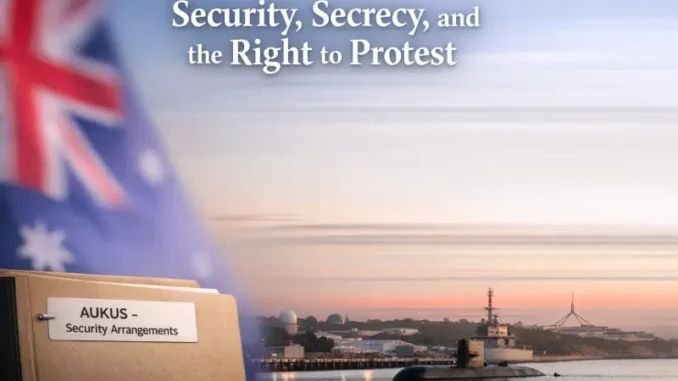
Freedom of Information documents obtained by transparency advocate Rex Patrick and reported by Michael West Media reveal that the Australian Federal Police has quietly established a new unit, Orcus Command, dedicated to protecting AUKUS-related defence facilities. The documents show this unit is also planning for public order management, including protest and political dissent connected to Australia’s growing role in US and UK military operations.
This matters because protest is a cornerstone of democratic accountability. When dissent is framed primarily as a security risk, the balance between public order and civil liberties shifts in ways that deserve close public scrutiny.
What has received far less attention is how the government is preparing to manage Australians who oppose it.
Internal link: “Australia’s AUKUS agreement”.
Editor’s note:
This analysis is based on Freedom of Information documents obtained by transparency advocate Rex Patrick and reporting by Michael West Media. All claims in this article are drawn from released documents, budget papers, and publicly available statements. Care has been taken to distinguish between documented facts, lawful policing powers, and broader democratic implications.
What Is Orcus Command
Orcus Command is a specialised AFP unit created to provide protective security for the AUKUS nuclear-powered submarine program, particularly at strategically significant defence bases such as HMAS Stirling in Western Australia.
FOI documents show that:
- The unit was created with minimal public disclosure.
- It has a mandate extending beyond physical asset protection.
- It is embedded within the Department of Defence, not a civilian oversight body.
- Its planning includes public order and protest activity.
This institutional placement is significant. By situating Orcus Command within Defence rather than a civilian agency, protest management around AUKUS is treated as a national security issue rather than a matter of routine democratic policing.
Internal link: “Defence influence in Australia”.
Protest and Dissent as a Security Issue
Internal AFP documents explicitly reference the monitoring and response to political opposition and protest activity linked to AUKUS and the expanding US military presence in Australia.
This reflects a broader shift in Australian governance. Over recent years, most states have introduced or strengthened laws restricting protest, increasing police powers, and imposing harsher penalties for disruption.
Rather than being framed as a democratic expression to be facilitated and protected, protest is increasingly framed as a risk to continuity and order.
The Orcus Command documents indicate:
- Planning for escalation scenarios
- Proactive monitoring of protest groups
- Coordination with state police
- Anticipation of increased protest intensity
Internal link: “right to protest in Australia”
Why is Protest Being Framed as a National Security Issue Under AUKUS?
The documents state that Orcus Command has Commonwealth responsibility for protecting the nuclear submarine program under existing legislative powers.
This places protest activity in the same conceptual space as counterterrorism and critical infrastructure protection. While such powers are lawful, their application to political dissent raises difficult questions.
When a protest is absorbed into a national security framework:
- Thresholds for intervention are lowered.
- Decision-making becomes less transparent.
- Oversight mechanisms are weakened.
- Civil liberties are more easily subordinated to strategic objectives.
This does not mean that protest is automatically criminalised. It does mean that the lens through which protest is viewed has changed.
Internal link: “national security frameworks”.
Lethal Force Provisions and What They Signal
One of the most sensitive revelations in the AFP briefing material is the inclusion of lethal force within Orcus Command’s armed protection planning.
Lethal force authorisations are standard in many armed federal policing and counter-terrorism contexts. Their inclusion alone is not unlawful or unusual. However, the context matters.
These provisions appear within documents that also discuss protest and public order management. This signals that scenarios involving political dissent are being contemplated within a framework that allows for the highest level of force available to federal police.
This does not suggest protesters will routinely face lethal force. It does show that dissent around AUKUS is being planned for within a security paradigm where extreme outcomes are legally contemplated.
That distinction is important, but it should not be dismissed.
Reassuring Allies, Managing Citizens
FOI emails reveal that Australian authorities are keen to show to the United States and the United Kingdom that protest activity will not disrupt or delay AUKUS operations.
This highlights a core tension: Australian policing resources are being used not only to keep domestic order, but also to reassure foreign military partners.
The documents emphasise:
- Proactive responses to identified protest risks.
- The importance of continuity for allied operations
- Minimising disruption to US and UK interests
Internal link: “Foreign policy dependence“.
Budget Allocations Signal Long-Term Expansion
Funding figures reinforce the seriousness of the operation.
- $73.8 million allocated to Orcus Command in late 2025.
- Funding rising to $125.2 million in 2026.
This near doubling suggests the government expects expanded responsibilities and sustained operations, rather than a short-term security task.
Budgets reflect priorities. In this case, substantial public funds are being committed to a policing unit designed to manage both infrastructure security and anticipated dissent.
Internal link: “public money priorities”.
Secrecy, FOI, and Democratic Oversight
AUKUS is one of the most secretive projects in Australia’s modern history. While some confidentiality around defence capabilities is legitimate, secrecy has expanded far beyond technical details.
The government has:
- Refused a comprehensive public inquiry.
- Limited parliamentary scrutiny
- Relied heavily on national security exemptions
- Restricted public access to key information
Without FOI requests and investigative journalism, the existence and scope of Orcus Command would remain unknown.
The Broader Democratic Context
The creation of Orcus Command does not occur in isolation. It sits alongside:
- Tightened protest laws across states
- Expanded police powers.
- Increasing surveillance of activists
- Reduced tolerance for disruption
Taken together, these trends suggest a gradual rebalancing of the state’s relationship with citizens, particularly where dissent intersects with powerful economic or strategic interests.
Why This Matters for Democracy
A functioning democracy requires more than elections. It requires:
- The right to dissent.
- Transparency in decision-making
- Civilian oversight of coercive power
- Proportional policing
When protest is framed as a threat rather than a democratic expression, public trust erodes and accountability weakens.
Orcus Command is not, by itself, proof of authoritarian intent. But it is a clear indicator of how the Australian state is preparing to manage disagreement over one of its most controversial policy decisions.
Frequently Asked Questions
What is Orcus Command?
Orcus Command is a specialist unit within the Australian Federal Police created to provide protective security for AUKUS-related defence facilities. FOI documents show its remit includes public order planning linked to protest activity around these sites.
Why is the AFP involved in managing AUKUS protests?
Because AUKUS infrastructure is classified as critical national security infrastructure, the federal government has assigned responsibility to the AFP. This places protest management within a national security framework rather than routine civilian policing.
Can Australian police use lethal force against protesters?
Lethal force is authorised in limited circumstances under federal policing laws. FOI documents show lethal force provisions are included in Orcus Command’s armed protection planning, though this does not mean peaceful protest is automatically subject to such force.
Is protesting against AUKUS illegal in Australia?
No. Protest is still lawful in Australia. However, laws and policing approaches increasingly restrict where, when, and how protests can occur, particularly near critical infrastructure and defence sites.
Why is there so much secrecy around AUKUS?
The government argues that secrecy is necessary for national security. Critics say the scope of secrecy extends beyond technical details and limits democratic oversight of costs, risks, and policing arrangements.
Who uncovered the existence of Orcus Command?
The unit’s existence and scope were revealed through Freedom of Information requests by transparency advocate Rex Patrick and reported by Michael West Media.
Conclusion
The establishment of the AFP’s Orcus Command marks a significant shift in how Australia approaches dissent related to defence and foreign policy.
By embedding protest management within a national security framework tied to allied military interests, the government has quietly redefined the boundaries between democratic expression and security enforcement.
This shift toward AUKUS protest police reflects a broader redefinition of dissent in Australia and deserves careful public examination, not silence.
Call to Action
We want to hear from you
- Please share your thoughts through our Reader Feedback
- Visit our Testimonials page to see how others are engaging.
- Leave a comment below; every voice helps shape future content.
Explore more
Find more writing on political reform and Australia’s dollar sovereignty at Social Justice Australia.
Share this article
Articles like this only create change when they are shared. If it stays with one reader, the message stops.
Support independent journalism
Running this site costs around $2000 a year, and reader donations have helped cover $807 so far.
Every contribution helps keep this work online, accessible, and independent.
Donate now, one time or monthly.
Already donated? A quick Google review helps others discover the site.
What Do You Think?
Do you believe protests related to major defence projects like AUKUS should be managed within a national security framework, or treated primarily as a democratic right?
Have your say in the comments below.
This article was originally published on Social Justice Australia
Keep Independent Journalism Alive – Support The AIMN
Dear Reader,
Since 2013, The Australian Independent Media Network has been a fearless voice for truth, giving public interest journalists a platform to hold power to account. From expert analysis on national and global events to uncovering issues that matter to you, we’re here because of your support.
Running an independent site isn’t cheap, and rising costs mean we need you now more than ever. Your donation – big or small – keeps our servers humming, our writers digging, and our stories free for all.
Join our community of truth-seekers. Donate via PayPal or credit card via the button below, or bank transfer [BSB: 062500; A/c no: 10495969] and help us keep shining a light.
With gratitude, The AIMN Team

The USUKA sub debacle is another Scummo scam established by a former COALition misgovernment Prim Monster who was willing to pay $17 MILLION per year for ”leadership” training to the then governor-general as the then Queen’s representative as part of a deal to establish the first democratically elected dictatorship by Royal Assent, paid for by the Australian people.
The further expenditure by the ALBANESE LABOR GOVERNMENT on this ORCUS COMMAND demonstrates that the US influence under the Canberra Bubble is far too great, exactly like the cost of the unwanted, outdated, redundant USUKA subs that likely will never happen.
Meanwhile the ALBANESE LABOR GOVERNMENT continues to sacrifice national sovereignty with MULTI-BILLION vassalage payments to the USA so that Scummo has a comfortable corporate board job being paid far more than he is worth.
Bending over for any bully only results in you being screwed.
This is truly disturbing. We really need an open public inquiry into the whole AUKUS deal. I ask again, is there any way the issue of the AUKUS payments can be referred to the High Court?
When Morrison the Scumload made the AUKUS announcement, I sucked in, shook, shivered, assessed and saw a USA scheme of subsidy, serf subjugation, subterfuge, shame and shitsouled shamminess, in that it was to extract tribute until the whole farce fell to bits, became obsolete, was universally outed. One day, they’ll abandon US. Disgraceful scammy skunky behaviour by friendless grinners; yank my doodle, it’s a dandy, sings Donald Dogshit.
I was impressed when Paul Keating asked his audience to test the reality of an invasion from China.
Imagine a fleet of Chinese boats sailing down the coast destined to discharge hordes of Chinese waving guns on our beaches in an effort to take over Aus.Its silly at best.
It would be a whole lot easier to take out our internet, but the AUKUS project relies on us being threatened by a whole bunch of strange threats.
These phantom situations are costing us big time while US demands our wealth because they are failing fast
Dissent has been squashed in the Labor caucus,and our”kinder politics”Albo doesn’t want dissent in the public realm, either.
Another miserable failure.Just another hypocritical politician.It’s hard to tell whether he’s not listening to his advisors, or he’s just getting bad advice, but a leader he is not.
Our P M is a careful observer, but what does one observe when every other different bum recedes with intent as the jogging P M tails and fails? Being a “prudent follower” is not leadership. Out of sight, soon, and for what? Survival? Politeness? Media allergy? Hun nation?
New England Cocky
You raise strong concerns about foreign influence and the cost of AUKUS, and I think many Australians share a growing unease about how deeply our strategic decisions are tied to US interests.
Where I would gently steer the discussion is toward process and accountability. Regardless of who initiated AUKUS, the current government has a responsibility to ensure transparency, democratic oversight, and clear safeguards for civil liberties. That is where this article is focused.
Australians should not be left guessing about how protest, dissent, and national security policing are being handled, or why these decisions are being made largely behind closed doors. Those questions matter no matter which party is in power.
I appreciate you taking the time to engage with the article and raise these broader issues.
RomeoCharlie,
I agree that the lack of an open public inquiry into AUKUS is deeply troubling. Given the scale of the costs, the strategic consequences, and now the policing implications, proper scrutiny should be the bare minimum in a democracy.
On the High Court question, the short answer is that it is very difficult, but not impossible. The High Court does not review policy decisions simply because they are poor or unpopular. Any challenge would need to argue that the payments or arrangements breach the Constitution, exceed executive power, or bypass required parliamentary authorisation.
Some avenues that are sometimes discussed include challenges around appropriation, executive spending powers, or procedural fairness, but these are complex, expensive, and uncertain. That difficulty is one reason governments rely so heavily on secrecy and executive agreements in defence matters.
Ultimately, sustained public pressure, parliamentary action, and transparency through FOI and independent journalism are currently the most realistic tools available to citizens. That may be unsatisfying, but it reflects how constrained democratic accountability has become in this area.
Thank you for raising an important and thoughtful question.
Phil Pryor.
I understand the depth of anger and distrust that AUKUS has generated, particularly given how abruptly it was announced and how little public scrutiny followed. Many Australians felt shock rather than reassurance when it was revealed, and that reaction was entirely reasonable.
Where I try to keep the discussion grounded is on evidence, process, and consequences. Regardless of how one characterises the motives of the United States or the former government, the real issue is that Australians were locked into an enormously expensive and far-reaching defence arrangement without proper debate, transparency, or democratic consent.
This article focuses on what has happened since: the continuation of secrecy, the lack of inquiry, and now the expansion of national security policing around protest and dissent. Those are serious issues that deserve scrutiny no matter which party is in power or how strongly we feel about past leaders.
Strong emotions are understandable. What matters now is ensuring Australians are informed, engaged, and able to demand accountability going forward.
Second comment.
Many people feel that caution and consensus-chasing have come to replace leadership in Australian politics. Being observant is not the same as being decisive, particularly when major strategic, economic, and democratic issues are involved.
What matters most to me is not style, but responsibility. Leadership should involve setting clear principles, explaining decisions openly, and being willing to defend democratic norms even when it is uncomfortable or politically risky.
This article focuses on one outcome of excessive caution and deference: important decisions being made quietly, with minimal scrutiny, and dissent treated as something to manage rather than engage with. Whether that comes from fear of backlash, media pressure, or a desire to avoid conflict, the result is the same for public trust.
Douglas Pritchard,
Paul Keating’s point cuts through a lot of fear-based narrative. Serious security planning should start with plausible risks, not cinematic invasion scenarios. The idea of a conventional amphibious invasion of Australia has always been highly implausible, and most defence analysts know that.
You’re also right that modern vulnerabilities look very different. Cyber disruption, economic pressure, and information warfare are far more realistic challenges than armies landing on beaches. Yet those threats are rarely used to justify trillion-dollar weapons systems.
That’s part of the concern many Australians have with AUKUS. Large defence projects are being driven by abstract or exaggerated threat narratives, while the real costs, trade-offs, and strategic assumptions are shielded from public scrutiny. This article focuses on one consequence of that approach: how dissent itself is increasingly treated as something to be managed within a national security framework.
Harry Lime,
There is clearly a lot of frustration with the way internal debate and dissent are handled in Australian politics at the moment, and many people feel that the promise of a more open, consultative style of government has not been realised.
What concerns me most is not personality or leadership style, but outcomes. Regardless of who leads the government, decisions of this scale and consequence should be accompanied by transparency, scrutiny, and respect for democratic rights, including the right to dissent publicly.
This article focuses on that gap between rhetoric and practice. If dissent is discouraged internally and then managed externally through secrecy and expanded security frameworks, it raises serious questions about how healthy our democratic processes really are.
@ Denis Hay (1): Aw shucks Denis, you write so succinctly, exposing the dangers without emotion and despairing the poverty of thought among the ALBANESE LABOR GOVERNMENT. This fires ”the little grey cells” to decry the obvious common sense that is not so common these days after too long duration of self-serving COALition misgovernments.
Thanks Denis Hay,personality and leadership style does matter, if you’re trying to sell something that stinks,as this obviously does.What’s more, this has become an established pattern with our boy Albo,and it would definitely indicate that our democracy is on an IV drip if not yet in the ICU.
I fail to see how this government is any better than the previous loud mouthed Liar when it comes to transparency.
There is only one way to resolve the AUKUS question. That is to conduct a referendum immediately – the question should be:
…”are you in favour of continuing with the AUKUS project? answer: YES or NO…”
Thus the Australian electorate will have decided what the nation needs.
I enjoy the article, and, these comments to us, damaged old blatherers, (who, me?) and keep up broad awareness and investigation, But, still, irritabilities leach out…we must “lead” on issues, even if some are out of sight and mind…