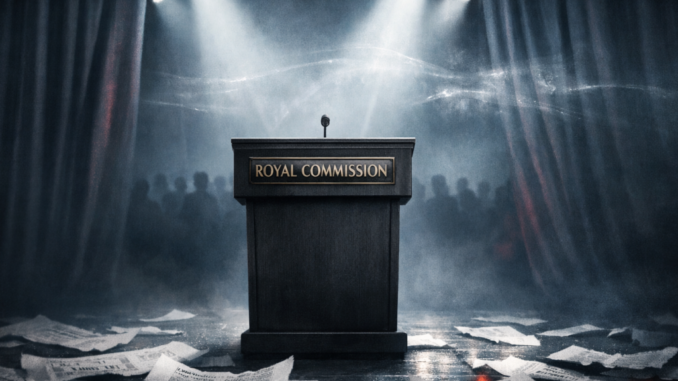
When inquiry becomes ritual, and outrage becomes virtue, democracy forgets how to tell the difference between justice and punishment.
The witch‑hunt is back; not in pointed hats, but in press cycles, vox-pops and panel shows. What we see, in the harrying of Prime Minister Albanese and his government, is something larger, darker, and more revealing than a political pile-on.
It is a morality play staged in headlines and hashtags, in which guilt is presupposed and penitence demanded daily. A campaign waged in such a way as to trap its victim, and with him, a nation that still imagines this is scrutiny rather than spectacle.
Behind the chorus baying for Albanese’s blood are deeper engines: anger as performance, outrage as credential, purity as political currency. And as ever, the human cost of that theatre is borne not just by the accused but by a public taught to see democracy as an ongoing trial.
Elastic Time and Manufactured Urgency
Albo has been “dragged kicking and screaming” into a Royal Commission easily wins best repeated Opposition talking point. “Dragged kicking … “is now the Opposition’s earworm, a pantomime-show trial with a Sky News soundtrack: boos on cue, outrage on tap, and guilt confetti-cannoned over the facts
Still minding the shop for one of the Liberal Party’s stack of meritorious male candidates, a probationary Ms Sussan Ley wins best in show hypocrisy in the name and shame class. Her sermonising sits so well against the LNP abysmal record: years of delay, denial, and “not the right model” deflections whenever a Royal Commission threatened. Banking, Aged Care, Veteran and Defence Suicides, Robodebt and Disability. There’s at least three parliamentary terms of delay in those opportunities foregone, alone.
But time is relative. Much of the “dragging, kicking and screaming” finger-wagging narrative depends on time’s elasticity. Picture a Dali clock. But accuracy matters. The Royal Commission is not “two years away.” It reports by 14 December 2026, with an interim report due in April, according to Reuters and AP.
To call that “delay” requires a peculiar arithmetic. It’s a bullet train compared with the Coalition slow-coach. But arithmetic is beside the point when the drama demands elongation; the longer the imagined delay, the greater the outrage, the purer the indignation.
The Politics of Self‑Righteous Anger
There is another fuel here, hotter than partisanship and more contagious than scandal: self‑righteous anger. Not ordinary anger, which can be clarifying, even noble, but the kind that calcifies into identity, a badge, the last clean possession many people feel they still have.
In a country atomised by rents, mortgages, dead‑end work; by algorithmic loneliness, ambient anxiety, low‑grade crisis; righteous fury becomes the only emotion that still feels intact. A community in pain clings to populism’s moral outrage as if it were the only life-preserver in their size.
But that moral certainty has a brutal political use: it creates the appetite not for understanding, but for punishment.
The Witch‑Hunt Logic
This is the barbaric logic of the witch‑hunt: the inquiry as ordeal, not as search for truth.
The Prime Minister is thrown into the water. If he floats: he is in league with the devil; he called the inquiry only because he was caught. If he drowns: his guilt is punished; he delayed, he hid, he failed; therefore, he deserves it.
Within that logic, procedure is irrelevant. Outcomes are pre‑written. The Royal Commission becomes less a tool of governance than a theatre of purification; a stage upon which the crowd can watch one man be made to answer for their hoarding of victimhood and accumulated disgust with politics itself.
That is why Labor has so little to gain. The loudest calls for a commission were never just calls for transparency; they were already structured as accusation: What have you got to hide? Compliance cannot wash away suspicion; it becomes “confirmation” that the PM was dragged, shamed, cornered.
When the State Declares a Sinner
When a state declares an enemy category – “witch,” “cartel,” “narco‑terrorist,” “fast boat”; the next step is not evidence but permission.
We have just watched a version of that logic unfold in reporting on U.S. strikes against alleged drug‑running boats: more than a hundred people reportedly burnt alive since September 2025, with families arguing many were civilians, including innocent fishermen. That campaign raises Trump’s justice; when suspicion itself becomes sufficient, killing becomes just another administrative detail.
You needn’t accept every detail of that debate to recognise its pattern. Once moral panic is authorised, proof becomes a luxury. The crowd feels clean, uplifted, vindicated while violence is done in its name.
The Local Mirror
Back home, substitute “RC” for “strike” and “shifty PM” for “fast boat.” The mechanism is identical.
The press can run the backdown headline today and the what were you hiding?headline tomorrow and both will land, because the public has been conditioned to experience politics as theatre of villains. Not deliberation, damnation.
Within a decade of the Christchurch massacre; a moral catastrophe born of online rage, conspiracist grievance, and algorithmic echo, it is chilling to see parts of that circuitry rewired into domestic politics. The emotional economy is continuous: suspicion, sanctimony, sacrifice. And once again, the power elite finds ways to weaponise communal anger not to heal the nation, but to wound an adversary.
Recent polling places public trust in media and politics at historic lows; under 30%. Yet outrage engagement metrics on social platforms spike after every scandal. The market rewards heat, not light. That profit motive disguises itself as moral conscience. And thus, the same economy that sells noise as news now peddles outrage as ethics.
The Cult of “Cohesion”
Now we reach the supposedly benign word doing so much quiet damage: cohesion.
If “social cohesion” means quiet, agreement, don’t inflame, lower your voice; then it isn’t cohesion. It’s a gag. The goddess Araldite: bonding by gluing your jaws closed.
A pluralist democracy, as John Rawls conceived it, doesn’t flourish through enforced conformity but through lawful dissent; the civic maturity to endure disagreement without summoning the state as cultural sedative. Healthy cohesion arises not despite friction, but because fair institutions tolerate it
Coda: The Ordeal Still to Come
The grim political truth is this: Labor has called a commission that will not, and cannot, exonerate it from the narrative; because the narrative is not about the commission.
It is about the demolition of a Prime Minister in a media economy that demands a daily victim. And in yielding to that demand, Albanese has done more than misjudge the theatre; he has joined the cast.
By calling the commission, he has implicated not only his government but the country in an act of bad faith. His concession may be born of political necessity; it will not save him. What it costs is integrity- and integrity, once surrendered to expedience, never returns at full strength.
There was courage, once, in holding the line against the mob, in believing that leadership meant tempering appetite rather than feeding it. That was the Keating instinct: to refuse to govern by focus group, to call the mob what it was; not democracy, but demand without discipline.
Albanese and his advisers are clever enough to see it; the ulterior motive behind Susan Ley and her Murdoch tag‑team chorus, underwritten by Advance and the dark money of billionaires, baying for “justice” when what they want is spectacle; not inquiry, but humiliation; not truth, but ritual bloodletting.
It’s Kill Bill 2.0: the same choreography that bull‑rushed Bill Shorten off the political stage, stage‑managed again for a fresh protagonist, but directed by the same tabloids, the same talk‑radio hangmen, the same theatre of vengeance dressed as virtue.
According to Reuters and AP, the Royal Commission will hand down its findings by 14 December 2026, with an interim in April; dates that place the finale barely eleven months ahead.
The report may deliver clarity, even a modicum of justice, but it cannot redeem the bad faith of its birth. Because it was never simply a search for truth; it was an ordeal; a test of the Prime Minister’s soul, conducted in public, under lights, with verdicts delivered in advance.
Chifley would have recognised the moral failure instantly: Labor’s task is the betterment of lives; the “greater happiness” and security of ordinary people; not feeding a machine that confuses public punishment for public policy. Whitlam, who spoke of widening liberty and defending dissent, would have seen the danger in a politics that treats disagreement as contamination and “cohesion” as enforced quiet. And Keating; who understood how the line between reporting and prosecution can blur when power wants a scalp; would have recognised the commercial logic at work: conflict must be manufactured, a villain must be maintained, and the gallery kept hungry.
It will not quench the appetite it was meant to feed. The show must go on; another villain will be cast, another crowd assembled. Unless someone of fibre finds the nerve to call the mob by its name, the country will keep mistaking vengeance for virtue; applauding each new purification while democracy herself shivers on the steps, lips blue from exposure, as the mob demands another sacrifice.
This article was originally published on URBAN WRONSKI WRITES
Keep Independent Journalism Alive – Support The AIMN
Dear Reader,
Since 2013, The Australian Independent Media Network has been a fearless voice for truth, giving public interest journalists a platform to hold power to account. From expert analysis on national and global events to uncovering issues that matter to you, we’re here because of your support.
Running an independent site isn’t cheap, and rising costs mean we need you now more than ever. Your donation – big or small – keeps our servers humming, our writers digging, and our stories free for all.
Join our community of truth-seekers. Donate via PayPal or credit card via the button below, or bank transfer [BSB: 062500; A/c no: 10495969] and help us keep shining a light.
With gratitude, The AIMN Team


Well said. The baying mob has won, a PM possibly fatally wounded, our right to free speech and freedom to demonstrate peacefully, eroded all by a politically partisan, calculatedly curated faux outrage. I have nothing but contempt for every person involved in this specious campaign.
RomeoCharlie
Your comment cuts to the heart of this manufactured crisis. The coordinated outrage over Albanese’s response to the synagogue attack was never about genuine concern for community safety or antisemitism—it was a calculated political hit job, weaponising moral panic to silence legitimate criticism of Israeli policy and erode fundamental democratic rights.
The speed with which News Corp, the opposition, and compliant commentators mobilised tells us everything. Within hours, they’d constructed a narrative that conflated peaceful protest with violence, criticism of Netanyahu’s government with hatred of Jewish Australians, and demanded the PM demonstrate his credentials by abandoning any pretence of balanced Middle East policy. The demand wasn’t for leadership—it was for submission.
What’s most insidious is how this faux outrage serves multiple agendas simultaneously. It provides cover for further restrictions on protest rights (already severely curtailed), establishes a precedent for political punishment over foreign policy positions, and normalises the idea that certain forms of advocacy—no matter how peaceful—constitute threats requiring state intervention. The real target isn’t just Albanese; it’s the very principle that Australians can publicly challenge their government’s complicity in war crimes.
You’re right to express contempt. This isn’t democratic accountability—it’s authoritarian rehearsal. And every politician, journalist, and commentator who amplified this cynical campaign has demonstrated they value political advantage over the freedoms they claim to defend.
The mob has won this round. The question is whether Australians will recognise the manufactured nature of their victory before the same tactics are deployed against the next target.
Meanwhile, parts of Australia are being cindered in the predictable infernos that as surely as night follows day are a function of the relentless warming this continent faces along with the rest of the planet, but hey… let’s conduct range wars over who’s right & who’s wrong, who’s on the right side of the argument and who’s on the wrong, and, hell, let’s sink the boot in as viciously as we can, let’s blame the PM for all the perceived wrongs, let’s plant the seeds that if germinated will generate the perception that the ALP is responsible by virtue of their recognition that Palestinians need to be included in the conversation for the Bondi massacre, along with the ticklish issue regarding the status of the state of Israel with its self-ordained sense of right to exist to the exclusion of all others as a god-given right being an offence of the first order and a poisonous affront to the generally accepted principles of humanity as well as being a divisive issue and likely irreconcilable within this country.
Ain’t nothing like a zealot to prosecute his cause to the exclusion of all other matters. Albanese must surely be ruing the day he accepted the poisoned chalice.
Canguro, you capture the exhaustion many feel: a country burning—literally and figuratively, while our public discourse fractures into ever narrower culture wars. The bushfires are not a metaphor; they are a predictable consequence of a warming continent, and yet they struggle to hold attention against the theatre of outrage and partisan point-scoring.
Point taken, also, about zealotry. When every tragedy is immediately pressed into service for a broader ideological battle, nuance is the first casualty. The Bondi attack, like all such violence, deserved clarity, restraint and humanity; not the instant weaponisation of grief or the imputation of collective guilt. Recognising Palestinian humanity does not negate Jewish humanity; nor does acknowledging Israel’s existence require silence on Palestinian suffering. Treating these positions as mutually exclusive is precisely how division is entrenched.
As for Albanese, the “poisoned chalice” line rings true in one respect: modern leadership often means being blamed for everything while having control over very little. But that reality does not absolve leaders, or the rest of us, of responsibility. If we continue to reward outrage over solutions, identity battles over shared interests, and moral absolutism over complexity, we shouldn’t be surprised when the big, slow crises, climate foremost among them, are left to burn unattended.
In the end, the fires don’t care who won the argument. They just keep coming.
Thanks, David, your essays and responses invariably fall into the arena of best-practice opinion, always something to ponder on when you put pen to page.
The bushfires are a topic close to home… I have a deeply invested relationship with a property 20 minutes north of the Murray at Jingellic, east of Albury, my sister-in-law’s farm and vineyard. In 2020 with the bushfires in southern NSW she lost her crop to smoke taint… her annual income gone. Mount Lawson NP, just across the river at Walwa, now burning out of control but at present the winds are from the north & north-west, so she’s not in danger of another crop loss. Two years ago I attended a function in Batlow where folk from that town, along with Tumbarumba people, came to collectively share their stories of what they’d gone through in the massive fires that swept through south-east NSW. Batlow itself was on the cusp of being razed. Historic houses in Tumbarumba were lost. Growers & farmers lost millions of dollars worth of crops, infrastructure, machinery. These experiences happen across this country’s reaches, north to south, east to west. City folk are largely immune to the realities and heartbreak associated with losses due to fires. I was in regular contact with the author Bob Ellis in the last half-dozen years of his life… he told me of the experience of his house being destroyed by fire, and said that he’d never recovered from the loss… as a writer he had a library of thousands of books… all gone. His story, one of hundreds, thousands, across the land.
You’re right, the fires don’t care for polemics… they just do what they do.
@RomeoCharlie
I have only increasing contempt for the blatant partisanship of Independent. Always., as demonstrated once more by ‘community consultant’ and Liberal-stooge-for-balance PPMcGuinness’s contributions to the public conversation this morning.
Published at 5.00am and open to comments, comments were quickly closed after 2 negatives managed to land, accumulating almost 200 upticks between them by 7am. By 8.20am when I last checked, there’s no trace of comments, or that comments had ever been open.
Whoopsie do.
Polls our intrepid reporter cites are the work of the masthead’s go-to pollster, Resolve Political Monitor (RPM), headed up by Jim Reed: “Before creating Resolve, Jim was Group Director of Research & Strategy at C|T Group (formerly Crosby|Textor) and Senior Research Director at Newgate Communications.”
Seems back in the day Jim’s old alma mater C|T Group helped run campaigns and provided advice to the Liberal party in Australia and advised the UK Conservative party on its general election campaigns.
A little reminder of the good old days: https://en.wikipedia.org/wiki/C/T_Group
Independent? Always?
Mmm.