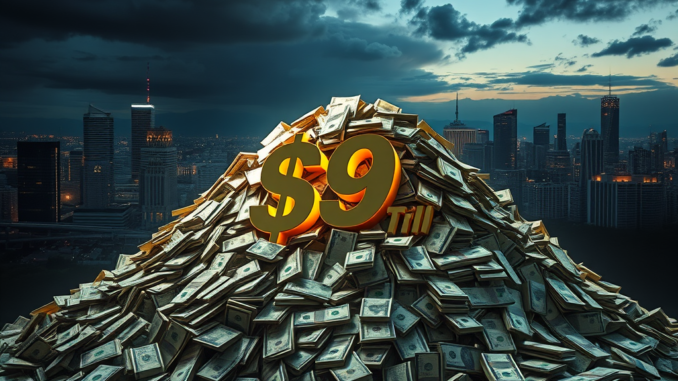
Imagine a stash of cash, the size of Germany’s, Japan’s and India’s GDP combined. For that you could buy every property in Australia. Or If you spent $1 million every single day, it would take you about 24,700 years to exhaust $9 trillion. Big bickies? Huge. But that’s what it’s going to cost us, reckons the National Party’s Roy Orbison, David Littleproud, if we go down the Net-Zero frog and toad.
Unbelievable? Of course. Big Dave’s not expecting us to just believe him. He’s got modelling. Scary? You bet. But the claim that even just trying to get to net-zero will cost Australians $9 trillion is no run-of-the-mill Coalition scare campaign, it is a preposterous, monstrous lie. Yet the Coalition is giving it a hammering. Desperation? What else? Even Net Zero Australia, which sounds like a rock-solid outfit, the very source the Coalition cites, says their figure is a “misrepresentation.”
The Anatomy of a $9 Trillion Misquote
Of course, it’s not new. Gorgeous Gus Taylor made the same sort of blue with Clover Moore’s air miles. When our born-to-rule-roosters start throwing around numbers with more noughts than their families’ Cayman Island water accounts, you know you’re not getting a costing; you’re getting a con job.
But it’s catchy. Suddenly, every microphone in Canberra is infected by the same bug. Nine trillion dollars. According to the Nationals’ last man standing, “deadly” Dave Littleproud, crouched behind the wheel of a brand-new LandCruiser ute groaning with numbers as rubbery as any Goodyear factory floor, “Labor’s net-zero” will cost every Australian, man, woman, child and pensioner, a lazy $250,000.
Even then, the ANZ and the other five will probably have to continue to invoice the dead.
Whre does Dave get his figures? The alleged source is Net Zero Australia (NZA), a hook-up between the universities of Melbourne and Queensland and Princeton. Of course. In 2023, NZA released “modelling” stating Australia would need to invest $7 to $9 trillion by 2060 to build a clean energy system and a massive export industry in green energy and metals.
Of course, the boys and girls in The Net Zero Australia project know all about big figures. NZA was funded by the Australian government, with a budget of $4.6 billion for climate-related spending up to June 2030, in addition to the $24.9 billion committed in October 2022-23.
But NZA did not say the $9 trillion was a tax bill for households. We can be clear about this. We have their strenuous, emphatic and rather pointed denial. In fact, NZA has since clarified the additional domestic cost of the clean energy transition is about $300 billion over 25 years; roughly 4% more than maintaining our ageing fossil-fuel system. With all its subsidies.
The scary $9 trillion figure represents whole-of-economy capital investment, most of it expected from private sources, types with Cayman Islands bank accounts and overseas customers buying our exports. It is capital put to work, not a sack of cash thrown into a volcano. Or up a gum tree. It is money in motion, not coins tipped down a mineshaft for luck.
Somewhere between “cumulative capital investment” and “your grandmother’s power bill,” the Coalition performs a conjuring trick. The trick grows legs. As Jonathan Swift may have said, “Falsehood flies, and the Truth comes limping after it.” (Probably said by someone else.)
The $9 trillion lie is now off like a bucket of prawns, breaking international land-speed records.
The timeline is damning. NZA releases its report and immediately stresses the number is not a direct indicator of energy bills. The director spells it out: this is an “immense opportunity,” largely funded by international customers. How does he keep a straight face?
Within months, the number is stripped of context. Husked. Barnaby Thomas, Gerard, Joyce tells both viewers of breakfast television, another oxymoron in terminal decline, the “alternative cost of renewables” is $9 trillion. The number migrates to Sky News chyrons. By 2024, Littleproud is calling it a “bill” for Australians. By 2025, it’s screamed from Daily Telegraph op-eds.
NZA finally loses patience and issues a public statement: the costs are being “misrepresented.” The political response? They note the correction, file it away, and repeat the lie anyway.
A Franchise of Failure
This scare is the latest instalment in a long-running franchise of Coalition climate hysteria and moral panic over balancing the budget. Remember their “carbon tax” pack of lies?
Whyalla would be “wiped off the map” by a carbon price. It wasn’t; it’s now a hub for green hydrogen and steel. It was also ingenuously argued, (Peta Credlin admits she and Tony made it up, over a mug of Milo) that a price on carbon was a carbon tax. That would lead to a huge rise in prices. A lamb roast would soar to $100, pricing itself right off the family Sunday lunch menu. It never happened.
The nine trillion dollar claim is simply today’s update, a type of bracket creep, if you like, or the same lie adjusted for inflationary corporate price-gouging, bigger, louder, and demonstrably untrue. But the bigger the lie, the better it wrecks debate. Floods the zone with shit, as Steve Bannon knows. Whyalla will vanish, your lamb will cost a fortune, now the Commonwealth will drop nine trillion into a shredder. The pattern is as predictable as it is dishonest.
The Science Settled, The Sums Done
The real world is less dramatic and deeply inconvenient for this myth-making.
The Australian Energy Market Operator is clear: as coal plants retire, the cheapest replacement is renewables, storage, and transmission. CSIRO’s GenCost report confirms that new wind and solar are cheaper than new coal, gas, or nuclear. This conclusion isn’t confined to Australia; the International Renewable Energy Agency finds over 90% of new renewable capacity built worldwide is cheaper than fossil fuels.
Awkwardly, a Griffith University analysis found that if we had ignored renewables and stuck with coal and gas, our power bills would be up to 50% higher today. Renewables are already shielding us from the true cost of the status quo.
The Nuclear Bait-and-Switch
Here is what the Coalition never mentions while shrieking about a fictional $9 trillion bill: their own nuclear fantasy comes with an actual, taxpayer-funded price tag.
Independent analyses suggest $300–400 billion for seven reactors that wouldn’t generate power before 2040. That’s not private investment or export capital, it’s your money, funding white elephants or chocolate teapots that would arrive decades too late.
This sudden fiscal panic is spectacularly selective. The same voices had no trouble with:
- $368 billion for nuclear submarines arriving in the 2040s.
- Billions in Stage 3 tax cuts tilted to the well-off.
- $11 billion a year in fossil fuel subsidies.
They discovered fiscal responsibility precisely when it threatened their donors’ business model.
The Real Bill: The Cost of Delay
The biggest cost isn’t acting; it’s not acting. The Clean Energy Council commissioned modelling on what happens if we slow down renewables to wait for nuclear. The results are stark:
- Household power bills in 2030 would be 30% higher, about $450 more per year.
- For small businesses, the hit is roughly $900 a year.
- If the coal fleet fails, households pay over $600 more, and small businesses pay $1,100+.
Multiply that over ten million households, and delay siphons billions from family budgets and small businesses each year to keep coal on life support. Treasury’s own modelling warns a “disorderly transition” could leave our economy $2 trillion smaller by 2050, with lower wages and less investment.
Delay is an active choice with concrete consequences:
- Stranded Assets: Coal and gas infrastructure is becoming worthless, threatening superannuation funds and workers’ savings.
- Lost Opportunity: Other countries are locking in green export contracts for the industries we should be building.
- Investment Strike: Policy uncertainty caused new large-scale renewables investment to fall by 80% in 2023.
Net Zero as an Opportunity, Not a Bill
It doesn’t have to be this way. The same Treasury modelling that warns of disorder also sketches the upside. An orderly transition could make our economy 80% larger by 2050. Households that electrify can cut energy costs by 40%.
The tradie in Western Sydney with solar on his shed, saving $200 a month, is living the transition the Coalition calls impossible. The Hunter Valley coal worker retraining as a wind turbine technician is building the future they deny exists.
The Verdict
The $9 trillion scare reveals five damning truths:
- The Coalition has no climate policy, only a culture war. They take an investment figure and pretend it’s a tax bill, counting on you not to read past the headline.
- The biggest cost is delay. We are already paying for a lost decade in higher bills, and our children will pay in a damaged climate and a weaker economy.
- Net zero is the foundation of any rational economic strategy for a country that wants to sell things to a decarbonising world.
- The Coalition’s fiscal outrage is a selective sham, reserved for policies that threaten their donors.
- It reveals how deeply a corrosive, American-style hyperpartisanship has taken root. This is the active cultivation of a politics where the opposition is not merely wrong, but acting in malicious bad faith.
The Imported Contempt and the Lost Social License
This tactic operates on a dual presumption: either a profound scientific and technological illiteracy amongst voters, or their effective exclusion from meaningful political debate. Often, it depends on both.
This strategy is not accidental. For the dark money investors and lobbyists whose profits are threatened by a clean energy transition, disenfranchising the masses from critical public debate is a strategic necessity. An informed and engaged citizenry might question why we are clinging to assets the world is leaving behind. A confused and excluded one is more easily sold a lie. They have much to gain by fostering a political culture where complex issues are reduced to slogans, and trust in institutions is eroded to the point where a fact-check is dismissed as part of the conspiracy.
Yet, this entire edifice of exclusion and misinformation comes at a catastrophic cost: the loss of the social license to operate. When political parties and their corporate allies systematically lie to the public, when they dismiss expert analysis and manipulate ignorance, they are not just losing an argument, they are torching the very social license that grants their policies and projects legitimacy.
This stands in stark contrast to the social contract in many Nordic societies. There, the model is not a tenuous standoff but a robust partnership. This creates a culture of mutual truth-telling and profit-sharing, where collaboration between government, business, and unions is the norm, and the goal of economic prosperity is inextricably linked to the well-being of the entire society.
The Coalition’s $9 trillion scare campaign is not just a lie about cost. It is a declaration that this kind of honest, collaborative politics is impossible here. It presumes a public too ignorant to understand the difference between investment and a tax bill, and too powerless to demand better.
But as the Nordic example shows, this is not the only way. A society can choose to build its prosperity on a foundation of social trust and shared benefit, rather than on the deliberate cultivation of public ignorance. The choice for Australia is not just between energy sources, but between a political culture that respects its citizens enough to tell them the truth, and one that holds them in such contempt it assumes they will believe anything.
This article was originally published on URBAN WRONSKI WRITES
Keep Independent Journalism Alive – Support The AIMN
Dear Reader,
Since 2013, The Australian Independent Media Network has been a fearless voice for truth, giving public interest journalists a platform to hold power to account. From expert analysis on national and global events to uncovering issues that matter to you, we’re here because of your support.
Running an independent site isn’t cheap, and rising costs mean we need you now more than ever. Your donation – big or small – keeps our servers humming, our writers digging, and our stories free for all.
Join our community of truth-seekers. Donate via PayPal or credit card via the button below, or bank transfer [BSB: 062500; A/c no: 10495969] and help us keep shining a light.
With gratitude, The AIMN Team


You are missing one vital element in making politics more viable and not just a liefest. We need a media who is unbiased and will hold all poublic officials to account.
This is not able to hapen in Australia, too many (nearly all) of our mass media outlets, be it TV, print, online or radio show a bias for the conservative side of politics. This is to the point where you can see the broad strokes of reporting as being Liberal/ National Good and Lobor bad.
Until we can get to the point of mass media not being on this mode we will never hjave a body politik that won’t lie to the masses, in some shape or form. The other aspect of media coverage is the theatre of question time that leads our Politicians by the nose for a quick headline, the grubier the better for the media to be able to complain about the combative nature of our political discourse so they don’t have to talk about the actual policy debates abd results.
This suits a party with no ideas with their media mates backing keeping the populace in a state of denial and unreality.
If you’re going for the big lie then go with a BIG LIE. Which sounds more frightening, $9.00 or an utterly ludicrous non-existent $9trillion?
None of it is ‘taxpayer funded’ anyway. Nor is it ‘private money’. Taxing those Cayman Island accounts and what-have-you is the purposeful destruction of private spending power commanding resources; or spending on ‘undesirable’ things blocking spending on ‘desired things’ in terms of the public purpose. The government’s job is to identify, and/or create and make available, resources which will meet that public purpose. Spending to that end is not a ‘cost’ (certainly not in financial terms) and certainly not something any taxpayers ‘fund’. The arguments around these things begin with wholly wrong assumptions and therefore end with wholly wrong conclusions.
This bloke, Gus Taylor, as is well-documented, has had an inside run for the whole of his life; a prosperous farming family background, Kings School at Parramatta, Sydney & Oxford Unis, a Rhodes scholar, a job at the global consulting firm McKinsey & Co, and more.
With such a background he ought to be, by all accounts, a shrewd and savvy operator. He’s not. He’s a nong, or what the British might call an upper-class twit. He sought to embarrass Sydney’s Lord Mayor with a set of fabricated numbers in relation to travel costs, and when exposed, dug down on his falsehoods.
Gorgeous Gus isn’t an outlier in this respect… the LNP is majorly comprised of self-serving shonks clad in Savile Row suits or tweed twin-sets with roped pearl necklaces, all meant to showcase the exclusive and privileged nature of their being. If it weren’t consequentially such a damaging affront to both the business of politics along with the outcomes foisted on an unwilling public it would be hilarious, but it’s not. It’s instead a sorry farce, acting in the only way it can… unprofessionally & incompetently. Lest we forget, long may they linger in languor on the opposition benches.